Select a site alphabetically from the choices shown in the box below. Alternatively, browse sculptural examples using the Forward/Back buttons.
Chapters for this volume, along with copies of original in-text images, are available here.


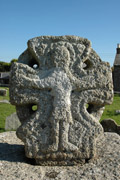
Object type: Cross-head
Measurements: H. 80 cm (31.5 in); W. 65.5 > 31.5 cm (25.3 > 12.4 in); D. 26.5 cm (10.4 in)
Stone type: Coarse-grained Land's End Granite (A.V.B.)
Plate numbers in printed volume: Ills. 29-32; Colour Pl. 21; Fig. 18b
Corpus volume reference: Vol 11 p. 126-7
(There may be more views or larger images available for this item. Click on the thumbnail image to view.)
The only portion surviving of this cross is the head and a very small part of the top of the shaft. It stands on a square base comprising a flight of five steps. The top step, a single square slab of granite with a rectangular mortice, may be the original base of the cross, perhaps re-cut to fit the current situation, but the other steps are probably later.
The shaft has been removed and the cut edge re-fashioned into a tenon to enable the head to be socketed into the base.
The cross-head is basically type B6 with curved arm-pits linked by a recessed ring, type a, but it is slightly elongated at the bottom and has a shape like an inverted pear. The horizontal arms are only slightly splayed but the vertical arms are more widely so; in the case of the lower cross-arm this is a means of accommodating the shape of the head to the width of the shaft and the form of the Crucifixion figure. On the front, the lower limb of the cross extends a short way down on to the shaft to help enclose the legs of the figure. On the back, the lower limb has an exaggerated curve.
A (broad): Around the edge of the head is an incised edge-moulding which is double around the lower half. On the head is a well-proportioned figure of Christ, carved in moderately high relief and carefully designed to fit within the cross-head. Christ's head with halo is enclosed by the top limbs of the cross. The arms completely fill the horizontal limbs of the cross and the feet the lower cross-limb. The figure is wearing a knee-length garment, probably a tunic, which dips down slightly to either side of the leg. The figure's arms are very slightly bent and narrow slightly at the wrist, perhaps in representation of the sleeves of the garment. The hands are clear though no detail is visible. At the waist, a slightly raised line is probably a belt. Beneath each arm-pit is a small hollow. The feet are turned out and extend to the incised edge-moulding. There are possible traces of an incised edge-moulding on the cross-ring.
B (narrow): On the end of the arm are faint traces of an incised edge-moulding. Within this, the stone is very rough and uneven and, if there was ever any carving here, it is not now clear.
C (broad): Around the edge of the head is a double incised edge-moulding. On the head are five prominent bosses, one in the centre, the others symmetrically placed around it, one in each of the cross-arms. Owing to the enlargement of the lower arm the lowest boss is not central within its cross-arm. A very short fragment of the shaft with incised edge-moulding, but no other decoration, survives.
D (narrow): As B. On the cut-down shaft there are traces of decoration, but insufficient to determine the pattern.
This cross is a member of the Penwith group of pre-Norman sculpture, characterised by a Crucifixion on one side of the head and five bosses on the other (Chapter IX, p. 88). It is a particularly well preserved and well executed example, the bold carving and the careful proportions of the figure comparing particularly with the Gwinear 1 cross now at Lanherne (Ills. 92, 94). Compared to these, the Crucifixions on other members of the group, for example at St Erth and Paul 1 (Ills. 66–7, 73, 178), are crude and simple.
Probably the principal pre-Norman church of the Land's End (Penwith) peninsula, St Buryan is first recorded in a charter of the first half of the tenth century (Olson 1989, 78–81; Orme 2010, 128). In all probability this charter represents a confirmation of the existence and status of a pre-existing religious house since the saint, Berion, is also recorded in the tenth-century List of Cornish saints (Olson and Padel 1986, 48). In Domesday Book, the church of St Buryan was held by the Canons of St Berrione and it remained a collegiate church with privileged sanctuary and two parochial chapelries throughout the medieval period (Henderson, C. 1925, 67–8). St Buryan church sits centrally in its parish, within a churchyard whose circular form may be due the fact that its boundary re-uses the ramparts of an Iron Age earthwork (Preston-Jones 1987, 153–60).
The monument is dated from its similarity to Gwinear 1 and from its primary context in the Land's End area, where it is likely to have influenced the sculpture in other locations, rather than the other way round.
The loss of the shaft is likely to have occurred in the late medieval period, when the cross-head was re-fashioned to suit the interests of the age, while the shaft with its redundant decoration was discarded or more probably re-used as building stone when the church was rebuilt in the fifteenth century (Henderson, C. 1925, 68).
