Select a site alphabetically from the choices shown in the box below. Alternatively, browse sculptural examples using the Forward/Back buttons.
Chapters for this volume, along with copies of original in-text images, are available here.


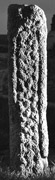
Object type: Cross-shaft
Measurements: H. 94 cm (37.6 in); W. 52 > 47 cm (20.8 > 18.8 in); D. c. 18 cm (7.2 in)
Stone type: Megacrystic granite with scattered small, white feldspar megacrysts up to 1.0 by 0.4 cm and crystals of roughly equidimensional quartz up to 8 mm across; scattered flakes of white mica up to 5 mm occur. Bodmin Moor Granite
Plate numbers in printed volume: Ills. 23-8, 384-8; Colour Pl. 28; Figs. 20m, 20q
Corpus volume reference: Vol 11 p. 125-6
(There may be more views or larger images available for this item. Click on the thumbnail image to view.)
Section of a tapering, rectangular-section cross-shaft, with foliage decoration on the main faces and knotwork on the narrower sides. All the decoration is in very low relief. Down the sides of the shaft is a broad incised edge-moulding, with a further low moulding (possibly a simple two-strand plait or fret, type J4 – see p. 72, Fig. 19b) within the two faces with foliage decoration. On these faces, a transverse moulding near the top of the fragment suggests that the layout of decoration on the shaft included some panelling.
A (broad): In the main lower panel is a large, loose, foliage scroll, whose two surviving volutes contain a cabbage-like leaf and a simple scrolling tendril. A curling bud terminates the scroll at the top. The upper panel is too fragmentary and worn for the decoration to be interpreted.
B (narrow): Free rings are crossed by diagonal strands (closed circuit pattern A), with a pronounced space or glide between each of the rings. In the upper part of the shaft, contrary to Langdon's interpretation (see Ill. 25), the free rings are replaced by a more complicated pattern, either a figure-of-eight or a simple plait; because the shaft is cut it is not possible to tell which.
C (broad): Langdon's interpretative drawing (Ill. 388) and a photograph of the stone when it was still built into the outhouse (Ellis, G. 1952–3b, fig. opposite p. 32; and see Ill. 28) suggest that this face contains a unique form of double plant-scroll. It appears to consist of two fleshy leaves hanging down on either side of the panel, linked by a pendant U-shaped stem hanging down between them, from the bottom of which the next pair of leaves is suspended. The detail is now difficult to confirm as the stone is so worn. The upper panel is worn and damaged, but may have contained another plant-scroll.
D (narrow): Langdon interpreted the interlace on this side as individual figures-of-eight linked by long diagonal strands (Langdon, Arthur, unpublished 1906), that is, closed circuit pattern F. However this is now uncertain and the pattern may alternatively be a simple three-strand plait.
The patterns on this shaft indicate it to be a member of the Mid and East Cornwall group of foliage-decorated crosses (Chapter IX, p. 91); the proportions and stone type make it possible that the two fragments at St Breward (St Breward 1 and 2) were originally parts of the same monument. The New Inn is adjacent to the parish church.
The shaft has parallels with a variety of crosses in this part of Cornwall. The closest comparisons can be made with Minster 1 (Waterpit Down) in the overall tapering shape and relatively narrow cross-section, in the double bead on the main faces, in the shape of the leaves in the foliage decoration, in the existence of some panelling, and in the very low relief decoration (see Ills. 140–3). Waterpit Down is some 11 km (7 miles) north of St Breward. The shaft also has similarities to St Neot 3 (Fourhole Cross), located only 8 km away: in particular, the foliage decoration on face C of St Breward 2, which consists of paired pendant leaves falling from looping stems, look like a stylised version of the Winchester-style acanthus on face C of St Neot 3 (Ill. 157), while the loose plant-scroll on face A of the St Breward shaft also reflects a similar but better executed plant trail on face A of St Neot 3 (Ill. 155). The free-ring pattern is also seen on Padstow 2 (Ill. 167) and on Cardinham 1 where it similarly changes to a different pattern (Ill. 44). The use of a step pattern as an inner edge-moulding is the sole example of this feature in Cornwall.
