Select a site alphabetically from the choices shown in the box below. Alternatively, browse sculptural examples using the Forward/Back buttons.
Chapters for this volume, along with copies of original in-text images, are available here.


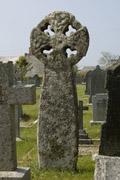
Object type: Part of cross-head
Measurements: H. 52 cm (20.8 in); W. 77.5 cm (31 in); D. 15 cm (6 in)
Stone type: Coarse-grained, megacrystic granite with scattered white feldspars megacrysts up to 1.5 by 0.5 cm and crystals of roughly equidimensional quartz up to 8 mm across; scattered flakes of white mica up to 3 mm occur. Bodmin Moor Granite
Plate numbers in printed volume: Ills. 19-22; Colour Pl. 5
Corpus volume reference: Vol 11 p. 124-5
(There may be more views or larger images available for this item. Click on the thumbnail image to view.)
The upper part of the head of a well-executed rectangular-section cross. The cross-head, type E8, has wide-splayed arms, with rounded arm-pits; the arms are linked by a narrow ring, type a. In the space between the arms and ring are three cusps, forming trefoil-shaped openings. All the decoration on the head is in very low relief.
A (broad): An incised edge-moulding runs all the way around the edge of the arms, and there is a large, flat boss at the centre of the head. In each of the cross-arms is a triquetra knot. The ring is undecorated.
B and D (narrow): Undecorated
C (broad): As face A, except that there is no central boss.
One of the small but dispersed group of crosses in Mid and East Cornwall, characterised primarily by the trefoil openings in the head (Chapter IX, p. 92). Other characteristic features of the group include the widely-splayed arms with triquetra knots, the central boss, the low-relief carving, and the narrow cross-section. The wide-splayed arms indicate a late pre-Conquest date, but as this is such a small fragment that it is impossible to be precise regarding dating.
The stone type and cross-section make it quite possible that this and the other fragment in St Breward (St Breward 2) were originally parts of the same monument. As both were found very close to the parish church, an original association with the church seems likely.
St Breward is an ordinary parish church, dedicated to a Celtic saint who also has dedications in Brittany, Jersey and Wessex (Padel 1988, 59). Despite the Celtic dedication, the origin of the church-site is uncertain. There is no known *lann name and the churchyard is rectilinear. The church is located at a high altitude (for Cornwall), on the edge of Bodmin Moor, in a parish with few tre- names and whose settlement is considered to represent a process of expansion and colonisation within the early medieval period (Johnson and Rose 1994, 79). The cross therefore constitutes the earliest evidence for the church-site, whose foundation may have been made to cater for the needs of farming and settlement expansion on to the fringes of Bodmin Moor in the later part of the early medieval period.
