Select a site alphabetically from the choices shown in the box below. Alternatively, browse sculptural examples using the Forward/Back buttons.
Chapters for this volume, along with copies of original in-text images, are available here.


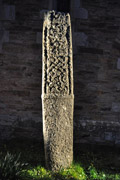
Object type: Cross-shaft
Measurements: H. 238 cm (95.2 in); W. 46 > 36 cm (18.4 > 14.4 in); D. 27 > 19 cm (10.8 > 7.6 in)
Stone type: Granite with white feldspar phenocrysts up to 5 cm x 1 cm. Clear, roughly equidimensional, quartz crystals up to 1 cm across occur, together with a few dark mica flakes up to 2 mm across. Tourmaline is intergrown into the quartz. St Austell Granite
Plate numbers in printed volume: Ills. 1-7, 353, 359-60; Colour Pl. 8
Corpus volume reference: Vol 11 p. 119-20
(There may be more views or larger images available for this item. Click on the thumbnail image to view.)
Cross-shaft of rectangular section with marked entasis. The shaft is probably unfinished. Langdon suggested that there was 'once a mortice in the top, which unfortunately is now missing, along with some inches of the uppermost part of the shaft' (Langdon, Arthur 1894, 312). However this is the first mention in print of a mortice and in 1754 the height of the monument was given as slightly less than Langdon's measurement (Borlase, W. 1754, 363). The evidence for the existence of a mortice is thus uncertain, and there is no mortice now. A flat raised band at the widest point of the shaft on all four faces divides the undecorated, and slightly more rounded, lower part from the upper part. The upper part of the shaft has incised edge-mouldings around the decoration on faces A, C and part of B. The broad faces also contain inscriptions.
A (broad): The top panel is undecorated. The second contains a ring knot comprising two diagonally placed rings intersecting with a single ring (closed circuit pattern B). The third has the inscribed text, incised in three horizontal lines. The letters, 6 to 7 cm high, are in predominantly insular script and are slightly deteriorated. The text is probably complete unless the space above the first line originally contained further lettering. The text reads:

B (narrow): The top panel is undecorated. The second has a small circular hole with five incised lines radiating from the lower half. The third contains a simple four-strand plait.
C (broad): This face is badly worn and not easy to examine as it is close to the wall of the church. The description therefore relies to a large extent on Langdon's drawing (Langdon, Arthur 1896, fig. facing 370; see Ill. 360). The top panel has an incomplete four-strand plait. The second panel contains the inscribed text, incised in two horizontal lines. The letters, 5 to 6 cm high, are highly deteriorated and it is not even certain what script was used. The text is probably complete and reads:

The third panel contains four simple knots arranged as a square, with patterns A and D on the top row and E on the bottom, all linked by diagonal strands. (This probably represents a mistaken version of four pattern E knots.)
D (narrow): This side is undecorated, possibly unfinished.
The text on face A is incised in a predominantly insular script (Ill. 5). It probably reads: + [ci]lroron, and is likely to be a personal name, possibly with a Celtic element [ci]l-. The text on face C is fainter and it is not certain what script was employed (Ill. 6). It reads: –[+ fili–], probably for filius, 'son of —', preceded by a personal name. It is not clear whether the two texts read together or separately. As with St Cleer 2 (the Doniert Stone, p. 134) the possible Celtic name-element could indicate a Cornish background for this monument.
Although the overall form of this monument is unique in Cornwall, its individual decorative features ally it with the Panelled Interlace group of sculpture (Chapter IX, p. 85), and most closely with St Cleer 2 (the Doniert Stone, Ills. 51–4). The ring-knot on face A is the same as that on face D of St Cleer 2, and the top panel on face C, although incomplete, may have been the same pattern as face B of St Cleer 2. While the bottom panel on face C is rather like face B of St Cleer 2, with four knots arranged in a square panel, the division of decoration and texts into panels also resembles St Just-in-Penwith 1, St Neot 1 and both of the St Cleer stones (2 and 3). Langdon (though no-one else) also suggests that the head was socketed on, which would be another point of comparison with the St Cleer stones. However, the proportions of the Biscovey stone are very different, with its tall shaft, rectangular cross-section and in particular its long undecorated lower half. Moreover, with thinner interlacing bands carved in relatively low relief, the decoration is not as well or as clearly executed as that of others of the group. The relationship, if any, of this cross to the Panelled Interlace group is therefore considered uncertain.
The middle panel on side B has decoration which is unexplained. The radial markings fanning from a small hole are superficially like those of a simple sundial (Ill. 3); but it seems too small and too simple to have functioned as such in reality.
The flat band round the centre is unusual and its purpose obscure. There is too much of the stone below the band for it all to have been sunk in a base or the ground, and in any case this part of the shaft is neatly dressed as though for display. There are no parallels in Cornwall; the few in Wales are very much more complicated (for example, Coychurch, Llandough or even Elisig's Pillar (Nash-Williams 1950, respectively no. 194, 130–2, pl. XLVI; no. 206, 134–6, pl. XLV; no. 182, 123–5, pls. XXXV–XXXVI; Redknap and Lewis 2007, 288–92, figs. G16a–f; 329–37, figs. G42a–m). A group of monuments found in the midlands and north of England, which have a cylindrical lower shaft and rectangular upper part, may be compared; this type became popular in the Viking period with a distribution centred on the Peak District (Bailey and Cramp 1988, 30–1).
The context is uncertain: the cross perhaps stood by a road and/or may have been associated with a cemetery. When first recorded it was close to almshouses on the main highway through St Blazey parish and around the southern side of the Hensbarrow granite upland; at the same time Borlase's report that many human bones had been found 'in a little meadow adjoining' suggests a cemetery (Borlase, W. 1754, 363–4). A chapel 'called St. Weryes chapel with a small cemetery and a small house called the Store House annexed to it in the parish of St Blasius or Blasé', sold in 1568 to Edward Grimston (Henderson, C. 1953–6a, 33), has been linked to this cemetery but this cannot be substantiated. It is not linked with any known parochial site. The parish church of St Blazey is only some three kilometres away. This church was a chapelry of St Austell throughout the medieval period, and its early medieval origin is indicated by an alternative name in lann (Padel 1976–7, 19; Padel 1988, 54) and by its curving churchyard.
The ring-knot indicates a date of the early tenth century or later but the cross cannot be more closely dated.
