Select a site alphabetically from the choices shown in the box below. Alternatively, browse sculptural examples using the Forward/Back buttons.
Chapters for this volume, along with copies of original in-text images, are available here.


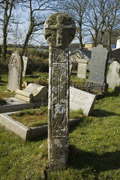
Object type: Cross-head and -shaft
Measurements: H. 236.3 cm (93 in); W. 47 cm (18.5 in) (head), 30 > 26 cm (11.9 > 10.3 in) (shaft); D: 28.5 > 27.3 cm (11.3 > 10.8 in)
Stone type: Coarse-grained Land's End Granite (A.V.B.)
Plate numbers in printed volume: Ills. 316-21
Corpus volume reference: Vol 11 p. 243-5
(There may be more views or larger images available for this item. Click on the thumbnail image to view.)
The cross-head has arms of type E8, linked by a plate which is recessed from the outer edge of the cross-arms. The arm-pits do not extend right into the central boss, and all the cross-arms are of a slightly different width, the vertical arms being slightly more splayed than the horizontal arms. The cross-shaft is of nearly square section and has a marked entasis. An incised edge-moulding around the head and shaft frames the decoration which is partly panelled. All the decoration, with the exception of the relief-carved Crucifixion, is boldly incised and very clear. The bottom of the shaft is undecorated apart from the fragmentary inscriptions; Langdon shows it tapering to a rounded end which was presumably intended to be set directly into the ground or into a base (Langdon, Arthur 1896, 360–1 and fig.).
A (broad): On the cross-head is a figure of Christ. Around the head is a halo, and features visible on the face include eyes, nose, mouth and a pointed chin or beard. The over-long arms extending horizontally to the edge-moulding are slightly bent at the elbow, unless the figure is wearing a tunic with long drooping sleeves. The hands contain a certain amount of detail: the palms are shown by hollows, and the thumbs, but not the individual fingers, are visible. Christ's torso is clearly waisted; he wears a garment which might be either tunic or loin cloth. The short legs extend on to the shaft and the feet are crossed. Nothing separates the Crucifixion from the incised decoration below.Immediately below the Crucifixion is an incised diagonal cross within a square. A horizontal line divides this from the panel below which contains a neatly incised long-stemmed fleur-de-lys standing in a jug with a rounded body, conical foot and flared rim. Langdon shows an incised circle beneath the jug but this is not now clear; however there is a short gap before the incised edge-moulding returns horizontally across the shaft to terminate the panel. A further horizontal line and edge-moulding define the bottom panel which contains traces of what was probably an inscription.The panel is not completed by a horizontal line across the bottom: the vertically incised lines at the edge simply fade out.
B (narrow): The only enrichment to the square end of the cross-arm is an incised edge-moulding. At the top of the shaft is an incised diagonal cross within a square. A horizontally incised line separates this from the band of decoration, below which is an incised zig-zag, terminated at the top by an additional oblique line and at the bottom by a horizontal line. Another horizontal line closes this panel, below which is a short panel with concave base containing a few incisions which do not form any obvious pattern.
C (broad): Apart from the incised edge-moulding, the only decoration on the head is an incised circle at the centre. On the shaft is a single panel containing, at the top, a diagonal cross within a square and below this a triangle (or shield?) pointing down. The remaining two-thirds of the panel are empty.
D (narrow): On the square end of the cross-arm is an incised edge-moulding. At the top of the shaft is a small incised pattern which resembles a rather irregular St John's cross within a square. Below this is a well-executed key pattern: Romilly Allen 926, Welsh N2 or N3 (see Fig. 19d, p. 72) and below this are the remains of an inscription in one vertical line. The text is now badly deteriorated. It probably read downwards with the letters facing left in a capital script. The letters [... SAT] might be visible at the lower end of the shaft.
Appendix D item (continuing tradition)
This is a complex and contradictory monument. While it has the form and some of the attributes of a pre-Norman monument, features of the decoration undoubtedly point to a later date. Meanwhile it also has fragmentary, worn inscriptions comparable to those on early Christian memorial stones. In this discussion, the contrasting features are discussed in chronological order.
Regrettably the inscribed texts are now illegible, apart from one or two letters, and provide no evidence for dating the cross. The text on face A, if text it is, is set in a panel; this suggests that it is primary (Ills. 316, 320). On face D the relationship of the text to the carving is more problematic (Ills. 319, 321). One possibility is that the cross was carved from an earlier inscribed stone (Langdon, Arthur 1896, 362).
The cross has a clear relationship with Sancreed 1 (p. 198, Ills. 212–17), an undoubtedly early medieval monument of the Penwith group. Features in common include the shape of the disc-head, the presence of the Crucifixion (although there are differences in detail), and the well-cut key pattern, which is similar to but not exactly the same as that on Sancreed 1. In addition, the tenon shown in Langdon's drawing (Langdon, Arthur 1896, plate opposite p. 361) is very like those known on other Penwith crosses at St Erth (1) and Paul (2) (Ills. 65–8, 181–2). The figure of Christ on face A has a design similar to that of the Crucifixion on Sancreed 1, although it is rather better proportioned and more detailed and the feet are crossed rather than splayed. On face C, the head has a simple incised circle at the centre, comparable to the boss on Sancreed 1, but no further decoration. It might in fact be a blank awaiting the triquetras and boss which decorate the head of Sancreed 1. The key patterns on both crosses are essentially the same, although that on Sancreed 2 is upside down relative to Sancreed 1, appears better executed (or is less eroded), and has a square incised pattern above it at the top of the shaft.
In contrast, the features which indicate a later date are the incised patterns, including the fleur-de-lys in a vase. Christ's crossed feet may also suggest a later date and a movement away from the archaic form of Crucifixion almost invariably seen in west Cornwall (see Chapter VII, p. 78); in this it can be likened to the Crucifixion on St Levan 1 (Ill. 305) and that at Chulmleigh, Devon (Cramp 2006, 91–2, ill. 39). The chevron pattern or zig-zag on side B is strongly reminiscent of Romanesque work and is found on a number of other Continuing Tradition crosses, including Wendron 6 (Rame, Ills. 337, 346–9). The diagonal cross within a square seen on face C can likewise be paralleled in Romanesque work: it is similar to those seen on the Norman fonts at Roche or Southill in Cornwall (Sedding, E. 1909, pls. CXXXVIII, CXLI) and on the simpler wayside crosses, for example at Boscathnoe, Madron and at Helland, Mabe (Langdon, Arthur 1896, 313–14, 323–4). In particular, the jug and fleur-de-lys are characteristically Gothic images (see Chapter X, p. 106).
In conclusion, the most rational way of explaining this variety of ornament is that it is a multi-phase monument. As noted by Langdon (Langdon, Arthur 1896, 362) it may have begun life on this site as an early inscribed memorial stone. In the tenth or eleventh century this could have been inverted, the stone re-cut, partly obliterating the inscription in the process, and the outline of the head with boss and Crucifixion carved. Only one side was fully sculpted, that with the key pattern, and for some reason, the monument never completed. Then, perhaps in the thirteenth century, patterns more in keeping with contemporary decoration may have been added, including the lovely fleur-de-lys on the main face, to complete the monument.[1] Some aspects of the monument may tell against this proposed phasing: for example, Sancreed 2's key pattern appears very much more freshly cut than Sancreed 1's: but this may be explained by the fact that it was perhaps re-cut when the cross was 'finished'. It seems unlikely that the key pattern would have been so competently executed ab initio in the thirteenth century. The zig-zag on side B is far more what might have been expected at this time.
For the context, see Sancreed 1 (p. 199). Of the history of Sancreed church after the Norman Conquest Henderson notes that 'Circa 1150 it was given to Tewkesbury Abbey, but in 1242 was transferred to the Dean and Chapter of Exeter' (Henderson, C. 1925, 193).
