Select a site alphabetically from the choices shown in the box below. Alternatively, browse sculptural examples using the Forward/Back buttons.
Chapters for this volume, along with copies of original in-text images, are available here.


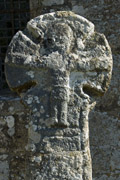
Object type: Cross-shaft and -head
Measurements: H. 191.5 cm (75.3 in); W. 53.5 cm (21 in) (head), 34.3 > 28.5 cm (13.5 > 11.3 in) (shaft); D. 20 > 16.3 cm (7.9 > 6.4 in)
Stone type: Coarse-grained Land's End Granite (A.V.B.)
Plate numbers in printed volume: Ills. 212-7; Figs. 2b-d, 3b-c, 17c, 18d
Corpus volume reference: Vol 11 p. 198-9
(There may be more views or larger images available for this item. Click on the thumbnail image to view.)
The monument is broken in two and cemented, but a portion near the top of the shaft is missing (Langdon, Arthur 1896, 363–4). The cross-head type E8 has a slightly recessed plate linking the arms. In the arm-pits on front are small hollows suggesting that the sculptor may have begun drilling the holes to make a ring-head but changed his mind. The rectangular shaft has a marked entasis. Decoration on both head and shaft is bordered by an incised edge-moulding. With the exception of the Crucifixion, the carving is all very shallow. It may have been clearer when seen by Langdon as the shaft had then only recently been moved from the church wall and was presumably without the thick encrustation of lichen which nowadays obscures most of the detail. For this reason, the description below is partly based on a laser scan (Fig. 3c; Ill. 216) as well as on Langdon's observations (Langdon, Arthur 1896, 362–5).
A (broad): On the cross-head is a Crucifixion carved in high relief. The figure is somewhat stylised in order to make it fit the cross-head, with over-large head and over-long arms in comparison to the size of body and legs, although the lower cross-arm extends slightly down the shaft to accommodate the legs. Around Christ's head is a halo. The arms, which expand slightly towards the ends but show no attempt to depict hands, perhaps because they are hidden by long sleeves, extend almost to the edge of the cross-head. A belt is clearly depicted as is the lower edge of a garment, probably a tunic. The legs are short and the feet rather neat and out-turned. The feet rest on the incised moulding which separates the cross-head from the shaft. On the shaft, Langdon shows a short panel now defaced with below it a longer panel containing interlaced work. The interlace is shown by Langdon as a rather roughly laid-out two-strand plait, a simple pattern F (the Carrick Bend) terminating at the bottom on a Stafford knot interlaced with a ring. However, the carving is so shallow and the shaft so thickly encrusted with lichen that the detail is now difficult to trace and only clear near the bottom of the panel.
At the bottom of the shaft is an inscription set in two lines within a panel. It is highly deteriorated but appears to be complete (Ill. 213). It is incised in a predominantly insular script and the letters read horizontally. The text reads:

B (narrow): In this single panel, Langdon shows an interlaced serpentine creature. The head with the eye and ear are at the bottom of the shaft, from which the ribbon-like body rises in waves up the shaft. From the top the tail returns down the shaft, interlacing the body with Stafford knots in each triangular spandrel. The beast bites the tip of its tail. Today the clearest element is the ribbon body running up the shaft and the laser scan shows that, as on Gwinear 1 (Ill. 97), the tail is (incorrectly) taken over the body every time.
C (broad): On the head, within an incised edge-moulding, is a double-strand interlace pattern in which linked Stafford knots fill the cross-arms. In the centre is a small boss with a small shallow hole in the centre. The shaft has an incised edge-moulding. Within this is a single panel of double-strand interlace comprised of Stafford knots (simple pattern E) arranged back to back in five registers. The pattern is badly constructed, with strands failing to cross correctly. A gap between the bottom two units is filled by a small off-centre boss. The bottom of the shaft is plain.
D (narrow): Within an incised edge-moulding is a key pattern, Romilly Allen no. 926, the Welsh N2 (see Fig. 19c, p. 72).
This cross is a member of the Penwith group of pre-Norman sculpture, characterised by a Crucifixion on one side of the head and (usually) five bosses on the other (Chapter IX, p. 88). This cross does not have the five bosses but does have other features in common with other members of the group, namely simple interlace patterns executed with double or triple strands, the key pattern and the serpentine beast. The beast and the inscription link it particularly closely with the Gwinear 1 (Roseworthy) cross (Ills. 92–9). It is possible but not certain that the rather ill-proportioned figure of Christ, the very shallow carving and the fact that the holes in the head are undrilled indicate that this is a later member of the group. The Stafford knots on the head (face C) are not found on any other cross-heads in west Cornwall, but are ubiquitous on crosses in mid and east Cornwall.
Outside Cornwall, the fret on side D is seen in south-east Wales, at Llandyfaelog Fach and Llandough (Redknap and Lewis 2007, 185–90, 329–37). The latter, though a rather bizarre monument, compares with Sancreed 1 in its range of simple patterns, notably the runs of back-to-back simple pattern E.
The inscribed text now reads R[.HO.] (Ill. 213). Early drawings of the text suggest that it has always been in poor condition. Langdon read the text as RUNHO and assumed it to be a personal name; he compared the text RŪHOL on the Gwinear 1 cross (Ill. 99) and, following the Rev. W. Iago, conjectured that this might be the name of the man who carved both crosses (Langdon, Arthur 1896, 364–5). In view of the fact that the Sancreed text is so deteriorated, and that the two texts are not identical, this attractive suggestion has to be treated with caution. It is possible that the name was that of the carver or commissioner of the cross, or of the commemorated. Alternatively Padel has suggested that it could be a word in Old Cornish, meaning 'inherited' or perhaps 'inheritance' (see the discussion under Gwinear 1, p. 154).
The early medieval origin of the Sancreed church-site is indicated by its small circular graveyard enclosure in a valley-head location and confirmed by the existence here of a re-used early inscribed stone (Sancreed 2: see Appendix D, p. 243). The church is named from its Celtic patron saint; a name in eglos is also recorded (Padel 1988, 153). Although there is no record of an early religious house at this parish church, the monumental evidence seems to point to a significant early Christian site (Preston-Jones 2005, 10).
