Select a site alphabetically from the choices shown in the box below. Alternatively, browse sculptural examples using the Forward/Back buttons.
Chapters for this volume, along with copies of original in-text images, are available here.


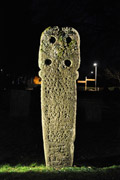
Object type: Cross-shaft and -head
Measurements: H. 247 cm (98.8 in); W. c. 67 cm (26.8 in) (head), 57.5 > 43 cm (23 > 17.2 in) (shaft); D. 22 cm (8.8 in) (head), 28 cm (11.2 in) (shaft)
Stone type: Coarse-grained, poorly megacrystic, granite with a few scattered white feldspar megacrysts up to 5.0 by 0.5 cm (these large megacrysts form less than 1% of the rock), but most feldspars are less than 1 cm long, and together with crystals of roughly equidimensional quartz up to 12 mm across constitute the bulk of the rock. Minor constituents include scattered tourmaline and a few white mica flakes up to 1 mm across. St Austell Granite
Plate numbers in printed volume: Ills. 312-15; Colour Pl. 23
Corpus volume reference: Vol 11 p. 241-2
(There may be more views or larger images available for this item. Click on the thumbnail image to view.)
Cross, with a rectangular-section shaft and slab-like form. It has a projecting roll-moulding at the neck and a sub-rectangular head. The shaft has a distinct entasis. The cross-base referred to by Langdon (Langdon, Arthur 1896, 344) is not visible, being buried beneath a thin veneer of moss and earth.
A (broad): On the head, a cross is indicated by four deep circular sinkings, each with a distinct raised 'boss' at the centre. These are arranged asymmetrically, the lower two being wider apart than the upper two. A boss in very low relief, enclosed by indistinct traces of a concentric incised moulding, is set between and slightly above the two lower sinkings, slightly nearer to the right than to the left. The upper part of the shaft contains irregular rows of incised dots, followed by four roughly horizontal incised lines, possibly but not certainly linked, as Langdon indicated, to form an M-shape on its side (Langdon, Arthur 1896, fig. opp. p. 344). Beneath this is a smaller set of irregular incised dots followed by an incised line resembling a U-shape on its side.
B (narrow): The cross-head and the rounded moulding at the neck are plain. On the shaft, within a recessed edge-moulding, a series of horizontally incised lines creates a 'ribbed' effect. This enrichment runs down the top three-quarters of the shaft, below which it is undecorated.
C (broad): As on face A, the cross-head has four circular sinkings, although these are more symmetrically placed and have smaller and lower bosses within them. At the centre of the head are two concentric incised circles but, unlike on face A, these are not raised to form a boss. Radiating from here are pairs of faint incised lines defining a cross. The lower cross-arm is absent, but seems to be represented by a shallow sunken hollow between the two lower sinkings. The decoration on the shaft is similar to that on face A, consisting of irregular rows of dots and irregular horizontal lines. The bottom set of lines differs slightly by incorporating vertical bars, thus giving the shapes the (probably false) impression of representing letters, which might be seen as an A and an F.
D (narrow): The cross-head and the rounded moulding at the neck are plain. The top of the shaft contains irregular rows of incised dots. Between these, set centrally, are four small raised bosses, one above the other. Below these is a relief-carved, vertically-set sword. The quillons and pommel of the hilt are down-curved and the parallel-sided blade is carefully cut with a double-ribbed or herringbone pattern along its length. The tip of the blade is not shown, as it is truncated by three raised bands at the bottom of the shaft. Down the left side of the top of the shaft is a row of horizontal incisions, with the same on the right side of the bottom half of the shaft.
Appendix D item (continuing tradition)
This monument is one of the most curious of the Cornish Continuing Tradition crosses with incised decoration. As a whole they are characterised by quirky and often crude decoration, but this cross is one of the most unusual.
As the decoration on the Roche cross is so bizarre and unusual, not to mention practically unparalleled, it is difficult to assign a date. However, the vertical raised bands carved on side B of the shaft have a passing similarity to the tongue mouldings seen on the Norman fonts at St Austell, Luxulyan and South Hill (Sedding, E. 1909, pls. V, CI and CXLI), and have a closer resemblance to the ribbing seen on the Norman doorway at Manaccan church (Sedding, E. 1909, pl. CVII). Swords are found occasionally in early medieval sculpture (for example Weston 1, Yorkshire: Coatsworth 2008, 268–9, ills. 777–83) but a better parallel may be with the medieval cross-slab grave-covers where swords are frequent amongst the emblems depicted (Ryder 1985, 18, fig. 2; Ryder 1991, 61–2). However there are none with this emblem in Cornwall, and the details of the Roche sword differ from both early and later medieval examples. The incised dots are a feature of most Transitional and Continuing Tradition crosses in Cornwall (Chapters IX and X, pp. 96, 101).
In fact, the closest parallel for the Roche cross is the cross at the Mertheruny chapel site in Wendron parish (Wendron 3, Ills. 328–9), some fifty miles away. Although this distance makes it difficult to believe in a relationship between the two, the similarity in their shape and design means that the possibility of some sort of link cannot be entirely ruled out.
There are a number of distinctive features in the shape of this cross which are attributable to its origin as a slab of granite, lifted from a horizontal position on a tor or other outcrop, and worked as little as possible to achieve a very basic cross-shaped form. These include the slab-like shape, the fact that it tapers towards the base, a slight natural twist to the stone, and the wedge-shaped top. The shaft also has a slight entasis, which by contrast may have been deliberately worked. The existence of an incised cross on the head, which was not noted by Langdon, indicates that the cross is perhaps slightly less crude and pagan-looking than has previously been suggested. Dexter and Dexter, for example, said that it 'seems to be a pagan monolith and not a Christian cross' (Dexter and Dexter 1938, 107).
The sword is unusual and the herringbone pattern on its blade particularly so (Ill. 315). It may be intended to represent pattern welding, although this technique of blade manufacture is said to have gone out of use c. 1100. On the other hand the fact that the point of the blade is not shown, but is buried in horizontal incised lines at the bottom of the shaft, may imply that it is in a scabbard, the herringbone pattern representing its covering, and the bands at the bottom representing the chape. Of the patterns on the cross, the sword is the most carefully carved and, although cut on the side rather than the face, was surely a very significant feature. On grave slabs, it is normally assumed that the appearance of a sword denotes a high status male burial, perhaps of a knight, and here at Roche it seems very possible that the cross represents a memorial of the lord of the manor, which here would have been Tremoddrett (Henderson, C. 1957–60b, 426).
In contrast with the cross is the exceptionally fine Norman font in Roche church, possibly of broadly similar date. The difference between the two in style and execution (with the possible exception of the sword) is so striking that it is a problem to see them as belonging to the same site, let alone the same period. There is no evidence that Roche church is on a site of early medieval origin. The church is in a marginal location, on a spur of land extending out from the Hensbarrow Downs towards Goss Moor and even in the nineteenth century large areas of rough land extended almost up to the settlement of Roche. The church-site gains presence from its association with nearby Roche Rock, a natural pinnacle of tourmaline-rich granite on which is a medieval chapel, and which recent discoveries of Neolithic pottery show to have acted as a symbolic focus from earliest times (Cole and Jones 2002–3, 107, 136–7).
