Select a site alphabetically from the choices shown in the box below. Alternatively, browse sculptural examples using the Forward/Back buttons.
Chapters for this volume, along with copies of original in-text images, are available here.


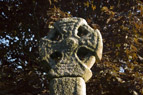
Object type: Cross-shaft and -head
Measurements: H. 90 cm (35.5 in) (head), 167 cm (65.8 in) (shaft, upper piece), 149 cm (58.8 in) (shaft, lower piece); W. 80 cm (32 in) (head), 55 > c. 38 cm (21.8 > c. 15 in) (shaft); D. 34 > c. 22 cm (13.5 > c. 8.8 in) (shaft); Base: roughly circular, diam. c. 137 cm (c. 54 in), D. 12.5 cm (5 in)
Stone type: Second stone up: small, abundantly mega-crystic, micaceous granite. White feldspars up to 2 x 0.5 cm form about 50% of the rock; white mica up to 5 mm across forms about 1%, with the remainder of the rock formed of roughly equidimensional clear quartz up to about 5 mm across. The bottom stone is similar. Bodmin Moor Granite
Plate numbers in printed volume: Ills. 206-11, 366-8; Colour Pl. 22, Fig.17g
Corpus volume reference: Vol 11 p. 196-7
(There may be more views or larger images available for this item. Click on the thumbnail image to view.)
The head and shaft of a rectangular-section cross. The cross-head is type E8 and is slightly taller than it is wide. The lower cross-arm is larger than the others and projects beyond the shaft. The arms are linked by a ring, type a. In the space between each of the arms and the ring are three cusps, forming trefoil-shaped openings. According to the account quoted by Langdon, the head is joined to the top of a shaft by a tenon and mortice and the bottom of the shaft also has a tenon, fitting the mortice in the plain circular base, believed to be the original one (Langdon, Arthur 1896, 398–9). The decoration on the head and shaft, framed by a shallow flat-band moulding, is in very low relief and, on the shaft in particular, is now extremely worn and indistinct.
A (broad): The upper and lower arms of the cross-head have a double moulding on the outer edge, which matches the double moulding of the ring. On the ends of the horizontal arms is a single edge-moulding, and a single moulding also surrounds the central boss. The upper three arms contain a triquetra knot while the lower arm contains an uncertain knot; this is possibly formed by two rings interlaced diagonally, as suggested by Langdon, though it is too worn to be sure (Langdon, Arthur 1896, 399–400 and fig.; see Ill. 367). The shaft is broken two-thirds of the way down, at the point where it is also divided into two panels by a flat-band moulding. The upper panel contains traces of an angular four-cord plait, executed in strands divided into two by median-incised lines. The lower panel has traces of a six-cord interlace executed in wide flat bands, but is too worn for the pattern to be discerned.
B (narrow): Around the end of the cross-arm is an incised edge-moulding enclosing a panel which Langdon (Langdon, Arthur 1896, 400) suggests is plain but in fact contains indecipherable traces of knotwork. On the right side of the shaft there is a cable-moulding rather than a plain edge-moulding; the shaft is divided into two panels, by a moulding located just above the modern break. Although Langdon (Langdon, Arthur 1896, 399; see Ill. 368) shows traces of interlace in both panels, the upper part in fact contains a very worn plant-scroll. However the lower panel does appear to have the 'double-beaded twist-and-ring pattern in a very mutilated condition' observed by Langdon (Langdon, Arthur 1896, 401). This is only clear near the bottom of the shaft.
C (broad): Cross-head probably as A, except that the decoration is less well preserved and the knot in the lower arm is definitely a triquetra. The decoration on the shaft has entirely disappeared from the lower part but there are faint traces remaining of a single-strand plait in a small area near the top of the shaft. On B there is a strong indication that this face of the shaft may be surrounded by a cable-moulding rather than a plain edge-moulding. Unfortunately this cannot be confirmed on this side.
D (narrow): As face B except that there is only one panel on the shaft, containing traces of a simple spiral scroll with small pendant leaves in the space between the plant stem and the edge-moulding.
The decoration is generally too worn to interpret and discuss, although the overall form of the head, the plant-scrolls, the very low-relief carving and the flat-band interlace compare with Lanhydrock 1, Lanivet 1, Padstow 3 and St Tudy 1 (Ills. 110–13, 114–18, 169–72, 229–33), thereby allying it with the Mid and East Cornwall sculpture group (Chapter IX, p. 91), despite its outlying location. The trefoil-holed head links it to the slightly later members of the group. In terms of overall design, its closest parallel is the cross at St Teath, even though the latter does not have trefoil holes (p. 200, Ills. 218–23). Like St Teath, it is nicely proportioned, with an elegant, tall, tapering shaft and well-designed head, which Langdon says is 'elliptical instead of round, presumably because a round head, at such a height, would have presented a flat or depressed appearance' (Langdon, Arthur 1896, 399). It can also be compared with the fragments at Pelynt, around 14.5 km away, whose size suggests that it may also have been associated with a very tall cross (p. 185, Ills. 183–4).
The possible hints of a cable-moulding down the right side of face B are of interest and rare in Cornwall, other examples being on the Gulval 1 shaft in the far west and the Tintagel 1 head (Ills. 83–6, 224–8).
As Quethiock church is not recorded until the thirteenth century and there are no remains in the church fabric earlier than the late twelfth or thirteenth century, the cross is the earliest datable feature on the church site. There is no Celtic dedication known but the name of Quethiock is Cornish, probably meaning 'wooded place' (Padel 1988, 146). Moreover the church, which is located in a valley head, has a small curvilinear churchyard, which may perhaps suggest an early medieval origin.
