Select a site alphabetically from the choices shown in the box below. Alternatively, browse sculptural examples using the Forward/Back buttons.
Chapters for this volume, along with copies of original in-text images, are available here.


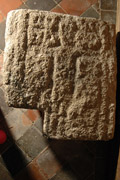
Object type: Part of an altar(?)
Measurements: H. 69.3 cm (27.3 in); W. 64.3 cm (25.3 in); D. 23 > 15 cm (9 > 6 in)
Stone type: Coarse-grained Land's End Granite (A.V.B.)
Plate numbers in printed volume: Ill. 205
Corpus volume reference: Vol 11 p. 195-6
(There may be more views or larger images available for this item. Click on the thumbnail image to view.)
A roughly rectangular slab with a Crucifixion incised on it. The slab is bordered by two parallel incised lines, though these are now only really clear on the right-hand side. The border is indistinct on the left-hand side, partly extant on the top and non-existent on the bottom, presumably because the lower edge of the slab has been trimmed off. Incised within this is a figure of Christ, with thin arms out-stretched horizontally. No facial features are apparent. Lines near the ends of the arms, a faint line at the neck (?), and the length of the garment suggest that the figure is wearing a tunic. The feet are not visible, presumably having been cut off, although there is perhaps a slight indication of the beginning of the left foot turning out. In the roughly square area to either side of the head is a simple incised cross with an incised single dot in the centre of each quadrant. This is less clear on the left-hand side.
This slab is considered by Thomas to display a mixture of Welsh and Irish influences and probably to be of seventh- to ninth-century date, although he does not preclude a tenth- to eleventh-century dating (Thomas, A. C. 1961, 88–92; id. 1978, 77; id. 1990, 11–15). He very reasonably suggests that the slab may have been an altar frontal. However, the use of incised work and the use of dots compare with the Penzance 1 cross for which an eleventh- to twelfth-century date has been proposed (p. 186, Ills. 185–8). Moreover the great similarity in proportion, size and shape of garment between this figure and that on the churchyard cross (Phillack 1, Ill. 197) suggests that they are closely related, if not by the same hand. The suggested date is therefore broadly in line with that proposed for the Phillack 1 cross, as well as for incised monuments like Penzance 1.
