Select a site alphabetically from the choices shown in the box below. Alternatively, browse sculptural examples using the Forward/Back buttons.
Chapters for this volume, along with copies of original in-text images, are available here.


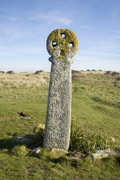
Object type: Cross-shaft and -head
Measurements: H. 244 cm (96 in); W. 57 cm (23 in) (head), 49 > 35 cm (20 > 14 in) (shaft); D. 18 cm (7 in) (head), 38 > 28 cm (15 > 11 in) (shaft)
Stone type: Coarse-grained granite, type 1a or 1b, probably from Land's End or St Austell (A.V.B.)
Plate numbers in printed volume: Ills. 193-6; Colour Pls. 13-14; Fig. 18n
Corpus volume reference: Vol 11 p. 189-93
(There may be more views or larger images available for this item. Click on the thumbnail image to view.)
Cross, with round (wheel) head pierced by three holes, with a projecting roll-moulding at the neck. Although almost square in section at the bottom of the shaft, the cross tapers to become rectangular in section at the top of the head. The cross-base referred to by Langdon (Langdon, Arthur 1896, 181) is not currently visible, being buried beneath about 25 cm of sand. The surface of the cross, especially near the top, is highly eroded as a result of its exposed location, but all faces of the shaft are decorated with rows of tiny incised dots within the possible traces of incised edge-mouldings.
A (broad): On the head, a St Andrew's cross is indicated, but not actually carved, by piercing three elliptical holes through the head, at the top and sides, while at the bottom of the head, the hole is not completely cut through, but is sunk to a depth of 4 cm. At the centre of the head is a small boss, 6 cm in diameter, in very low relief, encircled by a raised moulding. Within the faint traces of an incised edge-moulding, the shaft is covered by hundreds of incised holes in irregular rows. At the foot, a faintly incised line marks the bottom of the decoration.
B (narrow): The side of the head is plain. The decoration appears similar to that on face D, but is more worn. At the top is a panel containing irregular rows of small incised holes; below this is a small plain panel and below that again a further panel with rows of incised dots. At the centre of the shaft, another uncarved panel has, below it, a final panel again containing rows of incised holes. This, like the bottom panel on face D, may be enclosed above and below by double incised lines.
C (broad): On the head, the stone adjacent to the three holes appears slightly set back in relation to the remainder of the head, suggesting that the cross may once have had well-defined arms separated by a slightly recessed ring, details which have been almost obliterated due to erosion. The decoration is as on face A.
D (narrow): More detail is visible on this side of the shaft, with the decoration clearest near the bottom. There is an indication that on the left-hand side there is a double incised edge-moulding. The decoration on the shaft appears to be divided into four panels, although the method of division is only obvious near the bottom. In the top third the rows of dots are laid out so that the spaces between them create diagonal lines. In contrast, the dots in the middle third of the shaft are arranged in horizontal and vertical lines, so that the spaces between the dots define a grid pattern. These two areas may be separated by an uncarved area, but this is not certain. Below this is a panel which appears undecorated and is defined top and bottom by two horizontally incised lines; below that, at the foot of the shaft, is a further small panel containing rows of irregularly disposed dots. The panel is terminated at the bottom by double incised lines.
A grant of land at Tywarnhayle in Perranzabuloe, made by King Edgar in 960 and known from an original charter of that date (Sawyer 1968, 227, no. 684; Hooke 1994, 28–33; Padel forthcoming), has a feature described as a cristelmæl in its boundary clauses, at a point near the location of this cross. It has been assumed by many, for example Henderson and Hencken (Henderson, C. 1931, 39, 54; Hencken 1932, 267–8, 306), that the cristelmæl is identical with the extant cross. We therefore need to consider how compatible this suggestion is with the style and ornament of this cross.
The Old English word cristelmæl, a variant of cristesmæl, means 'Christ's cross; sign of Christ's cross'. Henderson suggested that the word 'must have a close connection with the church or the fine cross of St. Piran which still stands in situ on the south side of it'. He noted that later bounds of the manor of Tywarnhayle (dated 1617) name the chancel of Perran church as part of the boundary (Henderson, C. 1957–60b, 398; see also Padel forthcoming), and since the cross now stands some 18 m (59 ft) south of the chancel of the church, it is in a position close enough to suggest that there could have been a correspondence between the two bound points. Hooke believed the cristelmæl to be a crucifix and the church to be its 'most likely location ... This suggests that this church, known to have been built by 1150, was constructed on a sacred spot or, at least, on a boundary already marked with a crucifix at this point, although it is not certain that this was the present cross' (Hooke 1994, 29).
It is generally assumed that the ad 960 charter of Tywarnhayle represents a donation of land taken from St Piran's church, whose remnant is recorded in Domesday Book as the manor of Lanpiran (Henderson, C. 1957–60b, 398; Thorn and Thorn 1979, 4,26). Hooke's map showing the boundary of Tywarnhayle indicates that it extended over a huge area nearly equivalent to that of the parish of Perranzabuloe with its chapelry of St Agnes (Hooke 1994, 30). Domesday Book records that in 1086 Tywarnhayle was held by the Count of Mortain from St Petroc's Monastery, suggesting a reversion to ecclesiastical ownership between 960 and 1086 (Thorn and Thorn 1979, 4,7). One of the places where the boundaries of manor and parish were not identical was in the north where a segment with its turn at the cristelmæl was excluded from the later parish area. The excluded segment may represent land retained by St Piran's church (unless this was entirely contained within the boundary of Tywarnhayle, which is a possibility) or more likely the manor of Elhil, held by St Petroc's church in 1086, which lay to the north (Henderson, C. 1957–60b, 398; Thorn and Thorn 1979, 4,18). Either way it is a possibility that the cristelmæl was a new feature of c. 960, erected to identify a point where the boundary turned and perhaps where three separate manors ( Tywarnhayle, Elhil and Lanpiran: see below) may have met.
If the cristelmæl is identical with the existing cross, this is potentially important dating evidence for the style of ornament on the cross, which is otherwise difficult to date because the dot decoration which it features is unique to Cornwall and has no unequivocally dated parallels. And if St Piran's Cross is accepted as dating to ad 960 the implication is that all the other monuments with which it can be compared may be of similar date. However, the present authors feel that Hooke's caution in identifying the cristelmæl with the present cross was wise, for although the location that the present cross occupies may be close to that of the cristelmæl, a tenth-century date seems unlikely for this particular monument. But as it may seem surprising to question a potentially neat identification of the present cross with a documented tenth-century 'crucifix' we need to be clear what the reasoning for this is. There are two related lines of argument. One is that the cross does not conform with the sculptural styles generally accepted as of mid tenth-century date and the second is that certain features of the cross suggest that although its attributes may be derived from demonstrably early medieval types of monument form and decoration, they are not certainly pre-Conquest.
Although the dating of all early medieval sculpture is to a degree subjective, a consideration of other sculpture in Cornwall with a good claim to a mid tenth-century date presents a range of monuments of rather different character. All are crosses whose heads consist of four splayed arms supported by a ring, and a range of intricate decoration which includes interlace, knotwork, foliage scrolls, and frets. The decoration can be identified as being of early medieval date by comparison with dated examples in other media like metalwork and manuscripts. For example, the Cardinham cross (Cardinham 1) in mid Cornwall has a ring-chain on one side (Ill. 46) which art-historical parallels indicate was current in the tenth century (Bailey 1980, 72; see p. 132). Also the Fourhole Cross (St Neot 3, Ills. 155–8) features plant-scrolls similar to that seen on folio 1v of the tenth-century manuscript of Bede's Life of St Cuthbert (Cambridge, Corpus Christi College, MS 183; see p. 175). Beside these monuments, St Piran's Cross appears simple and crude, although generic similarities exist since they are all stone crosses. The decoration on both of these monuments is carved in relief, with a good understanding of the principles behind their respective forms of ornament.
St Piran's Cross is highly eroded due to its exposed location, a fact which may disguise a greater sophistication than is currently evident. The panelling visible on the sides and the hint on face C that the features of the head were once better defined suggests that the whole may originally have been more complex than it appears now. Nevertheless it can only be discussed on the basis of its current form, which is that of a substantial round-headed cross with roll mouldings at the neck and decoration on the shaft which consists exclusively of rows of incised dots. The holes in its head indicate a diagonal St Andrew's cross.
Yet although it is admittedly much eroded, especially on the head, the features of St Piran's Cross combine to suggest that it is a derived from a simplification of such monuments and is not contemporary. It is well proportioned and laid out, but the decoration is all incised: a method of carving which was presumably much easier to execute than relief carving. Rather than a range of ornament types, the cross appears to feature only lines of incised dots. The origin of these dots is obscure and has been discussed more fully in Chapter IX (p. 97): however there is a possibility that it represents a simplification of plaitwork, the dots representing the holes between the crossing strands which could have been painted in to give the appropriate effect. Such large panels of plaitwork would be unusual in Cornwall but can be seen in panels on the late ninth- to tenth-century St Cleer 3 or St Neot 1 (Ills. 56, 154) and in Wales covering all surfaces of the Neuadd Siarman cross, Maesmynys (Redknap and Lewis 2007, 227–30). However the dots on St Piran's Cross are all extremely close together, giving little space for the necessary painting, while irregularities in their lines would have made it difficult to indicate the crossing strands neatly. It therefore remains a possibility that the dots were simply intended to texture the surface of the stone.
The large round head, possibly compass-drawn, is plain compared to the demonstrably early medieval monuments in Cornwall like, for example St Columb Major 1, only 15 km (9 miles) from Perranzabuloe. This is a ring-head with triquetra-shaped holes and carved triquetras on the cross-arms whose wide splay may indicate an eleventh-century date (p. 140, Ills. 62–3). The pointed extensions of the lower cross-arm where it joins the shaft do, however, show how the idea of the roll-moulding at the neck of St Piran's Cross may have originated, although on the latter it has no function but is purely decorative.
In summary the relationship of St Piran's Cross with carving which is unquestionably early medieval appears to be derivative. Its relationships are more appropriately sought with other monuments decorated in incised decoration; and although these can also be hard to date, the pointers that exist suggest they are generally later than the relief-carved interlace-decorated monuments. Some, like those belonging to a group in the Wendron area, and whose finest example is at Scorrier (Wendron 6, p. 251) have elaborate decorative schemes including chevrons, suggesting that they are related to Romanesque art. The form of cross on their disc heads helps substantiate this date.
Another disc-headed cross with incised decoration whose form and stature are similar to St Piran's Cross is Lanivet 2 (p. 161). Its decoration is more elaborate and varied than St Piran's and includes panels with dots, as well as bosses, an incised figure, some fretwork and simple interlacing circles (Ills. 120–3). The greater range of decoration therefore includes some which is copying (but misunderstanding) early medieval styles. Lanivet 2 stands in a churchyard alongside another cross (Lanivet 1, p. 159) whose interlace and foliage scrolls clearly indicate an early medieval date (Ills. 114–18). Here, side by side on the same site, are two crosses which demonstrate the development taking place in Cornish sculpture in the eleventh century. With its pure early medieval decoration, Lanivet 1 is likely to be the earlier (though probably still of the eleventh century) and Lanivet 2, with its incised work and poorly rendered interlacing and frets appears to be later. Its disc head closely resembles those seen on many later medieval Cornish wayside crosses though the large central boss reflects a ubiquitous early medieval feature. In fact Lanivet 2 appears to be a monument spanning the transition from early to later medieval styles of monument. St Piran's Cross is far more like Lanivet 2 than Lanivet 1, but with its more restricted range of decoration may perhaps be slightly later.
On the head of St Piran's Cross, the St Andrew's cross is a feature which does not appear on any demonstrably early medieval carving in Cornwall. It does appear, however, on a small number of crosses with incised decoration and on one or two later medieval wayside crosses, for example Lelant (Langdon, Arthur 1896, 97–8). Of the incised crosses with a St Andrew's cross, the Connor Downs cross (Gwinear 2, Ills. 301–4) and the Three Holes Cross (Egloshayle 2, Ills. 297–300) are smaller, simpler versions of St Piran's Cross and if related to it, which is uncertain since they are located at distances of approximately 24 km and 30 km (15 and 19 miles) to the north-east and south-west from Perranzabuloe, are likely to be copies rather than prototypes. Originally in an adjoining parish and a much lesser distance from the St Piran's Cross was Kenwyn 1 (Tregavethan), now at Eastbourne (Ills. 103–9). Although its overall appearance is rather different, the decorative scheme on this cross includes panels of dots, along with a St Andrew's cross on the head which is indicated with three incised ovals. This in turn is most like the Market Cross at Penzance (Ills. 185–8). These parallels therefore point towards a similar date, possibly of the second half of the eleventh century, for St Piran's Cross, even though the ad 960 charter's tempting reference to a cristelmæl is persuasive of an earlier origin. It is however accepted that future research may reverse this decision because the incised crosses are perhaps the least understood of Cornish medieval stone monuments (Chapter IX, p. 95).
But if St Piran's Cross is of late eleventh century or slightly later date, then two problems remain to be addressed, namely: what exactly was the cristelmæl, if not the existing monument, and what was the context of the existing cross at the time it was erected?
A ready answer suggests itself for the first of these questions. Perhaps the cristelmæl was a wooden cross, erected in the tenth century, in or close to the location of the present monument and replaced after a century or so, once it had decayed. Alternatively, it could have been another, lost, stone cross. With regard to the second question, the situation here is complicated by uncertainty of the date at which a church was first built on the site, since there is another ecclesiastical site less than a quarter of a mile (0.366 km) to the west, known nowadays as St Piran's Oratory, which, it is thought, may represent the earliest religious focus in the area until it was overwhelmed by dune sand and the second church built on higher ground where the cross is located. In reality, the relationship between the two sites is uncertain and unproven although the Oratory is in a low-lying, valley bottom location, topographically suited to an origin as a *lann (Preston-Jones 1994, 85) even though no *lann-like enclosure can now be seen because the site is masked by dune sand. An extensive cist cemetery is known to surround the site and nineteenth-century finds here of a silver ring and coin of Roman date may point to an even earlier origin for the site (Peter, T. 1903–5, 139). On the other hand, the second church and cross stand within a large oval enclosure, assumed to have been the churchyard of the abandoned church (Cole 1997, 50–6). When first identified, it was assumed that this enclosure represented the *lann of Lanpiran ((—), unpublished 1982–3, 9–10); although the elevated position makes it a possibility that this form derives from the re-use of a prehistoric settlement enclosure or round (Cole 1997, 56): the most obvious example of such re-use in Cornwall is that of St Dennis (Thomas, A. C. 1965, 31–3; Preston-Jones 1994, fig. 6k).
Lanpiran was the name of the religious house in this area in 1086; the Oratory site would fit with that name. However it is believed that, at some point, encroaching dunes forced the Oratory site to be abandoned in favour of the site where the cross and the ruined St Piran's church are now located, although the date of that move is uncertain. Either the Oratory or church or both were the site of the landowning community recorded in Domesday Book, but Domesday Book gives no clue as to which location the community occupied in 1086. One thing we can suggest, however, is that as the Oratory lies west of the cross and ruined church and the lands of Lanpiran presumably included the Oratory, Lanpiran is likely to have existed as an entity within the greater manor, rather than occupying land outside it to the north. At some point after 1086 (probably sooner rather than later) the community of canons disappeared and the church became an ordinary parish church (Orme 2010, 134–5).
On the whole it seems likely that the community and its church were not at the cristelmæl in the tenth century since, had they been, the cristelmæl would hardly have been required to mark the boundary. Rather, a corner of the church might have been used, as in the later document. Equally, it seems likely that when the present cross was erected, possibly in the second half of the eleventh century, the church was not there either, for the same reason. But obviously the site had moved by the time the earliest stonework in the church was built, and since Hooke was writing, architectural appraisal has noted the presence of Romanesque work at the Oratory and shown the earliest stonework visible in the church to be no earlier than late twelfth century, inclining Allan and Blaylock to accept the traditional story of the relationship between the Oratory and church (Allan and Blaylock 2007, 31).
So, on present evidence, the original context of the cross, assuming that it is not the cristelmæl, is most likely to have been as a boundary marker. It perhaps replaced the earlier cristelmæl before a church was built close by. When the church was built it was presumably erected on an extremity of church land or in the place already sanctified by the cross. As a boundary marker, the cross occupied a prominent ridge-top point in the landscape. The removal of the church in the nineteenth century means that today the positioning of the cross as a significant landscape feature can be appreciated in a way that it could not have been when the church still stood (Colour Pl. 14).
A further question relates to the sponsorship of the cross. Since it sits within the abandoned graveyard of St Piran's church it might be assumed that it was erected by the community of St Piran. The proposed dating might just fit with that, although whether a community which was in decline would have had the resources is another matter. However, it is worth noting that the cristelmæl marked a significant point between the three manors recorded in this area in Domesday Book: certainly Tywarnhayle, possibly Lanpiran, and also Elhil (Thorn and Thorn 1979, 4,7; 4,18; 4,26). Interestingly, both Tywarnhayle and Elhil were owned by St Petroc's church in 1086 even though the Count of Mortain held Tywarnhayle from St Petroc. So it is instead a distinct possibility that the cross was erected not by St Piran's monastery but by St Petroc's, whose sculptured works of the tenth and eleventh centuries were impressive and influential (see Padstow 1–5, pp. 176–82). There are some connections that may support this. St Piran's Cross has been compared above with Lanivet 2, located not far from Bodmin which by the eleventh century is likely to have been the main centre of St Petroc's monastery (p. 160). One of its closest copies is also located in the Bodmin area (Egloshayle 2, the Three Holes Cross, p. 236), and to this line of speculation the fact that St Piran's Cross may be carved of granite from the eastern side of the St Austell granite outcrop (again, not far from the Bodmin area) may not be immaterial, although a source in the Penwith area is also possible.
