Select a site alphabetically from the choices shown in the box below. Alternatively, browse sculptural examples using the Forward/Back buttons.
Chapters for this volume, along with copies of original in-text images, are available here.


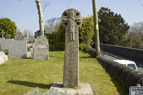
Object type: Cross-shaft and -head
Measurements: H. 176 cm (69.3 in); W. 44 cm (17.4 in) (head), 32 > 27.5 cm (12.6 > 10.9 in) (shaft); D. 36.5 > 30 cm (14.4 > 11.9 in)
Stone type: Carnmenellis Granite (A.V.B.)
Plate numbers in printed volume: Ills. 197-201
Corpus volume reference: Vol 11 p. 193-4
(There may be more views or larger images available for this item. Click on the thumbnail image to view.)
Complete cross with (according to Hockin, quoted in Langdon, Arthur 1896, 390) a tenon on the bottom; set in a modern base. The shaft has an almost square section and is unusual in that the main faces (i.e. those with figure and bosses) are slightly narrower than the sides. The cross-head is an irregular type E9, the top arm being wider than the horizontal arms and the lower arm merging with the shaft. The arms are linked by a recessed ring, type a, which is flush with the ends of the arms and upon which are two bosses in the lower quadrant. Only the top two holes between the arms and ring are completely drilled through. A double incised line frames all sides of the head and a single incised line runs down all sides of the shaft and across the bottom. On the shaft, the poorly executed plaitwork is incised, not relief-carved.
A (narrow): On the head, and extending down on to the shaft, is a rather long thin figure of Christ. The head is without features or halo; the arms extend to the very edge of the cross-head. The figure is clad in a knee-length tunic and has out-turned feet which are neat and small. The decoration on the shaft consists of a rather angular and irregularly executed three-strand plait. The pattern is incised and untidily finished at the bottom; at the top, two of the strands wiggle up beside Christ's legs.
B (broad): On the head, the double incised edge-moulding follows the outline of the cross-arms and recessed ring; on the lower part of the ring is a boss. Within the single incised edge-moulding on the shaft is an angular three-strand plait, fairly neatly finished at the bottom but with a couple of mistakes in the pattern.
C (narrow): On the head, within the double incised edge-moulding are five bosses, one on each of the cross-arms and one in the centre. That in the centre has a single incised line around it. On the shaft is an incised, angular three-strand plait, untidily finished at the top and bottom but without any mistakes.
D (broad): On the head, the double incised edge-moulding follows the outline of the cross-arms and recessed ring; on the lower part of the ring is a boss. On the shaft is a very bungled attempt at an angular incised four-strand plait.
Although Phillack 1 is clearly related to the Penwith group of pre-Norman crosses with a Crucifixion on one side of the head and five bosses on the other (Chapter IX, p. 88), various features indicate that it is a devolved copy. While the head has a very competent version of the usual Crucifixion and five bosses, the plaitwork on the shaft is crude and unparalleled; in addition, the merging of the cross-arms and ring, and the bosses added to the lower part of the ring, are notable departures from the traditional ring-headed form. The bosses on the neck may have been suggested by something like the roll-moulding on Penzance 1 (Ills. 185–8); similarly-placed bosses are found on the eccentric Wendron 3 cross (Mertheruny; see Appendix D, p. 248, Ills. 328–9). The proportions of the monument and Crucifixion are sufficiently similar to Gwinear 1 (Roseworthy), now at Lanherne (Ills. 94–7) to suggest that this may have been its model; originally the two were relatively close geographically. Equally, the Crucifixion is so similar to that on the Phillack altar slab (Phillack 3, Ill. 205) that they could be contemporary or at least close copies.
Although there is no record of a pre-Norman religious house at Phillack, the collection of early stone monuments here indicates an early and important ecclesiastical foundation. Discoveries in sand dunes to the north of the church suggest that the church is on the site of a large cist cemetery with possible prehistoric origins (Preston-Jones 1984, 170, 176–7; Thomas, A. C. 1990, 9–10), and adjoining Phillack is the farm of Riviere, traditional site of a castle of the Cornish tyrant-king Tuedar (Thomas, A. C. 1994, 197–8). The name of Phillack is derived from that of the patron saint, Felek, first recorded in a tenth-century list of Cornish saints' names (Olson and Padel 1986, 48–9), and Phillack Churchtown, first recorded in the twelfth century, was known as Egloshayle, the 'church on an estuary' (Padel 1988, 138).
