Select a site alphabetically from the choices shown in the box below. Alternatively, browse sculptural examples using the Forward/Back buttons.
Chapters for this volume, along with copies of original in-text images, are available here.


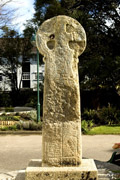
Object type: Cross-shaft and -head
Measurements: H. 212 cm (83.5 in); W. 70 cm (27.5 in) (head), 53.5 > 43.5 cm (21.1 > 17.1 in) (shaft); D. 26 > 23 cm (10.3 > 9 in)
Stone type: Coarse-grained, poorly megacrystic granite with a few sparse feldspar megacrysts up to 5 cm by 1 cm; roughly equidimensional quartz crystals up to 10 mm. Common tourmaline is present as needles and clusters, together with a few flakes of white mica up to 0.2 mm. Land's End Granite
Plate numbers in printed volume: Ills. 185-92, 380-3; Fig. 18m
Corpus volume reference: Vol 11 p. 186-8
(There may be more views or larger images available for this item. Click on the thumbnail image to view.)
Nearly complete cross with round head, shaft of rectangular section and a projecting roll-moulding at the junction between head and shaft. The head is over-large in proportion to the shaft, and slightly flattened on top. Part of the top of the head and of the bottom of the shaft are broken off. An incised edge-moulding runs all around the edge of the shaft on all four faces, and round the head and shaft on the front and back faces with no division between head and shaft. All sides of the shaft are divided into rectangular panels and, within these, the incised decoration consists of lines of dots, crude figures and inscriptions.
A (broad): Within the incised edge-moulding on the head is a cross formed by sinking four triangular areas with curved sides. On the ends of the roll-mouldings is a small circular hollow, and the first panel on the shaft starts just below this. It contains a crudely incised figure with round head, squarish body/garment, stick legs and out-turned feet. No arms are evident, although the line sticking horizontally out of the right-hand side of the body might conceivably be one. The panel below this is mutilated. On the lower part of the shaft, vertical and horizontal incised lines divide the shaft into four panels. Of the top two, one contains an inscription and the other is plain; of the lower two, one contains an inscription and the other rows of dots. Only the top part of the two lower panels is visible, the remainder of the shaft having broken off.
The inscribed texts are incised in a predominantly insular script and are set vertically with the bottoms of the letters facing the viewer's left. The text in the upper panel is virtually complete and reads:
| [.]MBUIN [–]UMQ: [–.]TNI |
That in the lower panel is incomplete and reads:
P[–]
C[–]
B (narrow): There is no decoration or incised edge-moulding on the head; the incised edge-moulding starts immediately below the roll-moulding, on the shaft. This face is divided into at least five panels by incised horizontal lines. The top panel is apparently plain. The panel below this contains a crudely incised figure with round head and pear-shaped body. Slight hollows may indicate the eyes and mouth. A line extending from the right-hand side may be an arm or perhaps a sword; the two stick-like legs have out-turned feet. The figure may have a belt around its rotund body. The next panel down contains neatly arranged rows of small dots, and the bottom two panels contain inscriptions.
The inscribed texts are probably complete but highly deteriorated and it is uncertain what script is used. The texts are set vertically with the bottoms of the letters facing the viewer's left. The texts read:

C (broad): The cross-head is as on face A except that the triangular areas are incised only, not sunken. There are dots on the ends of the roll-mouldings, as on A, and a small hollow in the centre of the shaft between them. The decorative panels begin just below the bottom of the roll-moulding. On this face, a vertical incised line runs all down the centre of the shaft, in addition to the horizontal incised lines, so that there are paired panels down the shaft. The top two rows are alternately filled with rows of dots or left plain, thus forming a chequer-board effect. Below these, the panels are all uncarved apart from a small number of dots in the third panel down on the left-hand side.
D (narrow): There is no carving on the head. On the shaft, below the roll-moulding, is an incised edge-moulding and the shaft is divided into panels by horizontal incised lines. The top panel appears to be undecorated. The second contains traces of a large incised diagonal cross. The third from the top contains neat rows of small dots and in the fourth and final panel is a simple pattern which may be a two-strand twist, carved with a double incised line.
The overall form of this monument, and the range of its incised decoration, allies it with other crosses in Cornwall for which a date at the end of the early medieval period or the beginning of the Norman period is ascribed (Chapter IX, p. 95). In its form, proportions and decorative features the Penzance cross is remarkably similar to a cross from the Truro area, now in Eastbourne (Kenwyn 1, Tregavethan, p. 157, Ills. 103–9), so that although there are obvious differences, the two nonetheless appear very closely related, despite the fact that they were originally located some distance apart.
There are no certain diagnostic dating features on the Penzance cross, although the fact that it has attributes in common both with monuments with undoubtedly pre-Conquest decoration and also with the simpler wayside crosses, which are most probably of post-Conquest date, suggests that we are dealing with a Transitional monument. The existence of the inscriptions and the figure on the main face of the shaft allies Penzance 1 with the interlace-carved crosses of Penwith, for example Gwinear 1 and Sancreed 1 (Ills. 94–7, 214–17), which date from the tenth or eleventh century; the roll-moulding at the neck may be derived, as Thomas has suggested (Thomas, A. C. 1967a, 90), from the treatment of the lower arm of a wheel-headed cross with a figure of Christ, for example, on St Buryan 1, Gwinear 1 or Sancreed 1 (Ills. 29, 92, 212). Yet the uniquely wide, slab-like shape of the cross has more in common with the hundreds of round-headed wayside crosses in Cornwall, which on the whole appear to date from the twelfth century. It is, however, a larger and more elaborate monument than most of these. A further feature of the Penzance cross which may favour a post-Norman Conquest date is the cross on the head, made by sinking or incising curved triangular areas. These compare to Norman Early Geometric cross designs, for example Almondbury I, west Yorkshire, dated by Ryder (1991, 10) to the late eleventh or twelfth century. The origin of the decoration of dots in panels is obscure; its possible relationship to both pre-Norman and post-Norman monuments is discussed in Chapter IX above (p. 97); however it is worth noting here that the vertical as well as horizontal division of the shaft on face C, where the panels of dots and uncarved panels alternate in chequerboard fashion, is reminiscent of geometric Romanesque decoration. However, the absence of chevrons or other clear Romanesque indications like those seen on Wendron 6 (Appendix D, Ill. 337) suggests that it is not as late as this.
The figure on the main face (Ills. 185, 189) is reminiscent of the Crucifixions which are very much a feature of early crosses in this area, yet the method of carving and the way the figure is depicted are very different. Thomas suggests that this figure may be the Risen Christ, and that the figure on face B (Ills. 186, 190) might be a depiction of the cross's donor (Thomas, A. C. 1999, 39–43). Both identifications are here considered uncertain as the sculptures contain so little detail, but the possibility is strong that the figure given a prime position on face A is Christ. The only other example of an incised figure (other than Christ) on a Cornish cross is at Lanivet 2, near Bodmin (p. 161 and see Ill. 119), another potentially Transitional monument with predominantly incised decoration. In their crudity, these figures could also be compared with the very simple figures on southern Welsh sculpture (Redknap and Lewis 2006, figs. 76–7; Edwards 2006, 82), or even with the Evangelists which adorn Breton manuscripts of the late ninth and tenth centuries: for example Luke in a gospel-book from Landévennec, now at the Bodleian Library in Oxford (Gospel MS. Auct. 2.D.16, fol. 101v) or those seen in the Landévennec Gospels at New York Public Library (the Harkness Gospels; see Morey, Rand and Kraeling 1931, pls. 1 and 2 and comparanda from the Gospels of Berne, pl. IV).
The texts on face A read [–.]MBUIN[–]UMQ:[.]TNI and FO[–]P[–]C[–] (Ill. 191); it is not clear whether they are to be read together or separately. The dots after q could indicate the end of a word or an abbreviation and might suggest that the language of the texts is Latin. It has to be concluded that these texts are now uninterpretable. The texts on face B read [RE..+.CR–] and D+[–] (Ill. 192). The former must be concluded to be illegible and the latter is too fragmentary to be meaningful. Thomas considers the inscription on face A to be in an eleventh-century book hand (Thomas, A. C. 1994, 300), but this is far from certain. Thomas (1997, 1999) has suggested various interpretations based on tentative readings of the inscriptions and numerological analysis of those hypothetical readings, but those interpretations are here considered too speculative to be discussed in detail.
The original context of the cross is uncertain. Its first definitely recorded location in the Greenmarket shows that it did duty as a market cross, but as the name Penzance is not first recorded until 1284 (Padel 1988, 136), and the market not until the fourteenth century (Pool 1974, 17–18), this is unlikely to have been its original function. Pool points to a Park-an-Grouse (Cross Field) just west of the Greenmarket (SW 4707 3028) as possibly indicating its original site (Pool 1974, 8). This location does not appear to coincide with that of any of the chapels recorded in Penzance in the medieval period (Pool 1974, 12–17). Either in the Greenmarket or in Park-an-Grouse, the cross stood on Alverton Road, whose name commemorates that of the principal manor of the area in Domesday Book, 'Alverton', held in demesne in 1086 by the Count of Mortain (Thorn and Thorn 1979, 5,1,11). The name of Alverton Road must signify the 'road leading to Alverton', for Pool locates Alverton in the area of Alverton Farm, a further 1 km or 0.6 miles west along the same road. The cross could then have marked a route to the manorial centre but this idea, as well as the theory that it may have marked a burial ground, must remain a matter for speculation, given the remarkable number of times it has been moved (Thomas, A. C. 1999, 10–13, 36–7).
In conclusion, although the decoration on the Penzance cross has a relationship to pre-Conquest sculpture of the Penwith area, its greater simplicity and the form of the monument suggest that it is transitional between pre- and post-Conquest types. However, the date suggested below leaves open the possibility that future consideration of the inscriptions may throw light on Thomas's (1994, 300) suggestion that they are in an eleventh-century book hand.
The overall form of this monument, and the range of its incised decoration, allies it with other crosses in Cornwall for which a date at the end of the early medieval period or the beginning of the Norman period is ascribed (Chapter IX, p. 95). In its form, proportions and decorative features the Penzance cross is remarkably similar to a cross from the Truro area, now in Eastbourne (Kenwyn 1, Tregavethan, p. 157, Ills. 103–9), so that although there are obvious differences, the two nonetheless appear very closely related, despite the fact that they were originally located some distance apart.
There are no certain diagnostic dating features on the Penzance cross, although the fact that it has attributes in common both with monuments with undoubtedly pre-Conquest decoration and also with the simpler wayside crosses, which are most probably of post-Conquest date, suggests that we are dealing with a Transitional monument. The existence of the inscriptions and the figure on the main face of the shaft allies Penzance 1 with the interlace-carved crosses of Penwith, for example Gwinear 1 and Sancreed 1 (Ills. 94–7, 214–17), which date from the tenth or eleventh century; the roll-moulding at the neck may be derived, as Thomas has suggested (Thomas, A. C. 1967a, 90), from the treatment of the lower arm of a wheel-headed cross with a figure of Christ, for example, on St Buryan 1, Gwinear 1 or Sancreed 1 (Ills. 29, 92, 212). Yet the uniquely wide, slab-like shape of the cross has more in common with the hundreds of round-headed wayside crosses in Cornwall, which on the whole appear to date from the twelfth century. It is, however, a larger and more elaborate monument than most of these. A further feature of the Penzance cross which may favour a post-Norman Conquest date is the cross on the head, made by sinking or incising curved triangular areas. These compare to Norman Early Geometric cross designs, for example Almondbury I, west Yorkshire, dated by Ryder (1991, 10) to the late eleventh or twelfth century. The origin of the decoration of dots in panels is obscure; its possible relationship to both pre-Norman and post-Norman monuments is discussed in Chapter IX above (p. 97); however it is worth noting here that the vertical as well as horizontal division of the shaft on face C, where the panels of dots and uncarved panels alternate in chequerboard fashion, is reminiscent of geometric Romanesque decoration. However, the absence of chevrons or other clear Romanesque indications like those seen on Wendron 6 (Appendix D, Ill. 337) suggests that it is not as late as this.
The figure on the main face (Ills. 185, 189) is reminiscent of the Crucifixions which are very much a feature of early crosses in this area, yet the method of carving and the way the figure is depicted are very different. Thomas suggests that this figure may be the Risen Christ, and that the figure on face B (Ills. 186, 190) might be a depiction of the cross's donor (Thomas, A. C. 1999, 39–43). Both identifications are here considered uncertain as the sculptures contain so little detail, but the possibility is strong that the figure given a prime position on face A is Christ. The only other example of an incised figure (other than Christ) on a Cornish cross is at Lanivet 2, near Bodmin (p. 161 and see Ill. 119), another potentially Transitional monument with predominantly incised decoration. In their crudity, these figures could also be compared with the very simple figures on southern Welsh sculpture (Redknap and Lewis 2006, figs. 76–7; Edwards 2006, 82), or even with the Evangelists which adorn Breton manuscripts of the late ninth and tenth centuries: for example Luke in a gospel-book from Landévennec, now at the Bodleian Library in Oxford (Gospel MS. Auct. 2.D.16, fol. 101v) or those seen in the Landévennec Gospels at New York Public Library (the Harkness Gospels; see Morey, Rand and Kraeling 1931, pls. 1 and 2 and comparanda from the Gospels of Berne, pl. IV).
The texts on face A read [–.]MBUIN[–]UMQ:[.]TNI and FO[–]P[–]C[–] (Ill. 191); it is not clear whether they are to be read together or separately. The dots after q could indicate the end of a word or an abbreviation and might suggest that the language of the texts is Latin. It has to be concluded that these texts are now uninterpretable. The texts on face B read [RE..+.CR–] and D+[–] (Ill. 192). The former must be concluded to be illegible and the latter is too fragmentary to be meaningful. Thomas considers the inscription on face A to be in an eleventh-century book hand (Thomas, A. C. 1994, 300), but this is far from certain. Thomas (1997, 1999) has suggested various interpretations based on tentative readings of the inscriptions and numerological analysis of those hypothetical readings, but those interpretations are here considered too speculative to be discussed in detail.
The original context of the cross is uncertain. Its first definitely recorded location in the Greenmarket shows that it did duty as a market cross, but as the name Penzance is not first recorded until 1284 (Padel 1988, 136), and the market not until the fourteenth century (Pool 1974, 17–18), this is unlikely to have been its original function. Pool points to a Park-an-Grouse (Cross Field) just west of the Greenmarket (SW 4707 3028) as possibly indicating its original site (Pool 1974, 8). This location does not appear to coincide with that of any of the chapels recorded in Penzance in the medieval period (Pool 1974, 12–17). Either in the Greenmarket or in Park-an-Grouse, the cross stood on Alverton Road, whose name commemorates that of the principal manor of the area in Domesday Book, 'Alverton', held in demesne in 1086 by the Count of Mortain (Thorn and Thorn 1979, 5,1,11). The name of Alverton Road must signify the 'road leading to Alverton', for Pool locates Alverton in the area of Alverton Farm, a further 1 km or 0.6 miles west along the same road. The cross could then have marked a route to the manorial centre but this idea, as well as the theory that it may have marked a burial ground, must remain a matter for speculation, given the remarkable number of times it has been moved (Thomas, A. C. 1999, 10–13, 36–7).
In conclusion, although the decoration on the Penzance cross has a relationship to pre-Conquest sculpture of the Penwith area, its greater simplicity and the form of the monument suggest that it is transitional between pre- and post-Conquest types. However, the date suggested below leaves open the possibility that future consideration of the inscriptions may throw light on Thomas's (1994, 300) suggestion that they are in an eleventh-century book hand.
