Select a site alphabetically from the choices shown in the box below. Alternatively, browse sculptural examples using the Forward/Back buttons.
Chapters for this volume, along with copies of original in-text images, are available here.


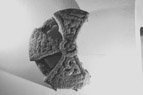
Object type: Cross-head fragments
Measurements: H. 89 cm (32 in); W. 49 cm (19 in); D. 20 > 16 cm (8 > 6.2 in)
Stone type: Pale yellowish brown (10YR 6/2), poorly sorted, clast-supported, quartz sandstone. The sub-angular to sub-rounded quartz clasts are a pale orange and range in size from 0.3 to 2.5 mm, but are mostly in the range 0.4 to 0.6 mm. Lower Long Sands Sand-stone Member, Bovisand Formation, Meadfoot Group, Devonian
Plate numbers in printed volume: Ills. 183-4; Colour Pls. 16-19
Corpus volume reference: Vol 11 p. 185
(There may be more views or larger images available for this item. Click on the thumbnail image to view.)
Fragmentary cross-head in four pieces, restored to nearly three-quarters of the head. The cross-head, type E8, has arms splaying out widely from the relatively small central boss. The arms are linked by a narrow ring, type a, and separated by trefoil-shaped openings formed by three cusps, one on the side of each limb and one on the outer ring. At the bottom, on the underside of the head, is a shallow mortice for fixing the head to the shaft.
A (broad): An incised edge-moulding runs all the way around the edge of the three cross-arms. At the end of each cross-arm are two parallel flat bands, which line up with the double-moulded ring to create a continuous double moulding around the edge of the head. The small boss at the centre of the head may have a small central hole and is surrounded by a concentric moulding. In each of the cross-arms there is a triquetra knot, although only the lower one is really clear.
B (narrow) and C (broad): Broken away
D (narrow): Undecorated
A member of the small but dispersed group of crosses in Mid and East Cornwall which are characterised by the trefoil-shaped holes between the cross-arms in the head (Chapter IX, p. 92). Other characteristic features of the group include the widely-splayed arms with triquetra knots, continuous double moulding surrounding the head and the low-relief carving. The wide-splayed arms indicate a late pre-Norman Conquest date. As no decorated shaft survives, the head is dated by analogy with other members of the group.
The mortice in the base of the cross-head shows that the head was a separate component, socketed to the missing shaft. Evidence noted when the cross-head was restored showed that it had been deliberately cut up. Mortar adhering to the fragments indicated that it had been re-used as building stone before being built into the garden wall at Trelay (Langdon, Andrew 2006a, 13).
The Pelynt head and the cross at Quethiock are the most far-flung members of the Mid and East Cornwall group. Quethiock (Ills. 206–11), a complete cross located about 15 km (just over nine miles) from Pelynt, may indicate the original decorative scheme and impressive scale of Pelynt.
Although found at Trelay in Pelynt, an original association with Pelynt parish church is likely (Langdon, Andrew 2004a, 16–17; 2006a, 13–14). The name of Pelynt, containing the Cornish place-name element plu, a 'parish' and the saint's name, Nennyd, refers to the church site (Padel 1988, 132), although by the time of Domesday Book, when the name is first recorded, it was as a manor in secular ownership (Thorn and Thorn 1979, 5,15,3). The church has a curvilinear enclosure suggesting, with the name, an early medieval origin, although the elevated location may indicate that a prehistoric enclosure was re-used (Preston-Jones 1987, 159–60).
