Select a site alphabetically from the choices shown in the box below. Alternatively, browse sculptural examples using the Forward/Back buttons.
Chapters for this volume, along with copies of original in-text images, are available here.


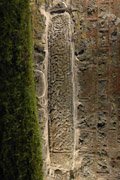
Object type: Cross-shaft
Measurements: H. 186 cm (73 in); W. 33 > 26 cm (13 > 10.25 in); D. 33 > 26 cm (13 > 10.25 in)
Stone type: Coarse-grained granite with a few sparse feldspar megacrysts up to 8 cm by 2 cm and with roughly equidimensional quartz crystals up to 8 mm; some tourmaline and a few flakes of white mica up to 0.2 mm. Land's End Granite. Similar to Paul 1, apart from the few (three) large feldspar phenocrysts
Plate numbers in printed volume: Ills. 181-2; Fig. 17d
Corpus volume reference: Vol 11 p. 184
(There may be more views or larger images available for this item. Click on the thumbnail image to view.)
Only the shaft survives. This may be nearly the full original length although some may be missing at the top since the break is oblique and the pattern at this end incomplete. The top 30 cm of the shaft tapers noticeably inward towards the broken end. At the opposite end, the bottom 22 cm of the shaft is undecorated and represents the tenon which would have been morticed into a base. It is not certain whether the one visible face is front/back or side of the monument. Investigation has indicated that decoration survives on all the hidden sides of the shaft, and that all angles have an incised edge-moulding (Preston-Jones 2009, 18).
A or C: Single panel of double-strand interlace whose exact identification is uncertain because of mortar adhering to the shaft, but which probably includes figures-of-eight and other knots based on simple pattern F.
B and D: The presence of ornament has been confirmed but its nature not established.
Although only one face is visible, and so identification cannot be wholly confirmed, it is almost certain that this shaft is from a cross in the Penwith group of sculpture (Chapter IX, p. 88). The use of double-strand interlace and pattern F is entirely characteristic. The tapering plain tenon can be compared with another in the group, St Erth 1 (Ills. 65–8), although in comparison with this Paul 2's tenon is very short, while the shaft is very much taller; this suggests that there may be a piece missing from the bottom of Paul 2.
As there is not enough visible of this monument to allow comment on date, the date given below is that proposed for the Penwith group as a whole.
It has been suggested (Preston-Jones 2009, 20) that this shaft and the cross-head Paul 1 may be parts of the same monument, but with a section of shaft missing from between the two. As noted above in Paul 1, the argument for this is based on the square cross-section of the shafts of each; the discrepancy in size (the shaft of Paul 1 is approximately 3–6 cm smaller in cross-section) can be accounted for by the fact that a section from the top of Paul 2 has broken off and is missing, a suggestion which is confirmed by the fact that the pattern is incomplete.
