Select a site alphabetically from the choices shown in the box below. Alternatively, browse sculptural examples using the Forward/Back buttons.
Chapters for this volume, along with copies of original in-text images, are available here.


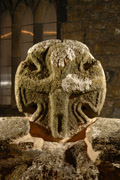
Object type: Cross-head
Measurements: H. 60 cm (23.6 in); W. 59 cm (23.3 in) (head), 20 < 23 cm (8 < 9 in) (shaft); D. 20 cm (7.9 in) (head), 19.5 cm (7.75 in) (head with bosses)
Stone type:
The two parts of the cross-head differ slightly, but not significantly, in the maximum size of the phenocrysts.
Top part: coarse-grained granite with sparse feldspar megacrysts up to 4 cm by 1.5 cm; roughly equidimensional quartz crystals up to 8 mm. Some tourmaline and a few flakes of dark mica. Land's End Granite.
Bottom part: coarse-grained granite with sparse feldspar megacrysts up to 6 cm by 1.5 cm; roughly equidimensional quartz crystals up to 8 mm. Some tourmaline nests up to 5 mm across and a few flakes of dark mica. Land's End Granite
Plate numbers in printed volume: Ills. 178-80; Colour Pl. 20; Figs. 17d, 18c
Corpus volume reference: Vol 11 p. 182-3
(There may be more views or larger images available for this item. Click on the thumbnail image to view.)
The cross-head only remains, with a tiny stub of shaft attached.
A (broad): The cross-head is a variant of type E8. It has very narrow arm-pits and widely expanded ends to the arms. The three upper cross-arms have rounded ends but the end of the lower arm is extended down to a point in order to accommodate the figure's feet. The cross-arms are linked by a slightly recessed ring, type a. The holes between the arms are very small; that on the bottom left fails to connect with the hole drilled from the opposite side and so does not go right through the stone. A very shallow incised edge-moulding (double from arm-pits to feet of figure) frames the figure of Christ. Christ has a disproportionately large head with halo and a rather pointed chin or beard. Irregularities in the stone may represent the eroded remains of features — eyes, nose and mouth. The figure's broad arms, which extend right to the edge of the cross-head, are slightly raised; there appears to be no attempt to show the hands. The figure may be clothed in a tunic. There are traces of a belt, and a faint, obliquely incised line running from the right-hand shoulder to the centre of the belt may represent a fold in the garment whose lower edge is certainly clear. The lower part of the body is disproportionately small and the feet are neat and point forwards.
B and D (narrow): No trace of any ornament
C (broad): On this side, the cross-head does not have a pointed extension to the lower limb. Around the edge is a double incised edge-moulding, very lightly carved, within which are five very large bosses, one on each of the cross-arms and one in the centre. The central boss has a trace of an encircling incised line.
With a Crucifixion on one side of the cross-head and five bosses on the other, this cross-head is a member of the Penwith group of pre-Norman sculpture (Chapter IX, p. 88). Compared to St Buryan 1, Gwinear 1 and Sancreed 1 (Ills. 29, 92, 212), the figure of Christ is ill-proportioned and the bosses are over-large. Unlike the others, the feet are side by side pointing forwards, in the manner typical of Romanesque Crucifixions. It may therefore be a copy of these others, and of slightly later date, or a more rustic version.
Paul 2, the shaft of a cross built into the north wall of the church (Ills. 181–2), is also a member of the Penwith group. Recent investigations, which provided dimensions for the cross-section of Paul 2, have indicated the possibility that this may be the missing shaft of Paul 1 (Preston-Jones 2009, 20). Both have a square cross-section, and although the small remnant of Paul 1's shaft is smaller than that of Paul 2, the difference could be accounted for by the fact that there is a section missing from the top of Paul 2. Geologically the two are similar, apart from the few large feldspar phenocrysts in Paul 2, which are not sufficient to rule out this possibility. Compared to other monuments in the Penwith group, the reconstructed monument would have had a rather slender shaft, a square cross-section, and a large head in relation to the shaft size, particularly at the neck.
On the basis of details in the 'Life' of the parish's patron saint, Paul Aurelian, Paul church is tentatively identified by Olson (1989, 20–8) as the site of an early medieval monastery. It is not recorded as such in Domesday Book, nor in any other source, and so it is possible that this status had already been lost by the time the cross or crosses were carved. A curving south boundary to the churchyard may suggest the site of an early Christian religious enclosure or lann, but again there is no other evidence to confirm this. Thus the cross fragments are the only definite evidence for the early medieval origin of the church site.
