Select a site alphabetically from the choices shown in the box below. Alternatively, browse sculptural examples using the Forward/Back buttons.
Chapters for this volume, along with copies of original in-text images, are available here.


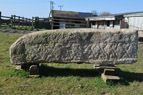
Object type: Part of coped stone(?)
Measurements: L. 181 cm (71 in); W. 47 > 38 cm (18.5 > 15 in); H. 50 > 33 cm (20 > 13 in)
Stone type: Coarsely crystalline granite with common white feldspars mostly up to 3 cm by 0.5 cm, but exceptionally there are scattered large feldspars up to 7 cm by 4 cm. Quartz crystals, which form about 40% of the rock, are scattered throughout and are generally less than 5 mm across, but some occur as phenocrysts up to 10 mm across. Black tourmaline intergrowths form about 1% of the rock; there are scattered flakes of a dark mica up to 4 mm across. Bodmin Moor Granite
Plate numbers in printed volume: Ills. 174-7
Corpus volume reference: Vol 11 p. 181-2
(There may be more views or larger images available for this item. Click on the thumbnail image to view.)
The stone appears to be part of a recumbent grave-cover of uncertain type. In plan, the stone tapers with end C the narrowest. It has vertical sides, and a slightly curved top which, above end E, tapers downwards to the decorated panel. End C has certainly been cut and the top may have been trimmed too, to facilitate use as a building stone. A small patch of mortar on side D certainly shows the stone to have been used for building purposes at some point prior to use as a gatepost. The decorated panels are enclosed by wide flat incised edge-mouldings. The truncated edge-moulding on the bottom and the incomplete knot on end E suggest that the bottom may have been trimmed as well.
A (top): The top is irregular but smooth. However it is uncertain whether this reflects its original shape or is the result of re-use; it is possible that a coped top has been trimmed off to enable the stone to be reused as building stone or alternatively the smoothness could be the result of wear when in use as a gatepost.
B (long): Though irregular and extremely worn, this panel appears to contain a key pattern or fret, Romilly Allen no. 940, the Welsh R2/W1 (see Fig. 19f, p. 72).
C (end) and F (bottom): Broken
D (long): As face B
E (end): Uncertain knot, modelled in deeply cut strands
Although it has been excessively mutilated, first for use as a building stone and then as a gatepost (with gate hangings inserted on at least three separate occasions), the positioning of the decorated panels and size of this stone suggest that it represents the remains of a grave-cover. It is uncertain if it had a coped roof, but if so, this has been trimmed off. The way in which the stone slopes down towards the carved end panel, E, may imply that the top has been trimmed away, perhaps for use as a building stone.
In its proportions Padstow 5 is directly comparable with the other two coped stones in mid and east Cornwall, Lanivet 3 and St Tudy 1 (Ills. 124–30, 229–33), although it is likely to have been a little more substantial than either of these. It is currently 181 cm long but with the missing end section of perhaps 25 to 40 cm restored, it may have been in excess of 2 metres. This would make it approximately the same length as, or longer than, Lanivet 3 which is 223 cm long. The sides currently stand 50 cm high, but if a coped roof perhaps 15 cm high were restored, it might have stood up to 65 cm, which is taller than St Tudy, the tallest coped stone in Cornwall, at 46 cm high.
Like St Tudy, Padstow 5 appears to have a tapering plan, but in its decoration it strongly resembles Lanivet 3, having a knot on the square ends and the same key pattern on the sides. The fret pattern is one which is also found in Wales, on Penally 2 D (Edwards 2007, 416, fig. P83.3). The fragment of a coped stone in west Cornwall, St Buryan 2, also has a key pattern, although a different one, on one of its long sides (Ill. 35).
The stone was found in use as a gatepost and the original context is therefore lost. However, this gatepost was on land which was glebe until the early twentieth century. This historic connection of the findspot with the church, located 0.95 km (0.6 miles) to the north, makes it a possibility that the stone was originally from the church site. The fact that the granite is of similar type to that of Padstow 2 strengthens this connection. A medieval chapel of St Michael is recorded close to the location in which the stone stood when in use as a gatepost, but as the original date of the chapel is not known and it is not known to have had a cemetery, a connection with the church may be more likely.
Whatever its original context, this new discovery helps to reinforce the significance of Padstow as a primary centre for the manufacture of sculpture in pre-Norman Cornwall.
Due to its similarity to Lanivet 3, the stone is similarly dated.
