Select a site alphabetically from the choices shown in the box below. Alternatively, browse sculptural examples using the Forward/Back buttons.
Chapters for this volume, along with copies of original in-text images, are available here.


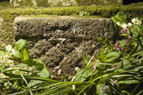
Object type: Fragment of cross-shaft(?)
Measurements: H. 53 cm (21 in); W. 27.5 > 29 cm (10.5 > 11.5 in); D. 30 > 33 cm (12 > 13 in)
Stone type: This piece is similar to the shaft of Padstow 3, with the maximum size of the feldspar phenocrysts 2.5 cm by 0.3 cm. The feldspar phenocrysts form some 50–60% of the rock. The clear quartz is mostly less than 3 mm, but a few phenocrysts are up to 6 mm. There are a few scattered flakes of white mica up to 2 mm across. Bodmin Moor Granite
Plate numbers in printed volume: Ill. 173
Corpus volume reference: Vol 11 p. 180-1
(There may be more views or larger images available for this item. Click on the thumbnail image to view.)
Possibly a fragment from the shaft of a cross, which has been cut to a square block for re-use as building stone. The piece still has mortar adhering.
A (broad): 10 cm wide flat edge-moulding and incised diamonds, possibly the remains of plaitwork
B (narrow): 10 cm wide flat edge-moulding
C (broad) and D (narrow): This face has been trimmed away.
Interpretation of this fragment as part of a cross has been questioned, largely due to the nature of the decoration, which more resembles, for example, the striations cut into granite paving to make it less slippery, than well-executed plaitwork. There is no sign of any attempt to create three-dimensional crossing strands. It also looks rather less worn than Padstow 3. However, the reasons for suggesting that this fragment may indeed be part of a cross-shaft, and possibly part of Padstow 3, are that the edge-moulding is approximately the same width as that on Padstow 3, while the plaitwork on face C of Padstow 3 deteriorates in the lower part of the shaft to a more irregular diamond pattern very similar to the pattern on Padstow 4 (Ill. 171). The geological identification, which is similar to that for the shaft of Padstow 3, supports the possibility that the two may have been parts of the same monument. Against its being part of Padstow 3 is the greater depth of Padstow 4, which would have been even greater before the decoration had been trimmed off; however this could relate to its having come from a position near the bottom of the original shaft.
