Select a site alphabetically from the choices shown in the box below. Alternatively, browse sculptural examples using the Forward/Back buttons.
Chapters for this volume, along with copies of original in-text images, are available here.


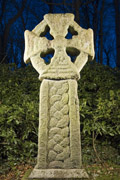
Object type: Cross-shaft and -head
Measurements: H. 83 cm (32.8 in) (head), 101.5 cm (39.6 in) (shaft); W. 83 cm (32.8 in) (head), 49.5 > 43 cm (19.5 > 17 in) (shaft); D. c. 30 cm (11.8 in)
Stone type:
Cross-head: weakly megacrystic granite composed of sparse, small, white feldspar megacrysts up to 14 mm, together with smaller feldspar megacrysts up to 6 mm, and roughly equidimensional, clear and milky quartz phenocrysts up to 12 mm across; a few scattered flakes of white (muscovite) and dark (biotite) mica up to 2 mm across occur. Bodmin Moor Granite. The overall weathering profile of this piece is different to that of the shaft and gives the impression of being older.
Cross-shaft: phenocrystic granite with common white feldspars up to 2 cm by 0.5 cm forming approximately 60% of the rock. Scattered phenocryst up to 15 mm of clear quartz, together with scattered flakes of white mica, occur. Bodmin Moor Granite
Plate numbers in printed volume: Ills. 169-72; Colour Pl. 27; Figs. 18h, 20e, 20h
Corpus volume reference: Vol 11 p. 178-80
(There may be more views or larger images available for this item. Click on the thumbnail image to view.)
The head, and a section of the shaft, of a rectangular-section cross, set on a modern base. The cross-head, type B12, has wide-splayed arms with flat, almost concave, ends and curved arm-pits. The arms are linked by a narrow ring, type a, which is in straight sections, giving the head an octagonal outline. There is a hint that the ring, which is very worn, had a double moulding on it. In the space between the arms and the ring are three cusps, forming trefoil-shaped openings. The shaft has a wide, flat, edge-moulding within which are well-executed interlace, a plant trail and a spiral scroll, all in very low relief. As the decoration is truncated at both top and bottom, this must be a section from the middle of the shaft.
A (broad): On the head, an incised edge-moulding runs all the way around the edge of the arms. At the centre is a small boss surrounded by a concentric moulding. At the end of each cross-arm, except the top (which is worn flat), are two parallel flat bands; in the bottom cross-arm there are also very worn traces of a triquetra knot, but similar ones cannot really be made out in any of the other arms because they are so worn. The ring has a central incised line, dividing it into two bands, which follow the line of the two bands at the end of each cross-arm. Within the prominent flat edge-moulding on the shaft, the decoration is in low relief, and comprises linked Carrick Bends (simple pattern F). These are worked in thick flat bands, with two median-incised lines to give the impression of three strands.
B (narrow): There is no decoration on the head. Within the prominent flat edge-moulding on the shaft is a simple, leafless spiralling plant-scroll.
C (broad): The cross-head is as face A. On the shaft, within the wide flat edge-moulding, are traces of a poorly-executed six-strand plait, which devolves in the lower part of the shaft to a series of criss-cross incised lines forming a diamond-pattern. Near the top of the shaft, the plaitwork is broken; above this is further interlace, too worn to decipher.
D (narrow): There is no decoration on the head. Within the wide, flat edge-moulding on the shaft is a plant trail with a single fleshy leaf in each volute.
In its original state, Padstow 3 must have been a substantial, distinctive and impressive monument: an original height of perhaps 3 m (10 ft) is likely. It is one of the small but dispersed group of crosses in Mid and East Cornwall, characterised primarily by the trefoil-shaped holes between the cross-arms in the head (Chapter IX, p. 92). Other characteristic features of the group include the widely-splayed arms with triquetra knots and continuous double moulding surrounding the head, and the low-relief carving. The wide-splayed arms indicate a late pre-Norman Conquest date.
It has always been assumed that the cross-shaft and cross-head, which were found on separate occasions within the grounds at Prideaux Place, are parts of the same monument: they certainly fit together well, bearing in mind the fact that the shaft has lost sections from both top and bottom. There is also a strong possibility that Padstow 4 (p. 180, Ill. 173) was originally part of the shaft of this cross. Stylistically, they could all have belonged together but the geological identifications of all three stones have a bearing on this. All three are Bodmin Moor Granite and the Padstow 3 cross-shaft and the Padstow 4 fragment are similar enough to be parts of the same monument. However, there is a difference between these and the stone of which the head of Padstow 3 is carved. While the shaft is abundantly megacrystic, the head is weakly megacrystic, with a different weathering profile. This therefore means either that the head was part of an entirely separate monument, or that it was part of the same monument but carved of stone from a different source and socketed onto the shaft. Either is a possibility. Crosses of the Mid and East Cornwall group are sometimes of composite construction (for example Quethiock 1, Pelynt 1); but it is equally possible, given the significance of Padstow, that there was a fourth cross here.
A unique feature of the cross-head is the flat, almost concave, end of the arms which, with the 'straight' ring sections, gives the head a striking octagonal outline. No other crosses in the group are like this, although other Mid and East Cornwall crosses at Cardinham and Lanivet do have straight arm-ends (Ills. 43–6, 114–15). Indeed, the form is difficult to parallel anywhere: the octagonal shape seems almost to be anticipating later medieval developments. The wide, flat, edge-mouldings are also distinctive; the closest parallels for this are Padstow 2 and Lanhydrock 1 (Ills. 164–8, 110–13), whose head-forms are unknown or uncertain.
Like other crosses in this group, and in the area generally, Padstow 3 features both plant-scrolls and interlace or plaitwork on the shaft. The acanthine plant-scroll on face D is particularly like that on the Fourhole Cross (St Neot 3, Ill. 158), and similar scrolls also exist on Lanivet 1 and Minster 1 (Ills. 118, 143). The spiralling scroll is quite like others in the area, for example that on face D of Quethiock 1 (Ill. 210), although the bare stems with no leaves or buds are unusual. The subdivision of the interlacing bands into three strands, seen on face A, is one of the distinguishing features of the Penwith group (Chapter IX, p. 88), although it is not unknown in mid/east Cornwall, where it exists on Lanivet 1 and Quethiock; the latter also has a trefoil-holed cross (Ills. 117, 207).
It is unfortunate that the original context of Padstow 3 is uncertain. It may perhaps have been associated with Padstow's extended sanctuary (Olson 1989, 72). At present, the cross forms a feature in the grounds of Prideaux Place, an Elizabethan mansion on the site of the medieval grange which farmed the Padstow estates of Bodmin Priory, the medieval successor of St Petroc's Monastery (see Henderson, C. 1925, 174). However the status of this site before the Norman Conquest is uncertain. An original association with Prideaux Place is possible but the cross (shaft, head, or both) might easily have been brought here after the Reformation to act as an ornamental feature in the gardens, which were extensive and elaborate (Pett 1998, 175–6).
