Select a site alphabetically from the choices shown in the box below. Alternatively, browse sculptural examples using the Forward/Back buttons.
Chapters for this volume, along with copies of original in-text images, are available here.


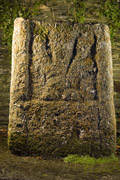
Object type: Lower part of cross-shaft
Measurements: H. 109 cm (43 in) to base; W. 88 > 75 cm (34.6 > 29.6 in) (shaft), 67 cm (26.4 in) (tenon); D. 34 cm (13.5 in); Base: L. 242 cm (95.5 in); W. 154 > 93 cm (61 > 36.6 in); H. 37 cm (14.6 in)
Stone type: Megacrystic granite with white feldspars up to 9 cm x 1.2 cm and clear quartz crystals up to 1 cm x 5 mm occur in roughly equal proportions; a few dark mica flakes are present. Bodmin Moor Granite
Plate numbers in printed volume: Ills. 164-8, 369-74; Figs. 3a, 17h, 20r
Corpus volume reference: Vol 11 p. 177-8
(There may be more views or larger images available for this item. Click on the thumbnail image to view.)
Part of the shaft and the base of a massive rectangular-section cross, which may have been deliberately broken up: Langdon records that there are the marks of three distinct wedges near the fracture (Langdon, Arthur 1896, 408n); though worn, these can still be seen on the top edge of face C. The decoration on the shaft, which comprises interlacing patterns and foliage work, is all in very low relief within wide, flat, prominent edge-mouldings. The shaft is trimmed on the sides only, in order to fit it into the mortice of the plain rectangular slab of granite which forms the base. Padstow 6, which is lost (Appendix C, p. 230), may have been the head of this cross.
A (broad): Executed partly in low relief and partly with incised lines, and arising from a three-lobed base, are three large fleshy leaves.
B (narrow): Above a plain area at the bottom of the shaft is a panel of interlace which Langdon (who had the benefit of seeing the cross soon after it had been dug out of the ground) interpreted as an asymmetrical version of closed circuit pattern D (Langdon, Arthur 1896, 410). This interpretation is probably correct.
C (broad): Above an unworked area at the bottom of the shaft is a panel of eight-strand interlace. Langdon identifies this as a complicated and unusual design with only limited parallels (Langdon, Arthur 1896, 409–10). Although the interlace is worn and on a face which is difficult to examine, it appears that Langdon's interpretation of the pattern is correct (turned pattern D with added diagonals and outside strands; Ill. 374).
D (narrow): Above a plain area at the bottom of the shaft is a simple ring-twist, with glides between the rings, rendered in shallow but gently rounded strands.
The size of the surviving section of shaft suggests that this cross might have been up to 4 metres (13 ft) high, and therefore comparable with other tall crosses at St Teath and Quethiock (pp. 196, 200, and see Fig. 17, p. 58). Its overall proportions and layout bear a close similarity to the cross at nearby Prideaux Place (Padstow 3), which has a trefoil-holed cross-head (Ills. 169–72). It is therefore a possibility (but by no means certain) that Padstow 2 also once supported a cusped head. Padstow 6, which is still buried in the churchyard (recorded in Appendix C, p. 230), might be the head of this cross.
As it displays both interlace and foliage decoration, this cross is considered a member of the Mid and East Cornwall sculpture group (Chapter IX, p. 91) but, with decoration which is more ambitious and well executed than that of others in the group, it appears innovative and may be an early example. The foliage design on face A is unparalleled in Cornwall (see Fig. 20r, p. 75). Although Langdon thought that it was a type of fleur-de-lys (Langdon, Arthur 1896, 410), it seems more likely to be an acanthine plant, whose large fleshy leaves sprouting from a three-element rootstock are similar to those seen on crosses at Colyton in Devon and Todber in Dorset (Cramp 2006, 52–3, fig. 22, i and l), and in more refined form on Cambridge, Corpus Christi MS 183 (Cramp 2006, ills. 530–4). The crude and fleshy acanthus seen in Breton manuscripts like the Landévennec Gospels should also be compared since Breton influence in a place like Padstow seems more than likely (see for example Morey 1929, pls. I and III). Langdon's analysis of the complex eight-cord pattern on face C also suggested manuscript parallels, including BL, Harley 2788 and BL, Cotton Vespasian A1; in sculpture he found parallels in Yorkshire and Scotland (Langdon, Arthur 1896, 410). For complexity, this panel is only matched in Cornwall by the patterns seen on St Neot 1 (Ills. 151–3), although their sculptural styles are very different. Combined, these parallels suggest that the cross was created by a highly skilled sculptor, who may have had access to manuscript models for his designs.
Although a Viking raid of ad 981 may have precipitated the monastery's move to Bodmin, it is clear, as Olson has suggested (Olson 1989, 72), that Padstow continued to enjoy some of its former significance even after the move had taken place, whenever that was. Petroc's relics were still there at the beginning of the eleventh century (Orme 2010, 134) and there is no evidence for St Petroc's relics having been moved to Bodmin until the twelfth century, so the shrine may have remained at Padstow for some time (Padel 2009, 6–7). Domesday Book clearly indicates that Bodmin was St Petroc's primary holding by 1066 but Padstow was listed second amongst the Saint's lands, so clearly remained important and was a significant holding of St Petroc's monastery up until the Reformation (Padel 2009, 7; Henderson, C. 1957–60a, 372).
Taking into account the other monuments at Padstow (Padstow 1, 3 and 4, 5, 6) it seems likely that there was an innovative sculpture workshop at Padstow, and the dating of the four monuments (or more, if 4 and 6 are not separate parts of 3 and 2) suggests that this workshop was active both before and after the Viking raid: clearly this was another of the institution's functions that did not immediately transfer to Bodmin. Given the status of St Petroc's monastery in Cornwall, it is also likely that the proposed workshop would have been influential and it can perhaps be seen as the source of the Mid and East Cornwall group and in particular the distinctive and uniquely Cornish trefoil cross-head (Chapter IX, p. 92).
The acanthine decoration provides a terminus post quem, since this originated during the tenth century. However the example on Padstow 2 is crude compared to that on St Neot 3 (Ill. 157). The well-executed and complex interlace designs may indicate that this monument is the earliest of the three Padstow monuments: its decorative scheme appears experimental compared to Padstow 3, which is a more typical member of the Mid and East Cornwall group. A precise date is uncertain but the stone could have been carved before the late tenth-century Viking raid.
