Select a site alphabetically from the choices shown in the box below. Alternatively, browse sculptural examples using the Forward/Back buttons.
Chapters for this volume, along with copies of original in-text images, are available here.


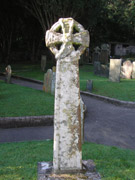
Object type: Cross-head
Measurements: H. 50 cm (19.8 in); W. 52 cm (20.5 in) (head), 29 cm (11.5 in) (neck); D. 14 > 11 cm (5.5 > 4.3 in)
Stone type: Heavily lichen encrusted with no clear section. The sub-angular to sub-rounded, clear, quartz grains are mostly in the range 0.3 to 1.0 mm; the scattered pebbles of quartz up to 8 mm across are probably original phenocrysts. A few scattered flakes of white mica (muscovite) are present. Greisen
Plate numbers in printed volume: Ills. 159-63; Fig. 18i
Corpus volume reference: Vol 11 p. 176
(There may be more views or larger images available for this item. Click on the thumbnail image to view.)
The head, and a small part of the shaft, of a rectangular-section cross. The cross-head is type E6, with the bottom cross-arm the widest, to fit to the width of the shaft. The arms are linked by a ring, type a. In the space between each of the arms and the ring are three cusps, forming trefoil-shaped openings. All of the carving is in very low relief.
A (broad, facing north): Each of the cross-arms has an incised edge-moulding and there is a moulding around the low-relief central boss. On the outer edge of the arms are two parallel bands. These match the double moulding of the ring and form a continuous moulding around the perimeter of the cross-head. Within the cross-arms, between the boss and the edge-mouldings, are traces of decoration, possibly triquetra knots although the stone is too worn to be sure. The shaft has an incised edge-moulding, but otherwise appears to be undecorated.
B (narrow): No trace of any decoration other than an incised edge-moulding which is clearest on the lower section of the ring.
C (broad): As face A, except that there is a small hole at the centre of the boss and no clear trace of any knotwork in the arms.
D (narrow): Around the end of the cross-arm is an incised edge-moulding, with faint traces of knotwork inside.
One of the small but dispersed group of crosses in Mid and East Cornwall with trefoil openings in the head (Chapter IX, p. 92). Other characteristic features of the group include the continuous double moulding encircling the head and triquetra knots in the cross-arms, which are not clearly displayed here, but probably existed. It is the smallest cross in the group. This is one of two crosses at Padstow with trefoil openings in the head, the other being at Prideaux Place (Padstow 3, Ills. 169–72).
The context of this cross is discussed below, under Padstow 2. As there is insufficient decoration on this cross to allow it to be dated in its own right, it is dated by analogy with other monuments in the same group.
