Select a site alphabetically from the choices shown in the box below. Alternatively, browse sculptural examples using the Forward/Back buttons.
Chapters for this volume, along with copies of original in-text images, are available here.


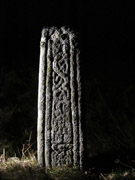
Object type: Cross-shaft
Measurements: H. 204 cm (81.6 in); W. 66 > 46 cm (26.4 > 18.4 in); D. 27 > 23.5 cm (10.8 > 9.3 in); Base: c. 140 cm (55.2 in) square
Stone type: Coarse-grained, poorly megacrystic, granite. Scattered feldspar megacrysts up to 3.5 x 0.6 cm occur, but most are no bigger than 1 x 0.4cm. Roughly equidimensional clear quartz grains are up to 5 mm across. The quartz and feldspars are approximately in equal proportions; there are a few flakes of dark mica. Bodmin Moor Granite
Plate numbers in printed volume: Ills. 140-4; Colour Pls. 11-12; Fig. 20g
Corpus volume reference: Vol 11 p. 168-9
(There may be more views or larger images available for this item. Click on the thumbnail image to view.)
The shaft only of a tapering, rectangular-section cross. It is slightly broken at the top, perhaps when the cross-head was knocked off. In the top of the shaft are the remains of the rectangular socket (9 x 13 cm and 10 cm deep) into which the cross-head would have been morticed. The shaft has a double flat-band moulding which frames the decoration on the front and back, and a single moulding down the sides. The decoration, in very low relief, is carved in long panels, which are not formally separated in any way. Langdon (1896, 376) illustrates a tenon at the base of the shaft, formed by cutting in the sides of the shaft, but merely tapering gently in the front and back. However this tenon is not now visible as the shaft is set in a base, probably its original one.
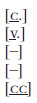
A (broad): In the upper half of the shaft, a broad band undulates from side to side down the shaft, with triquetra knots filling the volutes. Most of the strands between the knots cross beneath the main band, rather than regularly under and over. The panel below this contains the eroded remains of an inscribed text. The text is incised in five horizontal lines in a panel measuring 59 cm high by 29 cm. The letters measure between 5 and 8 cm in height but are now so deteriorated that it is not certain what script was used nor if the text was complete.
The text reads:
In the lower part of the shaft is a panel of interlace formed by a broad flat band with a median-incised line. The pattern is too worn to decipher.
B (narrow): The whole panel is filled with a simple plant trail, with a single large leaf in each spandril.
C (broad): This face is extremely worn. In the upper two thirds of the shaft is a panel of interlace, with small low bosses separating the registers of the pattern; the pattern may be Carrick Bends (simple pattern F). Below this are two large, diagonally crossed rings.
D (narrow): The upper panel contains a simple twist in the upper panel with a simple spiral plant-scroll below.
Although this cross has some unique details, most of its features are typical of the Mid and East Cornwall group of early sculpture (Chapter IX, p. 91). These include the tapering shaft, the low-relief carving, and decoration which is a mixture of plant scrolls and trails and poorly constructed interlace. Features which are unique to this cross include the motif in the top panel on the front (Ill. 140), which is similar to the serpentine animal seen in the West Penwith group (p. 89), but as Langdon says: 'in the present instance there does not appear to have been a dragon's head' (Langdon, Arthur 1896, 375–6).
As noted in the introduction (p. 92), this cross is closely linked to others in the area, especially the two important crosses of Cardinham 1 and St Neot 3 (Ills. 43–6, 155–8). Its tapering form and overall proportions are very similar to both these monuments and with a spiral scroll (as on Cardinham 1) on one side and an acanthine scroll (as on St Neot 3) on the other, it combines elements from each. It has a stronger resemblance to Cardinham, which also has undivided panelled decoration.
The text on the Minster cross reads: [C.V.–CC] but this is now too deteriorated to be interpreted (Ill. 144). The text has always been in poor condition and various different readings have been suggested (see Okasha 1993, 320). Most of these agree on the reading of the first word as crux 'cross', which fits the traces remaining today. This might have been followed by a personal name.
None of the decoration on the cross-shaft can be closely dated; the suggested dating therefore reflects the range for the group as a whole.This cross lies on a ridge-top, strategically located beside a modern road and historic trackway over an area of former downland around the head of the River Camel and at the northern end of the Great Cart-Track over Bodmin Moor, discussed in relation to the Doniert Stone (St Cleer 2, p. 135). Tucked into a valley head 2.4 km (1.5 miles) due north of the monument is Minster church, potentially the site of a pre-Norman monastery (Thomas, A. C. 1993, 109–10; Turner 2006a, 36, 38, 161), while 2.9 km (1.8 miles) to the north-east is Lesnewth whose name, lys nowydh 'new court', implies the court of a native Cornish ruler (Padel 1985, 150; Padel 1988, 109). The cross might originally have been associated with either of these.
