Select a site alphabetically from the choices shown in the box below. Alternatively, browse sculptural examples using the Forward/Back buttons.
Chapters for this volume, along with copies of original in-text images, are available here.


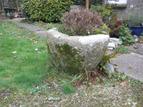
Object type: Alleged font bowl
Measurements:
H. 46 cm (18 in)
Diam. of top of bowl (external) 70 cm (27.5 in)
Diam. of bottom of bowl (external) 30 cm (12 in)
Depth 40.5 cm (16 in) (Henderson, C. 1957–60a, 317)
Diam. of hole 6.25 cm (2.5 in) (Henderson, C. 1957–60a, 317)
Stone type: Carnmenellis Granite (A.P.J.)
Plate numbers in printed volume: Ills. 267-8
Corpus volume reference: Vol 11 p. 218-9
(There may be more views or larger images available for this item. Click on the thumbnail image to view.)
Plain wine-glass-shaped stone bowl, roughly circular, with a slightly irregular profile and a flat rim. As the bowl is in use as a flower-pot, the interior is not available for examination. Henderson, however, noted that 'At the bottom — though not in the centre — is a rude drain-hole 2 ?? wide' (Henderson, C. 1957–60a, 317).
Appendix A item (stones of uncertain date)
It is unfortunate that the interior of the bowl is not available for examination. It is larger than most other alleged fonts described in Appendix A, its diameter at the top and thickness of sides most closely matching those of the Norman font at Morwenstow (Sedding, E. 1909, 295). Its slightly oval shape also resembles that of Morwenstow. If it is a font, as seems possible from the comparison with Morwenstow, its date is likely to be early, though whether pre- or post-Norman Conquest must remain uncertain.
The name Helland is from Cornish *hen-lann, meaning 'ancient church site' or 'old cemetery'; lann implies a Christian site of early medieval origin (Padel 1984, 130; Padel 1988, 96). A small oval enclosure raised above the level of surrounding roads still survives here, forming the front garden to Helland House and formerly known as the 'Graveyard' (Henderson, C. ?1932, 2, 30). There are no medieval records of a chapel or ecclesiastical site at Helland, although Henderson notes that graves, roofing slates, a celtic (more probably medieval) cross as well as the font have been dug up on the site. If a chapel survived here into medieval times, its rights of burial and baptism must have been inherited from its early medieval precursor. On the edge of the parish of Mabe, itself a chapelry to Mylor, Helland may perhaps have acted as a semi-parochial unit.
