Select a site alphabetically from the choices shown in the box below. Alternatively, browse sculptural examples using the Forward/Back buttons.
Chapters for this volume, along with copies of original in-text images, are available here.


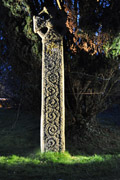
Object type: Cross-shaft and -head
Measurements: H. 320 cm (128 in); W. 71 cm (28.4 in) (head), 47 > 42 cm (18.8 > 16.8 in) (shaft); D. c. 18 cm (7.2 in) (head), 40 > 23 cm (16 > 9.2 in) (shaft)
Stone type: Coarse-grained, megacrystic, granite. Quartz and feldspar occur in roughly equal proportions. The white feldspar megacrysts reach a maximum size of 6 cm x 1.2 cm, but the dominantly yellowish grey (5Y 7/2) megacrysts are in the range 2.5 x 5 mm. The quartz crystals are up to 5 mm across. Intergrown tourmaline forms about 5% of the rock; there is some brown mica (biotite) up to 2 mm across, and a few flakes of scattered white mica (muscovite). St Austell Granite
Plate numbers in printed volume: Ills. 114-8, 362-5; Colour Pls. 6-7; Figs. 17f, 18g, 20d, 20k
Corpus volume reference: Vol 11 p. 159-61
(There may be more views or larger images available for this item. Click on the thumbnail image to view.)
Complete cross with rectangular-section shaft. The cross-head, of type B6, has widely splayed cross-arms with straight ends and a slightly recessed ring, type a. The cross-head has been broken off and cemented on again at a slight angle. The shaft has a slight entasis and is shaped, in Langdon's words, 'somewhat resembling a buttress' (Langdon, Arthur 1896, 384). The base is now beneath ground level but is apparently a rough piece of granite with the shaft 'not placed centrally in it' (Langdon, Arthur 1896, 384). The decoration on the shaft, framed by a flat wide incised edge-moulding, is in low relief.
A (broad): The cross-head has an incised edge-moulding right round the arms. Within each arm is a triquetra knot and at the centre is a boss surrounded by a flat moulding. On the shaft is a simple, almost spiralling, plant-scroll, with small drop-leaves filling the space between the edge-moulding and plant stem.
B (narrow): The cross-head is plain. On the shaft is a simple plait.
C (broad): In so far as this side can be examined, due to the tree, the cross-head seems to be as on face A except that the side cross-arms are slightly damaged and the triquetra knots are only visible in the lower and the left cross-arms. On the shaft is a continuous panel of interlacing simple pattern F knots, executed in broad, flat, median-incised bands (Ill. 364).
D (narrow): The cross-head is plain. On the shaft is a plant trail, with fleshy leaves in the volutes in the narrower upper part of the shaft, and a simple scroll in the lower volutes. Small drop-leaves fill the spaces between the edge-moulding and plant stem in the lower part of the shaft.
A member of the Mid and East Cornwall group of foliage-decorated crosses (Chapter IX, p. 91), which particularly resembles Lanhydrock 1 (Ills. 110–13), in an adjoining parish, just under 5 km away.
The similarities between the two are very striking, and encompass the overall size, the layout and type of decoration, with nearly identical decoration on the same sides. The shape of the cross-head, in particular the flat arm-ends of Lanivet 1, is the most noticeable difference. A slight difference of cross-section can probably be attributed to the shape of the piece of granite that was available. Lanivet 1 can also be compared with Padstow 3 (Ills. 169–72), which has cross-arms with flat ends (although on a trefoil-holed head), and a decorative scheme which includes plant trails on two sides of the shaft and plait or interlace on the others. None of the ornament on Lanivet 1 enables a close dating, although the wide-splayed arms suggest a date in the later part of the pre-Conquest period. Because of this, and by analogy with other members of the group, a date in the eleventh century is suggested.
Lanivet is one of the few church-sites in Cornwall with an abundance of early sculpture. It has, in fact, the stonework remains that might rather have been expected at nearby Bodmin, site of St Petroc's Monastery from the eleventh century, but where no early sculpture survives (see Chapter IV, p. 32). With two early inscribed memorial stones as well as the three pieces described in this volume, Lanivet's collection is outstanding. However the reasons for this wealth are not readily apparent.
Lanivet has a name in lann, which with the presence of the inscribed stones indicates a site of early medieval origin. At Lanivet, *lann is combined not with a saint's name but with the element *neved, a 'pagan sacred place', which Padel suggests is here used as a place-name, so meaning 'the lann at the place called Neved' (Padel 1985, 142–5, 172; Padel 1988, 106). No saint is known to have been associated with the site. The valley bottom churchyard, which may reflect the site's original status (Preston-Jones 1994, 72–3, 86–7) is large and curvilinear, but its later history gives no indication of any particular significance or importance (see for example Henderson, C. 1925, 104–5; Henderson, C. 1957–60b, 286–91). So if Lanivet was once an important site, this has escaped record and we have only the inscribed stones and the sculpture (and possibly the larger-than-average churchyard enclosure) to bear witness.
Alternatively it may be that pure chance of survival has led to the unusually rich collection of stones at this typical parish church. The work of a diligent and antiquarian-minded vicar at the time of the church restoration in the nineteenth century could account for these remains, but none such is known and there is no evidence that the stones were dug out of the church walls at that time: on the contrary, such records that we have suggest that this and Lanivet 2, at least, have always been standing in their current locations. A small further possibility is suggested by a note of Henderson's. He records that 'In the chancel is a Norman capital from Bodmin Priory and a document exists to show that in 1539 the parishioners purchased four of the bells of that dissolved monastery for ?36' (Henderson, C. 1925, 129–30). Could it be that a few other relics were acquired at the same time?
