Select a site alphabetically from the choices shown in the box below. Alternatively, browse sculptural examples using the Forward/Back buttons.
Chapters for this volume, along with copies of original in-text images, are available here.


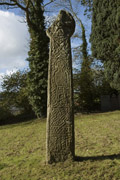
Object type: Cross-shaft and part of -head
Measurements: H. 292 cm (116.8 in); W. 56.5 cm (22.6 in) (head), 50 > 38 cm (20 > 15.2 in) (shaft); D. 20 cm (8 in) (head), 33 > 22 cm (13.2 > 8.8 in) (shaft)
Stone type: Large, abundantly megacrystic granite. The white feldspar megacrysts reach a maximum size of 8 cm x 2 cm, but most are smaller in the range 3.0 x 1 cm. The quartz crystals are up to 5 mm across. The feldspars form about 60% of the rock, and the quartz about 40%. There are a few flakes of scattered white mica (muscovite). St Austell Granite
Plate numbers in printed volume: Ills. 119-23; Fig. 18o
Corpus volume reference: Vol 11 p. 161-3
(There may be more views or larger images available for this item. Click on the thumbnail image to view.)
Cross with round (wheel) head and tapering rectangular-section shaft, set in a base (now buried). The cross-head, which is broken at one side, is slightly elliptical. Within an incised edge-moulding on all angles of the cross, all the decoration is incised.
A (broad): On the head is a cross type E6, formed by sinking triangular spaces between the cross-arms. The lower arm is more expanded at the end than the other three and overlaps the ring, which is more an edge-moulding than a ring; the other three arms merge with the ring. At the centre of the head is a boss with moulding around it. On the shaft are five panels of decoration, separated from each other by single incised lines. The top panel contains what appears to be a bungled attempt at two interlaced diagonal rings, outlined by further, roughly parallel, incised lines. The panel beneath this is large and contains a human figure in outline. The figure has a rounded body, with short little stick-like arms hanging down his side and thin legs with both feet turned to the right. Parallel lines incised around the head might represent a halo or might just be space-fillers as are, presumably, the incised dots below the right arm and the horizontal lines, small boss and diagonal cross between the legs. There are hints of two incised eyes, but otherwise there is no detail visible on the body. Hanging from the figure's left arm is a stick-like object terminating in three cross-bars with a ring in the centre. Langdon mentions 'some peculiar markings like letters' on the body, but these are not at all clear now (Langdon, Arthur 1896, 296). The third panel down contains a key pattern based on a square divided by diagonal lines into four triangles, but otherwise debased and irregular. The fourth panel is small and is filled with three lines of regularly incised dots, perhaps representing a very worn plait. The fifth panel is divided into two by incised lines. The left side and part of the right side contain rows of incised dots and there is a small incised cross (?) at the extreme right of the panel.
B (narrow): The head is very worn and uneven and may never have been decorated. The shaft has incised moulding down each side enclosing six panels of decoration. The top panel contains a small equal-armed incised cross. This is set near the top of the panel and is surrounded by incised dots. The second panel contains an incised diagonal cross, and the third panel is filled with incised dots. The fourth panel down contains two concentric incised rings with a dot in the centre. The fifth and sixth panels are too worn for the decoration to be made out, although the fifth panel might have had some interlace. The sixth panel has a large hole towards the bottom, of uncertain origin.
C (broad): The head contains an equal-armed cross, the arms of type E8, linked by a ring, type b. The spaces between the cross-arms are sunk. The cross-arms all appear to open into the ring. In the centre of the head is a boss surrounded by a bead. The shaft has incised moulding down each side enclosing six panels of decoration. The top panel contains two rows of incised dots with a plain band beneath. The second panel, which is very worn, contains two large oval rings forming a diagonal cross (Langdon, Arthur 1896, 296–7 and fig.). The third panel possibly contains an incised diagonal cross. Langdon describes the fourth panel down as containing 'remains of a debased diagonal key-pattern' similar to that in the third panel of face A (Langdon, Arthur 1896, 297). However this pattern is no longer visible. The fifth panel contains three rows of incised dots. In the sixth panel a second incised line creates a frame containing an outline round-headed cross with a small incised Latin cross within the head. The lower space within this panel, but beneath its interior panel, is now very worn.
D (narrow): The head is broken and worn. On the shaft are six panels of decoration. The top panel contains rows of incised dots and the second panel contains an incised diagonal cross. The third and the fifth panels are plain. The fourth panel contains an incised Latin cross and the sixth panel is entirely filled with irregularly arranged incised dots.
This cross contains an interesting mixture of decoration, with attempts at fret- and knot-work, alongside panels of dots (at least one panel of which may represent very eroded plaitwork) and other more eccentric incised patterns. If the varying proportions of each are weighed up, the more bizarre elements of the decoration outweigh the mainstream, while the 'mainstream' elements are found to be poorly executed. For example, although the panel of fretwork looks convincing, close inspection shows it to be irregular. Other than this, only the two interlocking ovals at the top of the two main faces, and the panel of dots (possible plaitwork) on face A, could also be regarded as potentially early medieval. The panelling of the decoration could be compared with the layout of St Neot 1 (Ills. 151–4): however none of the remaining panels contains patterns which could confidently be ascribed to the early medieval period. The rows of dots and incised St Andrew's crosses are characteristics seen on monuments like Kenwyn 1 and Penzance 1 (Ills. 103–9, 185–8), for both of which a later date has been suggested. Other features like the large incised figure cannot be confidently used to help dating. However the well-cut disc head with central boss can be compared to that on Lanteglos by Camelford 2 (Ills. 136–7), which (assuming it originally fitted on Lanteglos 1) is dated by inscription to the late eleventh or twelfth century. In Cornwall such heads are also most familiarly associated with the 'continuing tradition' of medieval wayside crosses.
The disc-headed pillar crosses of north Wales also have a superficial similarity, in featuring disc heads, panelled decoration, and use of key patterns, but these are better executed, in relief, not incised, and have more 'mainstream' elements despite rather outlandish appearances (Edwards 1999).
In summary, although it contains some early medieval elements, this cross appears to represent a development which cannot be precisely dated, but could have occurred on either side of the Norman Conquest (Chapter IX, p. 96). Nonetheless it remains an interesting and impressive monument. Its context in the parish churchyard at Lanivet is discussed above, under Lanivet 1 (p. 160).
The relationships seen in the decoration on the cross are varied. On Lanivet 2, the panelling may have been copied from monuments like St Neot 1. The rows of dots may perhaps be an attempt to represent interlace like that on St Cleer 3 or face D of St Neot 1 (Ills. 56, 154). However the fact that the dots on face D are very irregular may tell against this, and they are also found around the figure on face A, suggesting that their purpose was more to provide texture and fill spaces. The large crossed diagonal ovals could perhaps be compared to the rather better executed examples on the Doniert Stone (St Cleer 2, Ill. 52), which like St Neot 1 is a member of the Panelled Interlace group (p. 85). Fretwork, however, is found closer by, on Lanivet 3 (Ills. 124–30).
The incised figure (Ill. 119) could be compared with the much smaller examples on Penzance 1 (Ills. 189, 190), which is also an incised cross. However simple figures can be found in Wales also, for example in Breconshire at Llandyfaelog Fach, Llanfrynach and Llanhamlach (Redknap and Lewis 2007, 185–90, 200–2, 210–13), on monuments which are all unusual, but contain more 'mainstream' early medieval elements than Lanivet 2. On the figure's left-hand side is a feature considered by Langdon to represent a tail (Langdon, Arthur 1896, 296) and thought by the Dexters to have pagan symbolism (Dexter and Dexter 1938, 18, 39–44). This interpretation of the feature as a tail was questioned by Ellis (Ellis, G. 1956–8a, 2), and here it is considered that the figure possibly represents St Peter, holding a key in his left hand (Nancy Edwards, pers. comm.). Under this interpretation, the line around the head could perhaps be seen as a halo.
