Select a site alphabetically from the choices shown in the box below. Alternatively, browse sculptural examples using the Forward/Back buttons.
Chapters for this volume, along with copies of original in-text images, are available here.


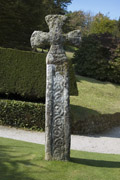
Object type: Cross-shaft and -head
Measurements: H. 238 cm (95.2 in) (total): 77 cm (30.8 in) (head to break), 159 cm (63.6 in) (shaft to break); W. 84 cm (33.6 in) (head), 40 > 34.5 cm (16 > 13.8 in) (shaft); D. 28.5 > 25.5 cm (11.4 > 10.2 in)
Stone type:
Top piece: the feldspar and quartz crystals, which occur in roughly equal proportions, are less than 1 cm across. Bodmin Moor Granite.
Bottom piece: similar to the above, but it does have sparse feldspar megacrysts up to 1.5 cm across. Bodmin Moor Granite
Plate numbers in printed volume: Ills. 110-13, Colour Pl. 15; Fig. 20f
Corpus volume reference: Vol 11 p. 158-159
(There may be more views or larger images available for this item. Click on the thumbnail image to view.)
Cross, with broken and mutilated head now re-joined to a rectangular-section shaft, of which a small section may be missing from the top. The cross-head, which has widely-splayed arms, is very worn and has had its ring cut off. Langdon observed 'some remains of the ring ... still attached' (Langdon, Arthur 1896, 382), but these are not now visible. The shaft has a slight entasis and is characterised by a disproportionately wide and prominent flat-band moulding down the sides. Within this, the carving is in very low relief and is very worn, particularly at the top.
A (broad): The only decoration remaining on the worn and mutilated head is a large and prominent central boss with a small hole at its centre. This is clearly surrounded by a single flat moulding, and there are traces of a double edge-moulding in the lower arm. On the shaft is a simple plant-scroll, with small drop-leaves filling the space between the prominent edge-moulding and the plant stem.
B (narrow): No decoration can be seen on the ends of the arms. Within the broad edge-moulding on the shaft are traces of a plant trail, but this is too worn for the detail to be made out.
C (broad): The cross-head is as on face A except that the boss has no hole and only traces remain of a double moulding at the ends of the arms, with hints of a triquetra in the lower arm. Langdon depicts a double moulding around the boss (Langdon, Arthur 1896, 382), but this is no longer clear. On the shaft is a continuous panel of interlacing figure-of-eight knots (simple pattern F), executed in broad flat bands.
D (narrow): No decoration can be seen on the ends of the arms. The badly-worn decoration on the shaft may be the remains of a simple plait.
A member of the Mid and East Cornwall group of crosses (Chapter IX, p. 91). It particularly resembles Lanivet 1 (Ills. 114–18), in an adjoining parish, about 5 km away. It is therefore probable that like Lanivet 1, the cross-head at Lanhydrock had a plain ring, even though some others in the group (for example Quethiock 1 and Padstow 3) have cusped rings with trefoil holes (Ills. 206–11, 169–72). The decoration on the cross is not diagnostic of date, but by analogy with others in the group, an eleventh-century date is proposed.
The ring has been so neatly cut off that it looks like a deliberate act designed to make the monument look more 'cross-like'. Given the intimate association of the cross with the Lanhydrock estate, its re-modelling is likely to have been linked to this. Unattributed information in the church suggests that the cross may have been restored in the early nineteenth century by Anna Maria Hunt (1771–1861), and this could well have been the context both for the re-modelling of the head and for the restoration referred to by Langdon, possibly also for moving it from the churchyard entrance to its present location to the south of the church.
Today it is difficult to divorce the Lanhydrock cross from its setting, adjoining a mansion now in the ownership of the National Trust. Yet Lanhydrock was originally no more than the chapelry and the 'whole parish constituted one of the oldest possessions of the Monastery of St. Petroc at Bodmin' (Henderson, C. 1925, 129). The name, which contains the element lann and a saint's name, Hydrek (Padel 1988, 106) indicates a site of early medieval origin.
