Select a site alphabetically from the choices shown in the box below. Alternatively, browse sculptural examples using the Forward/Back buttons.
Chapters for this volume, along with copies of original in-text images, are available here.


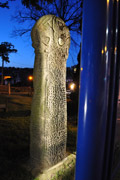
Object type: Cross-shaft and -head
Measurements: H. 231 cm (91 in); W. 81 cm (32 in) (head), 51 < 81 cm (20 < 32 in) (shaft);D. 13 cm (5 in) (head) < 44 (17.5 in) (shaft)
Stone type: Medium- to coarse-grained, equigranular, granitic rock composed of white feldspars less than 1 cm across and abundant grey quartz crystals, together with a few scattered flakes of mica and common tourmaline patches up to 1 cm across. Quartz porphyry or elvan
Plate numbers in printed volume: Ills. 103-9
Corpus volume reference: Vol 11 p. 157-8
(There may be more views or larger images available for this item. Click on the thumbnail image to view.)
Complete cross with head, shaft of rectangular section and a projecting roll-moulding at the junction between head and shaft. The head is oval, its width being slightly larger than its height. The bottom of the shaft is not visible where it is set into a modern base. An incised edge-moulding runs around the edge of the shaft on all four faces, and of the head on both front and back faces. All four faces of the shaft are divided by incised lines into rectangular panels which are alternately plain and decorated.
A (broad): Within the incised edge-moulding on the head is a cross formed by sinking three triangular areas with curved sides. Slightly below the centre of the head is a circular boss surrounded by an incised line. The top triangular area is set immediately above the boss, with the other two being placed equidistantly, one on each side of the boss and slightly lower than it. Two tau crosses are incised, one on each side of the top triangular area. The projecting roll-moulding contains a small hole at each side. Beneath the boss is an incised triangle, the base of which forms the top line of the uppermost panel on the shaft, the side lines being formed by the incised edge-moulding. This top panel is plain and undivided. Beneath it are four panels formed similarly but each being divided into pairs by an incised line running down the middle of the cross. The first and third pairs of panels are fully filled with incised dot decoration while the panels of the second pair are both plain. The fourth pair of panels is partly obscured by the base. The left panel now appears to contain an inverted triangle; the right panel has two diagonal lines terminating on an inverted semi-circle, possibly the upper part of a circle. Langdon assumes that these panels, when complete, were similar to two of the panels on face C (see below).
B (narrow): There is no decoration or incised edge-moulding on the head: the incised edge-moulding starts immediately below the roll-moulding, on the shaft. This side is divided into seven panels formed as on face A. The first, third and seventh panels are fully filled with incised dot decoration, while the second, fourth and sixth panels are plain.
C (broad): The head is similar to that on face A except that there is no boss within the incised circle. The triangular areas are set rather higher on this face and the shafts of the tau crosses are longer. Between the head and the shaft is a small incised v-shape with a hole between the arms, but Langdon suggests that the hole, and one lower down, represent later damage (Langdon, Arthur 1896, 306). The shaft on this face contains seven pairs of panels, the uppermost being larger than the rest and the lowest being almost completely concealed in the base. The first pair, the third pair, probably the seventh pair, and the left panel of the fifth pair are all plain. The second pair, the fourth pair and the right panel of the sixth pair are fully filled with incised dot decoration. The left panel of the sixth pair contains an incised diagonal cross. The right panel of the fifth pair has an incised circle with four lines radiating from the circle to the corners of the panel. These last two panels are those referred to above under face A.
D (narrow): As B except the shaft contains eight panels. The first, third, fifth and eighth are plain, while the second, fourth and sixth are fully filled with incised dot decoration. The seventh panel contains a diagonal cross, but it is not now clear whether the diagonals met in a circle, as on face C, panel five, or went from corner to corner as on face C, panel six.
The Kenwyn cross now at Eastbourne is so similar in its proportions, shape and decorative features to the Penzance cross (Ills. 185–8) that the two must be very closely related; they may even be by the same sculptor, despite the fact that they were located some distance apart. Compared to Penzance 1, however, the range of decoration on the Kenwyn cross is more restricted; there are, for example, no figures and no inscriptions. Moreover, the appearance of Kenwyn 1 is more bizarre, mainly because of the way in which the cross on the head is depicted, as a variant St Andrew's cross (Ill. 108). It also has a similarity to Perranzabuloe 1, located only 12 kilometres (7.5 miles) from the likely original location of the Kenwyn cross. However, as Perranzabuloe is rather simpler (Ills. 193–6), it may be of slightly later date.
As with Penzance 1, there are no definitive dating features, so the indicative criteria discussed for Penzance (p. 187) apply here, and a similar date range is suggested. As an incised and dot-decorated monument, it is most likely to be transitional, or an early post-Conquest example of the continuing tradition of monumental crosses in Cornwall (Chapter IX, p. 95).
The original location of the cross is not known precisely, but the Cornwall Historic Environment Record places it at approximately SW 778 451. Here it is likely to have stood by a ridge-top trackway, but given the uncertainty of the location it is not possible to say more.
