Select a site alphabetically from the choices shown in the box below. Alternatively, browse sculptural examples using the Forward/Back buttons.
Chapters for this volume, along with copies of original in-text images, are available here.


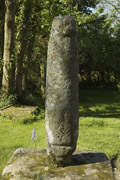
Object type: Pillar-stone
Measurements: H. 172 cm (68 in); W. 40 > 35 cm (15.7 > 14 in); D. 42 > 22 cm (16.5 > 8.7 in)
Stone type: Coarse-grained, abundantly megacrystic granite. Small feldspar megacrysts up to 6 mm across (exceptionally up to 25 mm) form about 40% of the rock. Quartz phenocrysts up to 6 mm occur, but most are in the range 2–4 mm — they form about 60% of the rock. A few scattered flakes of brown mica occur. Carnmenellis Granite. While Kea 1 and Kea 2 are both Carnmenellis Granite, they are not identical, differing in the relative percentages of quartz/feldspar and in the overall size of the feldspars.
Plate numbers in printed volume: Ills. 257-9
Corpus volume reference: Vol 11 p. 216
(There may be more views or larger images available for this item. Click on the thumbnail image to view.)
Cylindrical shaft, with entasis. Towards the bottom, it becomes more rectangular in section and has a tenon at the bottom, fastening it into a square base. Near the top, the shaft widens slightly on the east and west sides to give the appearance of a simple capital. On the south-west is a wide smooth hollow on the stone, possibly a natural feature of the rock. In the top of the stone is a shallow mortice, 10 x 16 cm (3.9 x 6.3 in). The stone is dressed to shape, but undecorated except for an incised line at the bottom on one side only, forming a band 14 cm (5.5 in) wide. As the tenon does not fit properly into the mortice in the base, it is assumed that the two do not belong together.
Appendix A item (stones of uncertain date)
The cylindrical shaft and decoration are simple but well cut. The fact that the incised horizontal lines only extend around three-quarters of the shaft may indicate that it was meant to stand against a wall. Langdon considered this stone to be an undecorated cross-shaft (Langdon, Arthur 1896, 225), although amongst the hundreds of medieval crosses in Cornwall there is nothing else like it. Nor does it resemble an architectural fragment of medieval date; a later origin is unlikely since it was discovered when digging on the site in the early nineteenth century. Alternative suggestions for this enigmatic stone include a converted standing stone (Henderson, C. 1929a, 33) or an Iron Age st?le (Thomas, A. C. 2007, 126–7). Reasons for alternatively considering it to be of early medieval origin have been discussed in Chapter VI above (p. 51), but in summary include its similarity to a pillar-stone in Tintagel churchyard (Tintagel 5, p. 227, Ills. 281–4) and comparison with monuments in Dorset at Wareham (1 and 2) and Batcombe Down (respectively Cramp 2006, 31, 116–17, 122–5, ills. 114–17; 128, ill. 162). The small mortice on the top may have been for fixing a small cross-head at a later date. The tenon on the bottom might have been added later or might indicate that it is actually a medieval cross-shaft but there is no evidence in Cornwall for methods of fixing early pillar-stones or inscribed stones.
Landighe, the *lann of Ke, the original name of the church site, indicates its early medieval origin (Padel 1988, 130). A pre-Conquest religious house is suggested here by the large size of the parish and St Che's possession of land in the Geld Inquest, although this is thought to have disappeared in about the mid-eleventh century (Orme 2010, 130–1). By 1086 it was a manor held by Godwin from the Count of Mortain (Thorn and Thorn 1979, 5,24,12).
