Select a site alphabetically from the choices shown in the box below. Alternatively, browse sculptural examples using the Forward/Back buttons.
Chapters for this volume, along with copies of original in-text images, are available here.


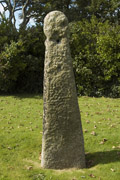
Object type: Cross-shaft and -head
Measurements: H. 211 cm (83 in); W. 26.5 cm (10.5 in) (head), 57 > 25 cm (22.5 > 9.9 in) (shaft); D. 44.5 > 22 cm (17.5 > 8.6 in) (shaft)
Stone type: Carnmenellis Granite (A.V.B.)
Plate numbers in printed volume: Ills. 301-4, 354-5
Corpus volume reference: Vol 11 p. 237-8
(There may be more views or larger images available for this item. Click on the thumbnail image to view.)
Complete cross with small round head and tapering rectangular-section shaft. At the junction between head and shaft is a projecting roll-moulding. The limited decoration is all incised.
A (broad): On the head is a St Andrew's cross, formed by sinking four areas which Langdon describes as having 'three-sided sinkings with rounded angles' (Langdon, Arthur 1896, 308). The shaft has an incised edge-moulding which extends approximately half way down the shaft. In the middle third of the shaft, within a rectangular panel defined by a faint incised line on all edges except the bottom, are irregular rows of dots.
B (narrow): There is no decoration on the head. The shaft has an incised edge-moulding which is double in places. On the upper half are irregular lines of dots.
C (broad): Within faint traces of an incised edge-moulding is a St Andrew's cross, formed as on face A by sinking four roughly triangular areas. On the shaft are traces of an incised edge-moulding and rows of incised dots.
D (narrow): There is no decoration on the head. The shaft has no trace of an edge-moulding (unlike side B) but in the top half of the shaft are irregular rows of dots.
Appendix D item (continuing tradition)
Thomas suggests that this cross is a converted menhir (Thomas, A. C. 1967a, 96–7), and its highly tapering shape makes this very likely. The minimum appears to have been done to 'convert' it; a head has been fashioned and some crude decoration added, but the basic shape may be virtually unchanged. The St Andrew's cross is rare but not unknown in Cornwall, appearing elsewhere, for example on Perranzabuloe 1 (St Piran's Cross, Ills. 193–6) or Kenwyn 1 (Tregavethan, now at Eastbourne, Ills. 103–9).
Presumably this monument is a crude derivative of better executed monuments with similar features (round head, cross formed by sinking triangular areas, moulding at neck, dots on shaft), like Penzance 1 (Ills. 185–8), Kenwyn 1 or Perranzabuloe 1. Since Penzance may date from the eleventh century or early twelfth century, a slightly later date is suggested for this.
Standing on Connor Downs, the cross is likely to have acted as a wayside cross on the main spinal road through Cornwall (now the A30, now diverted to the north), but would also have marked the parish boundary between the parishes of Gwithian and Gwinear (Thomas, A. C. 1967a, 96).
