Select a site alphabetically from the choices shown in the box below. Alternatively, browse sculptural examples using the Forward/Back buttons.
Chapters for this volume, along with copies of original in-text images, are available here.


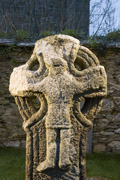
Object type: Cross-shaft and -head
Measurements: H. 149 cm (58.6 in); W. 42 cm (16.5 in) (head), 28 > 24 cm (11 > 9.5 in) (shaft); D. 21 > 18.5 cm (8.3 > 17. 3 in) (shaft)
Stone type: Yellowish grey (5Y 7/2), glassy, matrix forming about 50% of the rock is studded with clear quartz crystals ranging in size from 0.3 to 1.5 mm. Most of the quartz crystals have fallen out leaving holes. One fragment of white mica, 0.3 mm across, noted. The lithology of this piece is typical of Pentewan Stone and, if Pentewan is the source, this indicates transportation of some 40 km. However, it is possible that some of the dykes in the Roseworthy area are of similar lithology and the piece could be of more local origin.
Plate numbers in printed volume: Ills. 92-9; Figs. 17a-b, 18a
Corpus volume reference: Vol 11 p. 152-5
(There may be more views or larger images available for this item. Click on the thumbnail image to view.)
Complete cross with rectangular shaft, set in a modern base (original method of socketing unknown). The cross-head is not symmetrical. The top arm is splayed at the top as in head type B6; the horizontal arms are slightly splayed at the top but have a straight bottom edge and the lower vertical arm is widely splayed and merges into the shaft. The ends of the arms are straight. The head has a slightly recessed ring, type a. On the shaft, the panels on all four faces are bordered by an incised edge-moulding. Although the patterns are not particularly well laid out, all the carving is deeply cut and neat; individual chisel marks can still be seen.
A (broad): The ring has two incised lines, dividing it into three strands. On the head is a figure of Christ, carved in high relief. The top of the head is mutilated but there is a hollow which may indicate the mouth. The arms extend out horizontally, occupying the lower edge of the cross-arms. The right hand has been chipped off but fingers and thumb are depicted on the left hand. Incised lines on the chest indicate either ribs or the folds of a garment (a faint line around the neck may be the neck-line of a garment). The bottom of the garment is clearly depicted as a double line, possibly decorated with a step pattern. The legs extend down on to the shaft and the out-turned feet, which reach almost to the edge-moulding, rest on the top of the interlace on the shaft. Decoration on the shaft comprises a single panel of interlace: simple pattern F (the Carrick Bend), terminated at the bottom with a Stafford knot. Each interlace strand is divided into three by two incised lines. The pattern is not finished properly at the top: one or two loose strands run up parallel to the legs of the figure. A double incised moulding separates this panel from the one below, which contains an inscription in four lines. The inscribed text is complete and legible and is incised in a predominantly insular script reading horizontally. The text reads:

B (narrow): The upper part of the ring is divided into four strands by three parallel incised lines, the lower part into three by two parallel incised lines. Within an incised edge-moulding on the end of the arm are two double-strand ovals interlaced diagonally. In a single panel on the shaft are three registers of double-strand half pattern A, one of simple D, one of half F, and an uncertain knot at the bottom of the panel, which has been mutilated and is not clear.
C (broad): Five symmetrically-placed bosses dominate the cross-head. The ring is divided into three by two parallel incised lines. There is no line or moulding separating the head from the shaft, on which is an irregularly laid-out pattern executed with double incised strands. The pattern comprises two half pattern F knots, with a ring interlacing the crossing strands between the two knots. Beneath this, without any moulding to separate the panels, is an inscription in two lines. The inscribed text is complete and legible and is inscribed in a predominantly insular script reading horizontally. The text reads:

D (narrow): The upper part of the ring is mutilated; the lower part is divided into three strands by two incised lines. Within an incised edge-moulding on the end of the arm is a mutilated pattern, similar to that on the end of the opposite arm, of two interlacing double-strand ovals. On the shaft is a single panel occupied by an animal with a sinuous ribbon-like body. Its head, at the bottom of the shaft, has mouth, eye and ear visible, and just above this, a small foot. The body rises up the shaft in waves and at the top returns, interlacing the body with Stafford knots (simple pattern E) in each of the spandrils. There are several mistakes in this interlace, because the carver has taken the tail over the body every time. At the bottom, the beast bites the tip of its tail.
This cross is a member of the Penwith group of pre-Norman sculpture, characterised principally by a Crucifixion on one side of the cross-head and five bosses on the other (Chapter IX, p. 88). Other features characteristic of the group are the use of simple interlace patterns in double or triple incised strands and the serpentine beast entwined by Stafford knots (Ill. 93). On no other cross in this group is the sculpture so clear, probably because Pentewan Stone was used here instead of granite.
The Gwinear 1 cross includes all of the decorative elements associated with the Penwith group, except a key pattern, yet none of these allow it to be dated more closely than the tenth or eleventh century. Despite the mistakes in the patterns, this is one of the finest members of the Penwith group, which was copied at Phillack (Phillack 1, Ills. 197–201), so it may be one of the earliest, along with St Buryan 1 (Ills. 29–32), for which a mid tenth-century or later date has been suggested on the basis of historical context (p. 127).
The text on face A probably reads
Although now at Lanherne Convent in the parish of St Mawgan in Pydar, the cross came originally from the site of a chapel of St Gwinear at Roseworthy in Gwinear parish. Roseworthy was a demesne manor of the king in 1086 (Thorn and Thorn 1979, 1,11). The chapel's legendary associations with the local saint and the presence here of a holy well may point to an early origin for the chapel site (Henderson, C. 1953–6b, 198–200), although it is likely that by the date the cross was carved it was serving as a manorial chapel. The cross may perhaps therefore have originated as the memorial of a (Cornish?) steward associated with the manor.
The grid reference given in this entry is for the chapel at Roseworthy, and is based on the name 'Chapel Field' given in the Gwinear parish Tithe Apportionment of 1841. This field, whose centre is located 0.5 km (0.3 miles) south-west of the present settlement at Roseworthy Barton, is on high ground and contains the cropmark of an oval enclosure. Although this would normally be taken as the site of an Iron Age or Romano-British round, the Cornwall Historic Environment Record notes (on the basis of information from Charles Thomas) that it 'may indicate the site of the enclosure which once surrounded the chapel' (HER 29560).
Old Cornish runhol (O.J.P.)
Two stones of similar decorative style, Gwinear 1 and Sancreed 1, bear closely similar words inscribed on them (Ills. 99, 213). On Gwinear 1 the word is
The word has been explained as a personal name, and the coincidence of finding the same supposed personal name on two neighbouring stones of similar style and date has given rise to the suggestion that the name was that of the sculptor (references in Okasha 1993, 136 and 253). However, such a personal name is unattested in the Brittonic name-stock, and its second part would be unexplained and unparalleled. Moreover, it would be unusual at this period to find a sculptor signing his work; the few parallels incorporate some verb indicating that the sculptor 'made' the cross or inscription. [1] The variety of Brittonic personal names is such that one can never exclude a particular form as a possible personal name; but the lack of any parallel makes other possibilities worth exploring.
In fact, a Brittonic word of this form is recorded twice, in Old Welsh and Old Breton glosses of the same period as the two crosses. Tenth-century Old Welsh roenhol and ninth-century Old Breton roinol mean 'paternal, inherited', and Old Cornish runhol would be a regular equivalent of these words. Since the word occurs on two tenth-century Cornish monuments, and has not been convincingly explained as a name, it is worth asking whether a meaning 'inherited, paternal', or perhaps a noun, 'patrimony, inheritance', could be appropriate on two neighbouring tenth-century Cornish crosses.
In Old Welsh the word occurs in a tenth-century gloss to the metrical Latin version of the Gospels by Juvencus (Cambridge, University Library, MS Ff.4.42); the Latin phrase patrii pecoris 'of the paternal livestock' is glossed by two hands, one writing in Old Welsh (or Old Breton) and one in Latin: roenhol, dei patris 'inherited, of God the father' (McKee 2000a, 262–3, text and gloss, and 549–50, commentary; photograph of the passage in McKee 2000b, fol. 24r, line 9). Scribe F of this manuscript, who wrote the gloss roenhol, may perhaps have been Breton rather than Welsh (McKee 2000a, 20–3), so the word may actually be Old Breton rather than Old Welsh; at this date the ending -ol might be happier as Cornish or Breton rather than Welsh, though not necessarily so. Pierre-Yves Lambert has suggested that the word may here be a noun, 'patrimony, inheritance', rather than an adjective (Lambert 1995, 96–100; summarised by Schrijver 1997, 108; Falileyev 2000, 139; and McKee 2000a, 550).
In Old Breton the word roinol occurs in a gloss (seemingly ninth-century) to Priscian's Latin Grammar, occurring in a ninth-century manuscript (Paris, Bibliothèque nationale, MS Lat. 10290). The Latin phrase loco patronimicorum 'in place of patronymic [names]' is glossed loco roinolenuen, with roinol-enuen 'patronymic names' glossing patronimicorum. Old Breton enuen is 'names', and roinol again means 'paternal, inherited' (Lambert 1982, 185 and 199; see also Lambert 1995, 96–100). The derivation of the word roinol 'paternal, inherited' seems not to have been clearly established. Lambert has linked the word with Old Breton roi(a)nt 'kingdom'; McKee is open-minded, as is Patrick Sims-Williams (2003, 68–9 and 108).
A parallel Old Irish gloss to the same phrase in Priscian's Grammar appears in the St Gall manuscript of the same text (Sg), where loco patronimicorum is glossed as Old Irish i n-engraicc anmnae aitherrachtaigthi 'in place of a patronymic name' (Stokes and Strachan 1901–10, ii, 82–3, printing Sg. 30b16; and ii, 84, note g, commenting upon another instance of Old Irish aitherrechtaigthe 'patronymic (name)' at Sg. 32a1).
If 'inherited' or perhaps 'inheritance' is really the meaning of the word appearing on the two Cornish crosses, its significance remains a matter for speculation. As a noun meaning 'patrimony, inheritance', the word might possibly refer to a tract of land, though necessarily not the same tract at the two locations of the crosses; or might it be an allusion to the inheritance of the kingdom of heaven? However, it would seem improbable to name land as 'inherited' without giving any name of a person from whom, or by whom, it was inherited; so this suggestion remains very tentative. It has been suggested that some inscriptions and other monuments in Wales had a function relating to donation or ownership of land.[2] Or some other significance not obvious today is also possible. The possibility of an unattested personal name remains, but in this instance an alternative also exists.
[1] The Pillar of Eliseg, north Wales (Edwards 2009, 167); Andreas 99 (73) and Kirk Michael 101 (74) in the Isle of Man (Kermode 1907, 148, 150; Page 1995, 231).
[2] See Edwards 2001, especially pp. 19, 23, 28, 31-2, 33, 35, 37 and 38.
