Select a site alphabetically from the choices shown in the box below. Alternatively, browse sculptural examples using the Forward/Back buttons.
Chapters for this volume, along with copies of original in-text images, are available here.


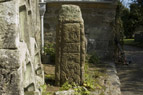
Object type: Part of cross-shaft
Measurements: H. 134 cm (52.8 in); W. 48 > 45 cm (19 > 17.8 in) (shaft), 30.3 cm (12 in) (tenon); D. 33.5 > 32 cm (13.3 > 12.5 in) (shaft), 26 cm (10.3 in) (tenon)
Stone type: Coarse-grained granite with feldspars megacrysts up to 7.5 x 2.5 cm forming about 50% of the rock; equidimensional quartz crystals are up to 1 cm across. There are a few flakes of brown mica, together with some intergrown tourmaline. Land's End Granite
Plate numbers in printed volume: Ills. 83-7; Colour Pl. 2
Corpus volume reference: Vol 11 p. 146-7
(There may be more views or larger images available for this item. Click on the thumbnail image to view.)
Part only of a rectangular cross-shaft with sub-rectangular tenon, mounted upside down. The shaft has a single panel of decoration on all faces except A which also has an inscription. The edges of the shaft are enriched by cable-moulding.
A (broad): The upper part of the shaft is filled with a simple type F interlace in triple-moulded broad, flat bands.
The top panel is not separated from the lower in any way: the flat termination of the lower interlacing strand serves to define the bottom of the panel. The lower panel has an inscription in two lines separated by an incised line. The letters of the inscribed text appear to read horizontally but they are so deteriorated that it is uncertain what script was used and the text must be concluded to be illegible.
B (narrow): Step pattern 2 executed with broad flat strands formed by incising lines between the strands.
C (broad): Shallowly carved in broad flat bands is simple pattern A with glides separating the individual figures.
D (narrow): Step pattern 2, more upright than on face B, and more crudely executed.
The ring-twist suggests a date in the later part of the early medieval period. The use of broad, flat strands is characteristic of Viking-age carving in Cumbria and the step pattern used here is very similar to that on Kirkby Stephen 4 (Bailey and Cramp 1988, 123, ills. 403, 405). The cable-moulding on the angles of the shaft can be paralleled in south Wales on Penally 1 and 2 (Edwards 2007, 410–17) but is unusual in Cornwall, where the only other examples are on the head of Tintagel 1 and possibly on Quethiock 1 (Ills. 208, 224–6).
The inscribed text has been read as vn vi (Langdon, Arthur and Allen, J. R. 1895, 58) and as vri vi (Macalister 1945, 440). In view of these differences and of the illegible state of the text today (Ill. 87), the original reading cannot be recovered.
Although it occurs in an area with a distinctive style of pre-Norman sculpture, this monument is in contrast with these and is unique in Cornwall, as, in a different way, is its companion piece, Gulval 2 (Ills. 88–91).
With a name in lann and a large curving churchyard located on a gently sloping coastal plain above Mounts Bay, Gulval church is a site of early medieval origin. The cross, however, is the earliest tangible evidence on the site. By the time of the Norman Conquest, the estate of Landicle (Gulval) was in the ownership of the bishop of Exeter (Thorn and Thorn 1979, 2,10), perhaps through appropriation of the site of an earlier (pre-Saxon) church here. There is further discussion of the context in the Gulval 2 entry below.
