Select a site alphabetically from the choices shown in the box below. Alternatively, browse sculptural examples using the Forward/Back buttons.
Chapters for this volume, along with copies of original in-text images, are available here.


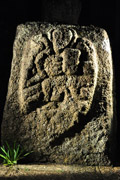
Object type: Cross-base [1]
Measurements: H. 88 cm (34.5 in); W. 60 < 66 cm (24 < 26 in); D. 67 < 74 cm (26.5 < 29 in); Mortice 36 cm (14 in) square (approx.)
Stone type: Coarse-grained granite with feldspar megacrysts mostly less than 2 cm long, but with some up to 6 cm x 1.5 cm. Equidimensional quartz crystals are up to 12 mm. The quartz and feldspars occur in roughly equal proportions. There are a few flakes of white mica up to 2 mm across. Land's End Granite
Plate numbers in printed volume: Ills. 88-91, 338-41; Colour Pls. 2-3
Corpus volume reference: Vol 11 p. 147-52
(There may be more views or larger images available for this item. Click on the thumbnail image to view.)
Decorated pedestal of a cross in the shape of an irregular cuboid, with a mortice in the top. It is not possible to gauge the exact dimensions of the mortice because it has been filled with cement, which is smeared over the top of the cut. The top of the stone has a rebated groove running around its edge, well defined on the south and west sides, less well on the north and east sides. There are figures carved in false relief or incised on each of its four faces.
In places, the carving is remarkably well preserved. There are areas with obvious damage, and places where the large feldspar crystals in the course-grained granite have deteriorated, interrupting the design, but elsewhere a fair amount of detail can be seen, both on the photos (Ills. 88–91) and with greater clarity on Goskar's photogrammetric images (Ills. 338–41, and see p. 7).
The bottom of the stone is uneven, and assuming that the stone is complete, it cannot have been buried but must have sat directly on the ground since the decoration on face C extends almost to the bottom of the stone.
A (south): The compact carving of a figure, presumably an angel, is set in an oval mandorla. The lower third of the carving has been mutilated. At the top of the stone, in the centre, is the angel's head, of oval shape, surrounded by a halo, with the eyes, nose and mouth lightly incised. The angel is holding a book in very large hands. On the book is some lettering or decoration. On either side of the head, wings extend outwards and enfold the angel's body.
B (east): This face of the stone is very worn, especially towards the top. The low relief carving is of a figure, seated or crouching, facing left and holding a roughly square object to its left. The elements that can be seen most clearly include the head with a halo and a rather beak-like mouth; the head faces left with rounded shoulders or back and possibly an arm reaching across the body towards the object on the left. Folds of drapery are shown across the knees, below which are two feet facing left. To the top left of this main figure is a further, smaller, roughly square object next to the head of the main figure; there are three vertical, finger-like lines below. A possible line curving out from the knee and then upwards, visible on the extreme left on Ill. 89, seems to be clearer in the photograph than in reality, although it cannot be entirely discounted.
C (north): The low-relief, well preserved carving depicts a single, haloed figure in a knee-length garment, apparently seated, or possibly crouching, facing right and holding a book on which lettering or decoration is depicted with fine incised lines. Immediately below the book, four parallel horizontal lines probably represent the fingers of a crudely-depicted hand. The head, turned to the right, has a single eye, shoulder-length hair (?), and a muzzle-like mouth giving it a rather beast-like appearance.
D (west): In contrast with that on the other three sides, the carving on this face is only lightly incised. Seen in profile is a single haloed figure, kneeling and holding a small book with outstretched fingers. Below the book, which has some markings on it, may be two further parallel fingers. The figure has long hair and wears an ankle-length garment with ribbed folds. Despite the very shallow carving, details such as the muzzle-like mouth separated from the hair by a fine incised line, the folds of the garment and the two tiny feet can be made out.
In the past, it has always been assumed that this stone is late medieval and would have supported a lantern cross of fifteenth- or sixteenth-century date. Nineteenth-century records place it with Cornwall's 'Gothic' crosses (Blight 1856, 50; Blight 1885, 127; Langdon, Arthur 1896, 426), presumably because the angel on face A, which has always been the most prominent and identifiable of the carvings, is reminiscent of the angels which adorn ecclesiastical carving of this period. Indeed, in Gulval church, the south aisle and the font are embellished with shield-bearing angels (Pevsner 1983, 76). Although the stone would be unusual amongst Gothic cross-bases, which are normally chamfered and stopped, this block with square mortice would not seem out of place as the base of one of Cornwall's more rustic lantern crosses such as those at St Ives or Callington (Hingston 1850, 17, 45; Blight 1856, 52–3; Blight 1858, 62). None of the Cornish Gothic bases have figure carving on them, although the lantern crosses that they support invariably did. However Gothic bases in Somerset occasionally feature figures, as for example at Bishop's Lydeard (Pooley 1877, plate opp. p. 90).
This suggested date of the base had never been questioned by the present authors. The first to recognise the possibility that this stone might be considerably earlier were Mick Aston and Teresa Hall, who suggested that it might be 'a very large cross-base with figure decoration on it, probably indicating a late ninth- or early tenth-century date', whose 'nearest parallels are in Ireland and Northumbria' (Aston, Hall, Cramp et al. 2013, 4, but not paginated). This possibility is examined next. However at the outset it should be stated that, as the monument is a late addition to the catalogue, there has been little time for research and this discussion must therefore be regarded as a preliminary statement.
The shape of the stone is rather different from the majority of cross-bases in Cornwall. Other certainly early medieval cross-bases are two at Padstow (2 and 3) and one at St Ewe, with possible examples at Quethiock and Minster. All these are very much wider, flatter slabs of stone providing simple collars for the crosses they supported. St Ewe 1 has an inscription but the others are plain. In its shape and in the presence of decoration, Gulval 2 is most like the Doniert Stone, St Cleer 2, which is considered to be the pedestal for a composite cross built in sections (p. 134, Ills. 51– 4). The Doniert Stone currently stands higher than Gulval 2 but if the bottom, uncarved section were sunk in the ground, the visible, carved, faces would be approximately the same height as Gulval 2. Its regular, geometric ornament is however very different from the decoration on Gulval 2.
Whereas Gulval 2's mortice is square, all the other surviving early medieval cross-bases in Cornwall have rectangular mortices, reflecting the shape of the crosses they support; but even so, the size of Gulval 2's mortice at 36 x 36 cm is closely comparable to that of St Cleer 2 (the Doniert Stone: 38 x 20 cm) or St Ewe 1 (47 x 33 cm). It is, however, smaller than the mortice of the largest base, Padstow 2 (73 x 43 cm).
Presumably the cross which fitted into this base had a tenon, perhaps stepped-in like that on Gulval 1 (Ills. 83–6), or tapering like that on St Erth 1. By analogy with Gulval 1 (as this is from the same site) it can be suggested that the bottom of the missing cross might have been about 48–51 cm (24–26.5 ins). Crosses with similar maximum dimensions include Lanivet 1 (47 x 40 cm) and Lanivet 2 (50 x 33 cm); crosses geographically closer to Gulval 2 include Gulval 1 (48 x 33.5 cm) and Penzance 1 (53.5 x 26 cm). These are all amongst the larger monuments in Cornwall and Penzance 1 is complete and over 2 metres high. If Gulval 2 is comparable then the assemblage of base and cross might have approached 3 metres in height and, with its exceptional carving, would have been one of the most impressive crosses in the area. It is, unfortunately, difficult to speculate about the decoration on the cross that this base supported, since the base is so different in character from any other early medieval sculpture in Cornwall.
It is unlikely that Gulval 1 was the cross originally standing in Gulval 2 since the tenon on Gulval 1 is rectangular, not square. Moreover the style of Gulval 1's lightly incised and simple decoration is in strong contrast with most of the false relief figure carving on Gulval 2, with the possible exception of face D . However both stones are the same sort of granite, no doubt because both were obtained from a local source.
Apart from the Doniert Stone (St Cleer 2), parallels for this type of base or pedestal are few in the English sculptural repertoire. In the South-west, the closest geographically is that which supports the Colyton cross in Devon, but at 33 cm high, this is very much smaller than Gulval 2 (Cramp 2006, 81, ills. 3, 5, 8, 9); another at Whitcombe in Dorset is 63.5 cm high (Cramp 2006, 124, ills. 144–6). Across the Bristol Channel, in south-east Wales, the base of Margam 2 (77 cm high, and a maximum of 118 x 65 cm across) is a large rectilinear block elaborately decorated with interlace, key patterns and horsemen; it supports a fine disc-headed cross whose decoration includes simple carved figures and inscriptions. This has been dated to the late ninth / early tenth century (Redknap and Lewis 2007, 408–20). A further cross in south-east Wales, at Llandough, is a composite monument set on a pyramidal pedestal with some figure carving, though this base is shorter, at 52 cm high (Redknap and Lewis 2007, 329–37). This monument has been dated to the late tenth to early eleventh century.
Decorated cross-bases are relatively common in Ireland, and it is here that the best parallels can be found for the form of Gulval 2. In Ireland, reflecting the style and date of the monuments they support, the earliest, from the late eighth century, feature intricate geometric ornament and spirals, while slightly later monuments bear complex biblical scenes. The latest Irish crosses, of the late eleventh and twelfth centuries, feature large figures of the Crucifixion, bishops or abbots alongside Urnes-style decoration; this variety is reflected on their bases (Edwards 1990, 168–70; Harbison 1992, i, 367–84). Although Irish cross-bases or pedestals are generally elegantly tapering or pyramidal, square blockish bases do occur, for example at St Mullins in Co. Carlow and Killeany/Teaglach Éinne, Co. Galway; the latter's cross features Urnes-style decoration indicating a later date (Harbison 1992, figs. 418–19, 554). Despite the wealth of scriptural scenes in Irish sculpture, single large images of saints and angels are rare, but there is an example on the granite base of the North Cross at Castledermot in Co. Kildare (Harbison 1992, i, 37–9; ii, figs. 101–4), a base which is also of similar size to Gulval 2, at 93 cm high and 85 by 75 cm across at ground level. Irish cross-bases often have a rebated top edge, like that on Gulval 2, and this appears to be a feature that is found on Irish cross-bases of all dates, from Ahenny's North Cross of the late eighth or early ninth century (Edwards 1990, 164–71, figs. 84–7), through to St Patrick's Cross at Cashel of probable twelfth-century date (Harbison 1992, figs. 93–6). Decoration on the latter's rebated base is limited and damaged but may have included some figure carving (Harbison 1992, i, 34–5; ii, figs. 93–6). The cross itself features large three-dimensional figures on its main faces, of the Crucifixion and of an abbot or bishop.
While the four figures on Gulval 2 are clearly visible, and on the whole the sculpture is in reasonable condition, it is difficult, except on face A, to make out what they represent. This is because the carving, although clear, is clumsily laid out, with the large figures bent up or cut off to fit them within the confines of the stone. All the figures have haloes, so must represent saints or members of the Holy Family. Three or possibly four of them hold books, presumably representing the Word of God or the gospels. It is notable that in each case, except face A, the heads of the figures are seen in profile and appear rather beast-like, two with muzzle-like mouths and one with a distinctly beaked outline. This may simply be a crude attempt to depict human heads in profile, but the most convincing explanation is that these four figures, each with halo and book, three with animal heads and one with angel's wings, represent the Evangelists and the animal-heads represent their symbols of lion, bull and eagle.
Goskar's images (Ills. 338–41) show even more clearly the beaked head of an eagle, representing St John, on the east face (B). Here, the seemingly incongruous three fingers may not then be a mistake but could represent the three claws of an eagle. This being so, the scheme runs clockwise around the base, with Matthew (the man) on face A, Mark (the lion) on face D, Luke (the bull) on face C and John (the eagle) on face B. Given this interpretation, the fine head of hair on Mark (face D) is evidently a mane and the two parallel fingers seen beneath his book may represent a Benediction. It is even possible that the swept back 'hair' on Luke (face C) in fact represents his bull's horns. These images also help illuminate some of the markings on the books, the clearest of these being on face C, where there appear to be two letters, possibly L and an angular S. If it is allowed that LS is an abbreviation for LUCAS, the Evangelist depicted on this face, then it follows that the letters on the other books might contain reference to their titular saints. Likewise, the possible lettering on face A could be interpreted as MT for Matthew, but as the stone has yet to be examined by an epigrapher, this remains an aspect in need of further research.
Figure sculpture, other than the Crucifixion, is rare amongst early medieval sculpture in Cornwall. The only other figures are (possibly) St Peter, on Lanivet 2 (Ill. 119), and the small and very roughly incised figures on the nearby Penzance cross (Ills. 189–90). This fact may in itself argue against an early medieval date; but on the other hand, the majority of what does exist, mainly representing the Crucifixion, is in West Penwith, in which Gulval is located. These Crucifixions are rather different in sculptural technique but do all date from the tenth to eleventh centuries, as at St Buryan (1), St Erth (1 and 2) and Phillack (1). In the discussion of the sculptured panels at St Stephen by Launceston (p. 220) it is noted that Romanesque architectural sculpture in Cornwall features lively animals on several Norman tympana and fonts. Figure sculpture is limited to the heads at the corner of certain fonts (Bodmin being the best example: Sedding 1909, pls. IX, X, XXXVIII, XXXIX), the slabs with the Virgin and Child and Christ in Majesty at St Stephen by Launceston (Ills. 269–70), and to images of the Crucifixion on both simple wayside and more elaborate churchyard crosses like St Levan 1 and St Buryan 3 and 4 (see Appendix D, p. 231). Images of saints, apostles and the Virgin and Child do become common in later medieval Cornish sculpture, notably on churches and lantern crosses; and these figures occasionally hold books alongside their symbol. Angels are commonly depicted at this period, but they normally hold shields on which heraldic devices may originally have been painted.
In early medieval art generally, depictions of the Evangelists are common, as human figures, in symbolic form, as humans with their symbols shown separately and occasionally as zoo-anthropomorphic figures, as at Gulval. In terms of the style of figure representation, the Gulval images can perhaps be compared to the very schematised figures seen in early Insular manuscripts like the Books of Kells, Durrow, and Chad (Nordenfalk 1978, pls. 9, 24, 25; Brown 1980). The way in which the Gulval St John's legs are tucked in to fit the stone (Ills. 89, 339) is especially like the angel on fol. 183r of the Book of Kells (Brown 1980, 30). But in contrast with these, the Gulval figures are presented alone, with no other decoration, not even an architectural frame.
Although they are by no means exactly alike, the Gulval sculptures can be compared to the very simple depictions of the Evangelists as human figures with the animal heads of their symbols as seen in Breton manuscripts, for example on the frontispiece of the ninth-century Landévennec Gospels (Morey, Rand and Kraeling 1931, pl. 1). Here, as on Gulval 2, the Evangelists each hold their books and all have their heads in profile except for Matthew, the man, who faces forward. All have large almond-shaped eyes, not dissimilar to that of St Luke on face C of Gulval 2 (Ills. 90, 340). Some also have writing on the books: which in the case of the late ninth- or early tenth-century Leofric Gospels at the Bodleian Library (MS. Auct. D. 2. 16), name the individual Evangelists
Images of the Evangelists are also found in Anglo-Saxon sculpture in England, appearing variously on cross-heads, shafts, and bases from the eighth to the eleventh centuries, as men, as symbols and as animal-headed people. For example, on the shaft of the late eighth-century Otley 1 cross in Yorkshire, the very classical busts of the four Evangelists appear in human form (Coatsworth 2008, 167–9, ills. 338, 339–42), whereas on nearby Ilkley 1, of mid to late ninth-century date, the half to three-quarter length figures have animal heads (Coatsworth 2008, 215– 19, ill. 558). On an eleventh-century cross-head at Durham they are shown as animals and a man set around the Lamb of God (Coatsworth 1978, 86, fig. 1A). The Evangelists are again represented as animals surrounding the Crucifixion on the shaft of the Market Square Cross (no. 1) at Sandbach in Cheshire of c. 900 (Bailey 2010, 99–113, ills. 264–5). However, the most apposite parallel is seen at Hornby in Lancashire where the Evangelists appear as four single figures on a tall, tapering cross-base of possible eighth- or ninth-century date.[2] Sadly, this base is so eroded that little detail of the figures can be made out, but they are believed to be shown as animal-headed humans. The major difference between this and Gulval is, however, that the Hornby 3 base is extremely neatly cut, with the figures framed by columns and arches (Bailey 2010, 214–15, ills. 558–61). In discussing the Evangelists on the Halton 2 fragment, Lancashire, which as on Gulval 2 and the Hornby 3 base are set around the four faces of the stone, Bailey notes that recent extensive study of zoo-anthropomorphic images of the Evangelists demonstrates that the use of the symbols is rare in Ireland and Scotland, but is 'a persistent theme' in Anglo-Saxon sculpture (Bailey 2010, 184, ills. 476–9).
This summary of sculptural parallels points to the fact there is a wide potential range of date for the Evangelists in sculpture. There is a strong possibility that the very appearance of the Evangelists at Gulval is suggestive of English influence. The frequent appearance of the Evangelists in a scheme which includes a representation of Christ, perhaps enthroned or on the cross, might imply that this missing element was on the cross that the base supported, perhaps as a Crucifixion on the cross-head, as is so common in this area of Cornwall (p. 78).
Closer to Cornwall, although the Evangelists are not depicted in Welsh sculpture, they are named on two crosses from south Wales (from St Davids: Nash-Williams 1950, 211, no. 383, pl. LVI; Edwards 2007, 444–6, dated late eleventh to twelfth century; and from Llanhamlach: Nash-Williams 76–7, no. 61, pl. LIII; Redknap and Lewis 2007, 210–13, dated tenth to eleventh century). In north Cornwall, however, on the eleventh-century Tintagel 1 cross, the Evangelists are named and may be depicted as small boss-like heads on the cross-head (p. 201, Ill. 226).
Discussion of the context (O.J.P.)
Gulval appears in Domesday Book as the manor of Lanisley, Lanisley being the name of the early estate associated with the church site and Gulval the name of the patron saint of the church (Thorn and Thorn 1979, 2,10; Padel 1988, 91). The estate of Lanisley (Gulval) was held by a tenant in 1086 (Exchequer Domesday). However, Exeter Domesday tells us additionally that in 1066 it had been held by Bishop Leofric himself in demesne, and that the tenant in 1086, Roland, was archdeacon. He may have been archdeacon of Cornwall or of Exeter (since one Rolamnus, archdeaon of Exeter, died in 1104). But in either case the link of Gulval to the bishopric in 1086 (with the archdeacon of either Cornwall or Exeter as tenant) and earlier in 1066 was close enough to provide a possible context for both commissioning this impressive piece of sculpture and providing the models on which the images were based.
The source of this estate among the bishop of Exeter's lands in 1066 is unknown (as is the source of most of his other estates). It could have been a property of the minster at Exeter from before the bishopric came there in 1050; or it could already have been a property of the bishopric before it arrived in Exeter. If the latter, it is most likely to have belonged to St Germans when that was the bishopric of Cornwall (930 to c. 1025) (Padel 2011a, 68–70). In summary, if an association with the bishop does indeed explain the presence of this remarkable sculpture, dates from the mid tenth century are possible but are perhaps most likely from 1050 when the diocesan centre moved to Exeter, under Bishop Leofric.
Finally, the date of this stone must remain uncertain since its decoration is unparalleled in Cornwall and is difficult to match elsewhere. The overall size and shape of the base can be compared to the Doniert Stone (St Cleer 2), of probable late ninth-century date, while Evangelists are named on the eleventh-to early twelfth-century Tintagel 1 cross. The form of the base is best paralleled in Ireland, in the bases of crosses from the late eighth to twelfth centuries; there, carvings of large single figures appear on the later monuments but none are of the Evangelists. Overall the best parallel for the figures is at Halton in Lancashire, on a stone dated to the ninth century. However, the style of decoration on the monument appears to argue against an early date. Most early medieval carving in Cornwall involves covering every inch of the surface with sculpture, normally geometric ornament, but in east Cornwall, foliage as well. On the transitional monuments, lines and dots feature; it is only with the later monuments that decoration becomes more minimal (as for example on St Levan 1, of twelfth-century date, p. 239). As Gulval 2 features figures, in isolation, with no other decoration, not even an edge-moulding or frame, a later date may be indicated. On the other hand, the figures have been compared to ninth- to early tenth-century Breton manuscript painting and the possibility of a similar date cannot be ignored: although it should be noted that many of the Breton Gospel books are thought to have arrived in England during the reign of Athelstan following Viking attacks in Brittany (Padel 2009). The fact that Leofric, Bishop of Exeter at a time when Gulval is known to have been under personal diocesan management, owned such a book (the Leofric Gospels: Bodleian Library, MS. Auct. D. 2. 16), indicates the potential for the existence of such a model at Gulval, on which the sculpture on this cross-base might have been based.
In conclusion, the date is left open and covers the main period of early monumental cross-carving in Cornwall, as illustrated in this volume, but with a preference for the second half of the eleventh century.
[1] This entry is dedicated to Mick Aston, who sadly died before it could be published.
[2] I am grateful to Derek Craig for pointing out these parallels.
