Select a site alphabetically from the choices shown in the box below. Alternatively, browse sculptural examples using the Forward/Back buttons.
Chapters for this volume, along with copies of original in-text images, are available here.


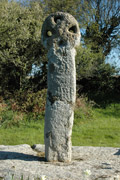
Object type: Cross-shaft and -head
Measurements: H. 173 cm (68 in); W. 46 cm (18.2 in) (head), 32 > 27 cm (12.6 > 10.6 in) (shaft); D. 19 cm (7.5 in) (head), 26 cm (10.3 in) (shaft)
Stone type: Feldspar phenocrysts up to 2 cm by 4 mm intergrown with quartz; some discrete, equidimensional, quartz up to 5 mm across occurs, together with a few flakes of white mica up to 2 mm across, and tourmaline. Medium-grained Bodmin Moor Granite
Plate numbers in printed volume: Ills. 297-300
Corpus volume reference: Vol 11 p. 236-7
(There may be more views or larger images available for this item. Click on the thumbnail image to view.)
Cross, with plain round head pierced by three holes, with a projecting roll-moulding at the neck. The shaft is of rectangular section at the bottom but rounded at the top. It is set into a modern base. The right side, containing face D, is not straight. Andrew suggests that this may be due partly to entasis and partly to damage (Andrew 1937–42, 223). As Langdon says, it 'is a most quaint and irregularly executed monument' (Langdon, Arthur 1896, 180).
A (broad): On the head, a St Andrew's cross is indicated, but not actually carved, by piercing three elliptical holes through the head, at the top and sides; at the bottom of the head the hole, which is slightly off-centre, is not completely cut through. Just off the centre of the head is a small low boss. There is a faint trace of an incised edge-moulding on the right side of the shaft. At the centre of the shaft, just above the break, is a small panel of incised holes in five irregular lines.
B and D (narrow): Undecorated
C (broad): As face A, except that there is no incised hole decoration. The lower hole of the head is similarly not fully cut and is noticeably off-centre.
Appendix D item (continuing tradition)
With its three-holed round head, St Andrew's cross, roll-mouldings at the neck, and irregular dot decoration on the shaft, this cross is remarkably similar to Perranzabuloe 1 (St Piran's Cross, p. 189, Ills. 193–6). It is, however, much smaller and more crudely executed. Gwinear 2 (the Connor Down cross) can also be compared, although in the latter, the holes in the head are not cut through but sunk (Ills. 301–4). Like the Connor Down cross, the Three Holes Cross is likely to be a copy of the better executed monument (although the distance of some 30 km, 20 miles, from Egloshayle to Perranzabuloe is a problem).
The cross is located on an important routeway from Launceston around the north side of Bodmin Moor, and from north Cornwall and the Tintagel area, towards the lowest fording point of the River Camel at Wadebridge, thence on to west Cornwall and also to the Bishop of Exeter's important manor at Pawton. It is at a major junction of routes, one of which led to the Bishop of Exeter's manor on this side of the River Camel, at Burnayre.
