Select a site alphabetically from the choices shown in the box below. Alternatively, browse sculptural examples using the Forward/Back buttons.
Chapters for this volume, along with copies of original in-text images, are available here.


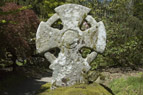
Object type: Cross-head and part of -shaft
Measurements: H. 100 cm (39.5 in); W. 87 cm (34.3 in) (head), 42 cm (16.5 in) (shaft); D. 18 > 15 cm (7.2 > 6 in) (head), 25 cm (9.8 in) (shaft)
Stone type: Dark yellowish brown (10YR 4/2), medium-grained, greisen. The sub-angular quartz grains range from 0.3 to 0.7 mm, but are mostly between 0.5 and 0.6 mm, with a few of clear quartz up to 4 mm (original phenocrysts?). A few scattered flakes of white mica (muscovite) are present as plates up to 1 mm across and intergrown with the quartz. Greisen
Plate numbers in printed volume: Ills. 60-1; Colour Pl. 4
Corpus volume reference: Vol 11 p. 141-2
(There may be more views or larger images available for this item. Click on the thumbnail image to view.)
The head and part of the shaft of a rectangular-section cross. The cross-head, type E8, has wide-splayed arms, very rounded where they meet at the centre. The bottom arm is wider than the others, to fit the shaft. The arms are linked by a ring, type a. In the space between each of the arms and the ring are three cusps, forming trefoil-shaped openings. The cross is largely undecorated apart from an incised moulding around the edge of the arms, and a large central boss on each side.
A (broad): There is an incised moulding around the edge of the arms, and a central boss surrounded by a raised band with an incised line encircling it.
B and D (narrow): There is an incised moulding around the edge of the arms.
C (broad): There is an incised moulding around the edge of the arms, and a central boss surrounded by a raised band. The boss is smaller and flatter than that on face A.
This cross is one of the small but dispersed group of crosses found in Mid and East Cornwall, characterised primarily by the trefoil-shaped openings in the head (Chapter IX, p. 92). Other characteristic features of the group include the large boss, the widely-splayed arms and the narrow cross-section. This is the only example in the group which is undecorated. It is also the largest, the head being 10 cm wider that of Quethiock 1 (Ills. 206, 211) and 17 cm wider than that of Padstow 3 (Ills. 169–72), suggesting that the original monument must have been extremely impressive, and perhaps between 3 and 4 m high. A shaft at Trescowe, noted by Langdon, may possibly have been the missing shaft, although nothing more is recorded of this stone, which is probably now lost (Langdon, Arthur 1896, 226).
Egloshayle 1 (now at Pencarrow) is the only example in this group which is not in an obviously ecclesiastical setting. Moreover information on its find-spot is unspecific and conflicting, making it difficult to discuss its original context; however, it may be significant that it is close to Bodmin, and at the centre of the distribution of the trefoil-holed crosses. Langdon gives most detail on the discovery of the stone (Langdon, Arthur 1896, 194–5). According to Langdon, it was found by a farmer at Trescowe when repairing a fence (probably a stone-faced earth bank rather than a wooden or wire fence) adjoining one of his fields, which was formerly a part of the Pencarrow deer park. Trescowe is a farm just to the east of Pencarrow, the two being separated by a small stream which forms the boundary between the parishes of Egloshayle and St Mabyn. An alternative suggestion, that the cross was brought from Bodmin Moor in the eighteenth century (Harvey 1978, 114), can probably be dismissed as being much later and with no supporting information.
Langdon's description of the find-spot may indicate a connection with the deer park, but since the earliest park in this area, which was associated with a mansion of the Peverells at Park (SX 031 092), may not have been emparked until the fourteenth century (Henderson, C. 1935, 158, 162) and in all probability lay to the west of Pencarrow and Trescowe (Peter Herring, pers. comm.), this suggestion can probably be ruled out. The other park in the area, associated with Pencarrow itself, appears to have been of far later origin (Henderson, C. 1935, 162; Pett 1998, 261) and so it seems more likely that the cross was used as a simple building stone in the construction of the pale; however, due to its size, it may not have been transported very far to fulfil this secondary role. The deer park pale possibly described an approximately oval shape around Pencarrow, its line roughly following the C road to the west and south of Pencarrow, the B road to the south-east, and the valley separating Trescowe and Pencarrow to the north and east.
Given that the valley between Pencarrow and Trescowe is a parish boundary, it is an alternative possibility that the cross was associated with the parish boundary, although so great a cross seems unlikely to have been tucked away in a valley and reserved solely for this purpose. On the other hand, as the deer park boundary may have run south from Trescowe to follow the line of the B3266 road from Bodmin to Camelford around the north-west edge of Bodmin Moor, this road is perhaps a more likely location for the original site of the cross.
Here, the cross could have acted as a wayside cross and would still have stood close to the parish boundary. It might also have had some significance in relation to St Petroc's monastery at Bodmin, less than 6 km distant, perhaps marking the approach to lands owned and controlled by the monastery, although the surrounding land was all in secular ownership in 1086. A similar suggestion has been made in relation to a later medieval cross with fleur-de-lys emblem on its head and found in the same general area. Bodmin Priory, the later medieval successor of St Petroc's monastery, was dedicated to the Blessed Virgin Mary and St Petroc and the fleur-de-lys was a symbol of Mary (Langdon, Arthur 1896, 337–8).
In the absence of any decoration, the cross is dated in the same way as others with trefoil-shaped holes.
