Select a site alphabetically from the choices shown in the box below. Alternatively, browse sculptural examples using the Forward/Back buttons.
Chapters for this volume, along with copies of original in-text images, are available here.


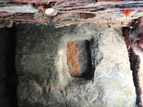
Object type: Cross-base
Measurements: L. 137 cm (54 in); W. 130 cm (51 in); H./D. 124 cm (49 in); Mortice 51 x 30 cm (2 x 1.5 in); All measurements are approximations.
Stone type: Medium bluish grey (5B 5/1) tufaceous shale with thin interbeds of tufa. Cleavage cuts across the bedding. Tintagel Volcanic Formation
Plate numbers in printed volume: Ills. 250-1
Corpus volume reference: Vol 11 p. 212-3
(There may be more views or larger images available for this item. Click on the thumbnail image to view.)
Undecorated cross-base of roughly rectangular form, with a mortice which is rectangular but with rounded corners and slightly tapering sides. The base has been trimmed along one edge to make it fit its present location, so would have been slightly larger originally; the mortice is asymmetrically positioned in the base.
Appendix A item (stones of uncertain date)
Although the cross is now missing, the large size of the base suggests a substantial monument of possibly early medieval origin (see Chapter VI above, p. 63).
The original location of the cross is uncertain. Davidstow holy well was constructed in the nineteenth century with stone from the site of St Austen's chapel and holy well close to the boundary of the parish at SX 1351 8846. It is possible therefore that the base-stone was brought from there. On the other hand, the holy well is close to the parish church, which with a name in Old English stow is likely to represent a site of early medieval origin (Preston-Jones 1994, 77). If from the site of St Austen's, it may have had an association with the chapel and well, the parish boundary, or even the route on which Minster 1 (the Waterpit Down cross) sits, from Bodmin Moor to the coast at Tintagel (p. 169).
