Select a site alphabetically from the choices shown in the box below. Alternatively, browse sculptural examples using the Forward/Back buttons.
Chapters for this volume, along with copies of original in-text images, are available here.


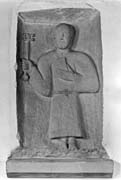
Object type: St Peter panel
Measurements: H. 92 cm (36.2 in); W. 58 cm (22.8 in); D. 30.5 < 33 cm (12 < 13 in) (estimated: see p. 109); Max. depth of carving 9 cm (3.5 in)
Stone type: Greyish orange (10YR 7/4) clast supported very shelly limestone with a small amount of rather indistinct, possibly redrystallised, ooliths. Shell debris 4 to 6 mm in size. Signs of bedding fabric across the figure. Probably White Limestone Formation, Great Oolite Group, Middle Jurassic.
Plate numbers in printed volume: Ills. 105-6; Fig. 32A
Corpus volume reference: Vol 10 p. 158-9
(There may be more views or larger images available for this item. Click on the thumbnail image to view.)
St Peter stands with a narrow book or writing tablet in his left hand and his keys held high in his right hand. He wears an ankle-length, full-skirted tunic. The full sleeves of the tunic come to his wrists, and the collar is high. Around his waist he wears a two-cord girdle, with a vertically looped central knot. His feet are set together. He has a long, clean-shaven face, with a cleft chin. His mouth is carved in a smile. His nose is long and straight and his eyes are almond-shaped. He wears his hair in a fringe with looped and curling tips, and he has a crown or 'Roman' tonsure. Peter's ears are quite large and set in a more natural position on his head. His shoulders are hugely broad and his arms are large and rather awkward. As with no. 3, the upper part of Peter's body seems out of scale with the lower part. The background to the niche in which Peter stands is fairly coarsely tooled.
The clean-shaven St Peter with the 'Roman' crown tonsure of a cleric is a distinctively Anglo-Saxon image. Most of the surviving examples date from the tenth or eleventh centuries but earlier examples are widespread, for example the engraved portrait of St Peter with the other disciples on one side of St Cuthbert's wooden coffin dated to ad 698 (Higgitt 1989, 267–8). A late manuscript example can be found on the dedication folio 6 in the Winchester New Minster Liber Vitae dated 1031, where St Peter stands to one side of Christ in Majesty in the upper register of the image above Cnut and his queen Ælfgyfu, as the royal couple present an altar to Christ (Temple 1976, 95–6, cat. 78, ill. 244). The looped, fringed hairstyle is found on the figure of St John on the crucifixion folio 3v in a late tenth-century psalter also from Winchester (Temple 1976, 64–5, cat. 41, ill. 142).
(See Daglingworth 2 for comments that are relevant to the dating of all four panels, Chapter IX for an analysis of the archaeological context, and Chapter III for a discussion of possible local parallels for the carving style used on the Daglingworth panels.)
