Select a site alphabetically from the choices shown in the box below. Alternatively, browse sculptural examples using the Forward/Back buttons.
Chapters for this volume, along with copies of original in-text images, are available here.


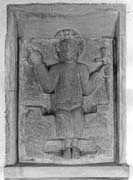
Object type: Christ Enthroned panel
Measurements: H. 73 cm (28.75 in); W. 58 cm (22.75 in); D. 30.5 < 33 cm (12 < 13 in) (estimated: see p. 109); Max. depth of carving 12.6 cm (5 in)
Stone type: Greyish orange (10YR 7/4) clast supported slightly oolitic or peloidal shelly limestone. Shells, mainly bivalve debris up to 5 mm in size. Ooliths/peloids around 1 mm in size. Probably White Limestone Formation, Great Oolite Group, Middle Jurassic.
Plate numbers in printed volume: Ills. 103-4; Fig. 32B
Corpus volume reference: Vol 10 p. 157-8
(There may be more views or larger images available for this item. Click on the thumbnail image to view.)
Christ, with cruciferous halo, sits on a broad simple throne with raised armrests. He wears an ankle-length, long-sleeved tunic with a high collar. Around his waist he wears a four-cord girdle, with a double-strand, vertically looped central knot. His legs and feet are set close together, and the feet are set on an semi-circular footstool. Christ holds a long-staff cross in his left hand, but the bottom of the shaft is now cut away. His right hand is raised in blessing. His face is long and very similar to the crucified Christ on Daglingworth 2. His expression is wonderfully calm. He has a short beard and a moustache with curling tips. He wears his hair in a fringe with curling tips, and his ears are small and set high on his head. Christ's mouth is small, his nose is long and straight, and his eyes are almond-shaped. The figure's arms are rather large and awkward, and the upper body is slightly out of scale when compared to the lower body and legs.
The image of Christ Enthroned with a long-stemmed cross in his left hand and the right hand raised in blessing occurs on folio 21 of the Aethelstan Psalter from Winchester, dated to the second quarter of the tenth century. Temple describes the iconography of the image as Christ in Majesty (Temple 1976, 36–7, cat. 5, ill. 33), while Haney uses the same image in support of her descriptions of the Last Judgement (Haney 1986, 22, ill. 150). Christ Triumphant, standing with a long-stemmed cross in his left hand and the right hand raised in blessing, is found in manuscript illumination and in carving belonging to the late Anglo-Saxon period. A manuscript example occurs in an early eleventh-century psalter possibly from Crowland (Temple 1976, 96–8, cat. 79, ill. 259). A carved example from the second half of the tenth century can be seen locally at Beverstone (Beverstone 1, Ill. 25). It is more usual for Anglo-Saxon depictions of Christ in Majesty to include a book rather than a cross, although an illumination in a mid eleventh-century psalter from Winchester depicts Christ with a book, a long-stemmed cross and a 'flaming' horn for good measure (Temple 1976, 115–17, cat. 98, ill. 302). It is possible, therefore, that the iconography of this Daglingworth Christ should be seen as a composite image of Christ Triumphant in Majesty and Christ Enthroned in Judgement.
(See Daglingworth 2 for comments that are relevant to the dating of all four panels, Chapter IX for an analysis of the archaeological context, and Chapter III for a discussion of possible local parallels for the carving style used on the Daglingworth panels.)
