Select a site alphabetically from the choices shown in the box below. Alternatively, browse sculptural examples using the Forward/Back buttons.
Chapters for this volume, along with copies of original in-text images, are available here.


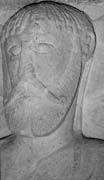
Object type: Crucifixion panel
Measurements:
H. 74 cm (29 in); W. 58 cm (22.8 in); D. 30.5 < 33 cm (12 < 13 in) (estimated: see p. 109);
Depth of carving of Christ's body 6 cm (2.4 in)
Stone type: Very light grey (N8) partly recrystallised oolitic, shelly muddy limestone. Sparse bivalve shell debris 5 to 10 mm. Probably White Limestone Formation, Great Oolite Group, Middle Jurassic.
Plate numbers in printed volume: Ills. 101-2; Fig. 31A
Corpus volume reference: Vol 10 p. 155-7
(There may be more views or larger images available for this item. Click on the thumbnail image to view.)
Daglingworth 2, 3 and 4 were discovered built into the jambs of the chancel-arch in the course of the restoration of the chancel in 1850–1; the stones were set with the carved faces concealed within the masonry (see further Chapter IX, pp. 108–10) (Gloucestershire Archives, P107 IN 4/1, p. 122; see also Bazeley 1887–8, 66; Bagnall-Oakeley 1892–3, 260–2). The panels were initially set in the E face of the chancel-arch wall above the chancel-arch with no. 2 in the centre, no. 3 to its south and no. 4 to its north. The panels were moved to their present position in 1918 (Carver n.d., 11).
Unframed Crucifixion panel. The cross has splayed arms and a tapering shaft. As with Daglingworth 1, the figure of Christ, with cruciferous halo, is a Coatsworth type 1 figure (Coatsworth 1988, 167 n. 29). The remains of a suppedaneum survive under Christ's feet, but the lower part of the panel has been cut off, removing most of the suppedaneum plus the feet of one of the flanking figures and part of the feet of the other. The upper part of the panel may also have been cut off. Christ wears a loin-cloth which droops at the back. The loin-cloth is held up around Christ's hips by a double-strand knotted girdle. Downward-pointing, V-shaped inscribed lines denote folds in the cloth on either side of a central panel with vertical inscribed lines. Christ's arms, neck, chest with nipples and belly are all carefully carved. Coatsworth drew attention to the collar bones, which are especially pronounced, and, which together with strands of hair that fall either side of Christ's neck, have led some previous commentators to suggest that he is wearing a tunic. She showed that this is not so (Coatsworth 1979, ii, 79; eadem 1988, 179). Christ's face is long, with a forked beard and a moustache with curling tips. His mouth is small, his nose is long, and his eyes are quite large and almond-shaped. He wears his hair in a fringe with curling tips and a central parting. His ears are small and set high on his head. Christ's outstretched arms are slightly bent at the elbows. His right hand is missing and the left is damaged, but it is still possible to see that the hand would have been large, rather out of proportion to the rest of the figure (as with Daglingworth 1). Christ is flanked by Stephaton and Longinus, with goblet or cup and spear. Both figures wear high-necked, long-sleeved tunics with pleated skirts. They have double-cord, knotted girdles. Stephaton, to Christ's left, hold up a cup of sour wine (rather than a sponge soaked in wine). In his other hand he holds the pot of sour wine. His head is quite round, his eyes are slightly bulbous and he wears a moustache with curling tips. His lower lip protrudes a little and his nose, now damaged, is fairly broad. His hair is receding, surviving only on either side of a bald crown almost as if he was tonsured from front to back across his head. Longinus carries a spear and what is probably a scourge. His head, long and narrow in outline, is damaged but it is possible to see that he wears a forked beard and a moustache with curling tips.
The Crucified Christ flanked by Stephaton and Longinus is a fairly widespread iconographic image in Ireland and in earlier Anglo-Saxon art, but is rare in late Anglo-Saxon England. Indeed Raw lists only six carvings, two ivories and one manuscript example from tenth- and eleventh-century England (Raw 1990, 150–1). The manuscript example is Cotton Tiberius C.VI, a mid eleventh-century psalter (Temple 1976, 115–17, cat. 98, ill. 311). The two ivories are of late tenth- or early eleventh-century date and are now in the Victoria and Albert Museum (Beckwith 1972, 124, 125, ills. 69, 71). Of the stone carvings, only two — this Daglingworth panel and a piece from Romsey in Hampshire — are southern examples, the rest being from northern England (Alnmouth, Aycliffe, Gosforth and Penrith). A date in the late fifth century proposed by Bradfield is completely untenable, as is his suggestion that the stones are the work of Visigothic carvers (Bradfield 1997).
Christ in the Cotton Tiberius psalter illumination offers an Anglo-Saxon parallel for the curling tipped moustache that is an obvious feature on two of the Daglingworth figures of Christ. The looped, fringed hair style of all three figures on this stone, together with the other figures in this group of carvings, can also be paralleled in the Cotton Tiberius illumination in the hairstyle of Longinus, and a further example of this hairstyle can be found on the figure of St John on the crucifixion folio 3v in a late tenth-century psalter from Winchester (Temple 1976, 64–5, cat. 41, ill. 142). It should, however, be noted that these features have been used, together with other material, to suggest that the panels belong to the late eleventh or twelfth century (Kendrick 1949, 50–1; Coatsworth 1979, ii, 80–1; Coatsworth 1988, 179).
The two ivory pieces, which show angels or personifications of the Sun and Moon above the cross-arms and Longinus and Stephaton below, may have been plated with gold, painted and studded with small jewels or jet beads. One of these ivories may have been used as a pectoral cross and the other may have acted as a reliquary. Clearly the iconography of the crucifixion with Stephaton and Longinus was still valued in the late Anglo-Saxon period if it was chosen for these small but important items of personal adornment.
Coatsworth has suggested that the Romsey panel, which has angels above the cross-arms and the figures of Mary and John as well as Stephaton and Longinus, can be dated convincingly to the late tenth century (Coatsworth 1988, 167–8, ill. 1a), although Tweddle has since proposed a ninth-century date (Tweddle et al. 1995, 261–3, ills. 453, 455). The combination of supporting figures also indicates that a different iconographic statement is intended to that portrayed by the Daglingworth stone.
This Daglingworth carving may, therefore, stand alone in the late Anglo-Saxon period in southern England. As has been indicated above, elements of the style and the iconography can be paralleled in late tenth- or eleventh-century material, but it is equally true that the style and subject matter could belong to the twelfth century. However, if the art-historical parallels are set beside the date of the archaeological context from which the panel came (see Chapter IX, pp. 108–10), then a date for the Daglingworth carving of late tenth century to early eleventh century is the most likely.
The Daglingworth carving is different from most representations of the Crucified Christ flanked by Stephaton and Longinus in one quite fundamental way. The figures of Stephaton and Longinus are diminutive when compared to Christ. He is represented as powerful, in control despite being on the cross, the victor rather than the vanquished, and the flanking figures seem to reinforce this sense of victory. Stephaton holds the cup up to Christ not on a stick or a branch of hyssop but in his hand almost as if he is saluting him, while Longinus stands stiffly to attention, with his spear resting on the ground like a royal bodyguard. He also holds what seems to be a scourge, the symbol of Christ's punishment under Pilate, but both he and, by implication, the worldly power of Pilate have been overwhelmed by Christ's ultimate victory.
This calm assumption of power is, perhaps, the underlying theme that binds all of the Daglingworth figures together — Christ enduring the pain of the cross with quiet dignity, Christ victorious over the cross and over the power of men, Christ Enthroned in Judgement and Majesty, and even Peter the Rock.
(See Chapter IX for an analysis of the archaeological context, and Chapter III for a discussion of possible local parallels for the carving style used on the Daglingworth panels.)
