Select a site alphabetically from the choices shown in the box below. Alternatively, browse sculptural examples using the Forward/Back buttons.
Chapters for this volume, along with copies of original in-text images, are available here.


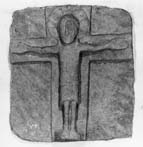
Object type: Crucifixion panel
Measurements:
H. 53.5 cm (21 in); W. 48 cm (18.8 in); D. unknown
Max. depth of carving 5.5 cm (2.2 in) (head and suppedaneum); depth of cross 1.5 cm (0.59 in)
Stone type: Greyish orange (10YR 7/4, sparry matrix supported shelly oolite with ? glauconite grains. Ooliths range in size from 0.2 to 1.2 mm and the shell debris from 5 to 8 mm. The shell debris looks mainly of bivalve origin. Probably White Limestone Formation, Great Oolite Group, Middle Jurassic.
Plate numbers in printed volume: Ill. 100; Fig. 31B
Corpus volume reference: Vol 10 p. 155
(There may be more views or larger images available for this item. Click on the thumbnail image to view.)
In 1850–1 the chancel of Daglingworth church was rebuilt. The rector from 1841–89, Canon H. C. Raymond-Barker, left notes in which he described how this stone had been set in the east wall of the chancel externally above the east window, from 'a very remote date, and probably from the building of the Chancel'; it was removed in the course of the restoration but subsequently replaced in its original position (Gloucestershire Archives, P107 IN 4/1, pp. 121–2); see also Bazeley 1887–8, 66; Bagnall-Oakeley 1892–3, 262 n.1; Glynne 1902, 58–9; Keyser n.d.; Taylor and Taylor 1965, I, 188. The stone was removed from the east gable of the chancel for conservation reasons in 1972 and placed in its present position (Coatsworth 1988, 166).
Crucifixion panel. The cross tapers from the top to the bottom of the shaft, and the background is coarsely chiselled or axed with round ended, diagonal tooling. The figure of Christ, with cruciferous halo, is a Coatsworth type 1 figure (Coatsworth 1988, 167 n. 29). He stands upright with straight legs, and wears a loin-cloth which droops a little at the back. The sides of the loin-cloth are inscribed with diagonal lines denoting folds, while the front of the loin-cloth has weathered away, but the remains of diagonal or V-shaped fold lines can still just be seen. A roll of cloth or a girdle, now also badly weathered, holds the loin-cloth around Christ's hips. The figure's belly and chest are carefully shaped, but the hands are large. Christ's feet are supported by a wedge-shaped suppedaneum. Strands of hair fall over his shoulders on either side of his neck. Christ's face is bearded with a long straight nose, but little remains of his mouth and eyes. There are no flanking figures.
As noted above, this panel was set high on the external face of the east gable until 1972 and is, as a consequence, much more weathered than the other three Daglingworth panels. However, the similarities in style and detail employed on this carving and the figure of Christ on Daglingworth 2, indicate that this crucifixion should be seen as part of the same scheme.
(See Daglingworth 2 for comments that are relevant to the dating of all four panels, Chapter IX, p. 108 for an analysis of the archaeological context, and Chapter III, p. 27 for a discussion of possible local parallels for the carving style used on the Daglingworth panels.)
There is no pre-Conquest historical evidence for Daglingworth, but it has plausibly been suggested that Daglingworth was a secondary minster created out of a larger territory originally served by an early minster at Cirencester; Daglingworth perhaps served the Duntisbourne valley to the north of Cirencester (Slater 1976, 95). A document of c. 1155 does indeed refer to Daglingworth as the 'monasterium de Dantesburne'; since Daglingworth was never in any sense monastic, it seems likely that the scribe had the English word minster in mind (Clark 1905–11, i, 134 n.3).
