Select a site alphabetically from the choices shown in the box below. Alternatively, browse sculptural examples using the Forward/Back buttons.
Chapters for this volume, along with copies of original in-text images, are available here.


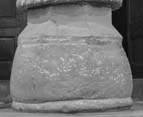
Object type: Font reused as pedestal for later font1
Measurements:
Upper font: H. 44 cm (17.3 in); W. external diam. 75 cm (29.5 in); internal diam. (of bowl) 52.5 cm (20.6 in); internal depth 21.5 cm (8.5 in)
Lower basin-shaped font: H. 41 cm (16.1 in); W. (external diam.) 76.5 cm (30 in) (N/S); 78 cm (30.7 in) (E/W)
It was not possible to take internal measurements because the font is upside down on the floor.
Stone type: Upper font: grey-red sandstone. Lower font: grey-red sandstone
Plate numbers in printed volume: Ills. 758-9
Corpus volume reference: Vol 10 p. 387-8
(There may be more views or larger images available for this item. Click on the thumbnail image to view.)
The upper font is square in plan becoming circular at the base with a cable moulding around the lower edge 6 cm (2.4 in) wide. The font rests on a short, modern octagonal shaft which is supported by the inverted basin-shaped font described below. There are splendidly dynamic figures on all four faces, and the truncation of some of the heads, and the upper parts of other elements of the carving, shows that as much as 8 cm (3.1 in) has been removed from the top of the font. If there was a similar moulding around the rim to that around the base then a further 6 cm (2.4 in) has been lost. This would add 14 cm (5.5 in) to the depth of the bowl which is, at present, quite shallow (see above under measurements). The figures depicted are as follows: on the east face, there is an Agnus Dei (now headless) trampling on the head of a Great Beast that is emerging from flames or waves; on the north face is what seems to be a serpent or dragon flying above flames or waves similar to those on the east face; the south and west faces carry pairs of round-faced figures wearing heavy cloaks or copes. Each has his right hand raised in blessing and a book in his shrouded left hand. The south-west corner has been largely destroyed, but the south-east corner carries a damaged figure (an angel?) with dramatic, upswept wings. The north-east corner shows a seated figure wearing a long-sleeved shirt and full, pleated trousers. His right hand rests on his hip while in his left hand he is holding a small bowl up towards the dragon on the north face. The north-west corner carries a figure with what look like bound hands, held palm outwards with fingers raised and the thumbs together. Houghton, however, after initially giving a similar description, later suggested that 'the supposed cords are more probably an ornamentation of the sleeves such as is seen on other figures on this font' (Houghton 1917, 57–8). The body is outlined with parallel carved ridges that are in turn surrounded by a complex of horizontally carved lines that fan out to create a border between the figure and adjacent images. The effect is similar to the border created by the outer edges of the wings on the figure at the south-east corner.
The lower (inverted) font is, as indicated above, basin-shaped with a rather irregular roll-moulding around the rim, 8–9 cm (3.1–3.5 in) wide. The body swells slightly at the shoulders before curving in towards the base. The base of the font has been roughly re-shaped to match the octagonal shaft that now stands upon it. It is not possible to say how big the actual bowl of the font is, nor if the base is flat although this last seems likely. The font is almost circular in plan and the outer face is roughly carved with no sign of decoration other that the moulding around the rim.
Appendix K item (Fonts and stoups in the Western Midlands).
In 1908 Bond suggested that the upper font was Anglo-Saxon, but in an article published eleven years later Houghton declared that the font was twelfth century (Bond 1908, 138; Houghton 1917, 57). The present writer agrees with Houghton. There is a summary description of the font in the on-line entry for the Corpus of Romanesque Sculpture in Britain and Ireland, and detailed descriptions with interpretative suggestions in Houghton and Bond (Houghton 1917, 56–8; Bond 1908,131, 135, 138).
In some ways the now inverted lower font is more intriguing than the marvellously robust upper font. It is difficult to envisage a time when a church would decide to replace a carved (but perhaps damaged) font with a new one that is so much simpler, even rustic, but this is apparently what happened at Curdworth. Perhaps the 'basin' font was not, in fact, new but was found when they dug the hole to bury the twelfth-century font, as happened at Haselbech (Hazlebeach) in Northamptonshire. There, during restoration in 1860, 'a new font was set up and the ancient font was solemnly interred beneath the church floor, whereupon another font, yet more ancient, was discovered' (Bond 1908, 278). Stocker notes that this 'yet more ancient' font was uncarved, and then gives a postscript to the story that might be relevant to Curdworth. In 1903 'the 1860 font at Heselbech was sold for use in a new urban parish and the late medieval one was exhumed and reverently re-established in the location it had held prior to 1860, over its buried predecessor' (Stocker 1997, 17).
At Curdworth there is, in fact, a third vessel which now stands in the south porch of the church. The flat-bottomed bowl of this vessel (diameter 44 cm and depth 24 cm) is carved into the top of a plain square block of grey sandstone with chamfered corners (H. 42 cm, W. 50.5 cm). One corner of the rim has been roughly repaired with cement (probably where a hinge has been broken out of the stone) and in the opposite corner there is the remains of the oval socket for a locking staple. This suggests that the vessel was provided with a lockable lid, indicating that it was indeed used as a font. This is surely a post-Reformation or even post-Restoration vessel, a simpler version of the font dated 1669 now in Peterborough Museum (Bond 1908, 266–7).
If all three fonts were used in this church, then perhaps the 'basin' font is the earliest. Large plain fonts, more normally tub- or bucket-shaped, are not uncommon and are generally presumed to be of late eleventh- or twelfth-century date. Plain basin-shaped fonts are less common. An eleventh-century date has been suggested for the basin-shaped font at Aller, Somerset (Cramp 2006, 181, ill. 354). Kinwarton font, Warwickshire, similarly shaped but now set on a modern pedestal, is described as 'old, but not medieval', but no reason for this assessment is given (Houghton 1917, 54, pl. IV, fig. i). The bowls of the pedestal fonts at Dinsdale (Co. Durham) and Shepton Mallet (Somerset) are also basin-shaped, and eleventh-century dates have been suggested for them (Cramp 1984, 152, pl. 151.791; Cramp 2006, 186, ill. 373).
The shape of the lower font at Curdworth is clearly based upon the ordinary, wide-necked bowl or basin that would have been used in various sizes in a wide range of domestic or industrial situations during the medieval period. John Blair has recently drawn attention to the remarkable diversity in the form and size of fonts that was already fully established by the early Norman period. He also reminds us that many of the earliest fonts are skeuomorphs which 'can perpetuate established and valued symbols of culture and ritual into new social, institutional and physical environments. The skeuomorphic fonts seem to embody ... traditional images of the kind of containers that were in familiar use for infant baptism' (Blair 2010, 152). Perhaps the Curdworth font is just such a vessel (see also Chapter V, Further thoughts on fonts, pp. 62–4).
[1] There are, beside the Deerhurst font in Gloucestershire which has been shown to be of ninth-century date (Deerhurst St Mary 3, p. 163, Ills. 132–44, 740), a number of fonts in the study area that have been said to be Anglo-Saxon or could be Anglo-Saxon. There are also objects like Bisley All Saints 6 (below, Ills. 732–4) that has been described as a font fragment, and Kenchester 1 (p. 382, Ills. 735–6) that now functions as a font, but that are much smaller than all of the other vessels and may, therefore, have originally been used as stoups or lavabo bowls (see below, and 'Further thoughts on fonts' in Chapter V, pp. 62–4, Table 1). In the following Appendix three vessels that were probably stoups have been listed first, followed by the fonts in chronological order by form (cylindrical tub fonts, square tub fonts, tapering or cone-shaped fonts, and bowl-shaped fonts). Some clearly belong to the Overlap period but are included because they show continuity of form and decoration into the later decades of the eleventh century and beyond.
The tub font at Deerhurst is the earliest securely datable font, and an eighth-century Anglo-Saxon ivory panel in the Victoria and Albert Museum that depicts the baptism of Christ also show a tub font (Beckwith 1972, 119, cat. 5, ill. 20). Tub fonts have, therefore, been placed first in the catalogue below. However, in the south-west of England the earliest surviving fonts are bowl-shaped (copies of domestic bowls) and it seems inherently likely that both tubs and bowls were in use at the same time (Cramp 2006, 38; Blair 2010).
Many of the western Midlands fonts seem to have been carved from newly worked stone, but several are carved into reused Roman capitals and bases. One of the reused Roman bases (at Woolstaston, Shropshire), almost certainly came from the Roman city of Viroconium (Wroxeter) but, unlike the similarly reused bases at Wroxeter St Andrew and Shrewsbury Abbey (pp. 390, 389, Ills. 762–3, 768–70), this vessel has been very crudely reshaped and the bowl is only 8 cm deep (p. 386, Ills. 756–7). It does not look like a font at all but it would, in fact, be ideal for the baptism of adults by affusion or aspersion. Adult baptism must have been very rare by the later Anglo-Saxon period, so it seems possible that the Woolstaston font might be very early, perhaps even sub-Roman.
