Select a site alphabetically from the choices shown in the box below. Alternatively, browse sculptural examples using the Forward/Back buttons.
Chapters for this volume, along with copies of original in-text images, are available here.


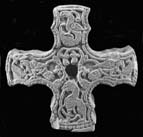
Object type: Cross-head
Measurements:
H. 83 cm (32.6 in); W. 85 cm (33.4 in); D. 24.5 > 18 cm (9.6 > 7.1 in)
Left arm tapers outwards on the top from 21 > 17.5 cm (8.3 > 6.7 in), and on the bottom from 21.5 > 19.5 cm (8.5 > 7.7 in).
Right arm tapers outwards on the top from 21 > 18.5 cm (8.3 > 7.3 in), and on the bottom from 22 > 20 cm (8.6 > 7.9 in)
Stone type: Yellowish grey (5Y 8/1), muddy, grain supported oolite with no visible shell debris. Ooliths 0.5 to 0.8 mm. Remnants of pale buff coloured paint cover in places. Cleeve Cloud Member, Birdlip Limestone Formation, Inferior Oolite Group, Middle Jurassic.
Plate numbers in printed volume: Ills. 621-33; Figs. 25A-H, 27M-N
Corpus volume reference: Vol 10 p. 353-6
(There may be more views or larger images available for this item. Click on the thumbnail image to view.)
Reported in a letter from Mr. W. T. of Fladbury to the Gentleman's Magazine in September 1793 as having recently been discovered by him 'fixed in the wall of the chancel' ((—) 1793, 791). The cross-head was apparently left in position; Brassington (1894, 50) described it as 'built into the outside of the south wall of the chancel (close to the angle buttress of the east wall)'. In 1906 the cross-head was reported to be standing on the sill of the east window of the south aisle (Willis-Bund and Page 1906, 183). It would thus seem highly probable that the cross-head was removed from the south wall of the chancel when the chancel was rebuilt in 1893–4 (Brooks and Pevsner 2007, 248–9); the cross-head is indeed described in sources of 1896 as having been taken out of the wall during this rebuilding ((—) 1896, 70; Kelly 1896, 62).
The cross-head has been carved from a square block. All four 'arms' are double-cusped, and the arm-pits are curved to form a classic type D9 cross-head in the list of types published in the Grammar of Anglo-Saxon Ornament (Cramp 1991, xvi, fig. 2). There is carving on the front, back and side faces. The upper surfaces of the cross-arms and the cross-head carry no trace of carving, but it may have been weathered off. In the centre of the cross-head on face A there is a circular hole c. 8 cm in diameter and 4 cm deep which appears to be part of the original design and was probably the seating for a raised boss.[1] There is a double edge-moulding around faces A and C of the cross-head. The inner moulding is plain, and the outer moulding is a cable with an incised line down the centre of each twist. Across the neck, below the slightly downward-curving inner moulding, there is a row of large, squarish pellets.
Four round holes about 2 cm in diameter and up to 6 cm deep have been drilled into the top of the cross-arms (two on each arm) and two more into the top of the cross-head (face E). In between each pair of holes is a smaller diameter hole. These are all probably for window bars and suggest that, at some point, the cross-head was reused as part of the sill of a window. The holes are surrounded by wider holes that taper downwards from c. 7 cm diameter and in some cases run together. These wider holes may be associated with the removal of the window bars. About 13 cm up from the base on face A there is a drilled hole about 2 cm in diameter filled with lead. This hole has the same dimensions as the drilled holes across the top of the cross, but may be a pouring hole for jointing the cross-head to the shaft. It was not possible to check if there was a hole in the base that might confirm this hypothesis.
A (broad): A quadruped stands in the lower arm, enmeshed in what is probably its own, greatly extended, median-incised tail. On either side of the creature's head there are hatched, horseshoe-shapes (rather like the domed clips which attach foliate ornament to the side frames on some West Saxon carvings) from which median-incised plant stems climb up and around the missing central boss before bifurcating at ridged nodes. Between the stems a single round fruit on a straight stalk grows upwards from each node. Below the nodes clusters of three fruits grow out from the main stems. From the nodes, two of the stems curve back over each other and end in downward-hanging lobed leaves. The other stems sweep onto the side arms where they end in large, curling-tipped lobed leaves. On each of the side arms there is a large bird, straddling the plant stems and apparently pecking at the leaves. The upper arm contains a winged creature with a bird-like beak but a broad curving body that seems to end in a curling-tipped leaf-shape. It is possible, however, that the leaf is unattached and that the creature's body passes behind it to end in a narrow, curving tail with a rounded tip. This upper creature is probably a griffin, and from the back of its head sprouts what seems to be a downward-curving crest which has a circular, hollow-centred terminal. All the leaves are divided by central veins, either side of which the leaves are covered with diagonal hatching. Each leaf also has a plain border. The creatures and birds all have drilled eyes and their bodies are outlined, but they are otherwise treated in rather different ways. The two birds and the griffin have plain bodies with carefully incised wing and tail feathers. The birds' bodies are rather more moulded than that of the griffin. The beaks of all three are hooked and the clawed feet are large. The griffin has five parallel lines incised onto its neck and the beak is clearly differentiated from the rest of the head. The two birds have double incised lines between their heads and bodies. The quadruped is very different, with zones of contoured hatching all across its body and neck. Its legs are plain and it has huge, clawed feet. The creature has open, outlined jaws with prominent canine teeth, and it is busily biting it own tail. A fine, incised, curling-tipped brow line run back from the drilled pupil, to be joined by a second incised line that defines the bottom of the creature's elongated eye.
B and D (narrow): The sides of the cross, including the underside of the arms, are covered with broad, simple, incised rectangular meander patterns, formed from pairs of double straight-line spirals (Allen 1903, 323, no. 841a).
C (broad): As on face A, a quadruped stands in the lower arm, enmeshed in its own, median-incised tail. Above the creature, there is a complex, median-incised plant stem that does not appear to grow from any specific point. Instead the stem rises into the top arm and falls on either side of the now damaged centre point of the cross-head, repeatedly bifurcating though a series of ridged nodes. At each node a small fruit grows from between the splitting stems. Most of the stems terminate in clusters of three fruits. However, one of the downward-growing stems ends in a hatched, horseshoe shape, similar to those of face A but in this case seemingly attached to the back of the lower creature. Rosemary Cramp thought that this was a raised wing (Cramp 1977, 230). In the upper arm a stem curls round in an almost complete circle before terminating in an animal head. The animal seems to have a crest rising up from its head, or perhaps it is a single arm. It has a wide, almost closed mouth from which protrudes a long, curling-tipped tongue. Perhaps this is intended to be a frog. In the side arms there are two quadrupeds, lying down and facing away from each other. They have curling-tipped tails and their tongues are drawn out into knots of interlace. Both creatures have large clawed feet. The creature to the left has a smallish head with upright ears and small, rounded jaws, and might be a cat. The creature to the right has a more hunched back, much heavier jaws and what is probably the remains of at least one quite large ear. This looks more like a dog. The head of the lower creature is rather damaged but looks very like that of the lower creature on face A. These might both be lions or leopards. All four creatures on face C, as on face A, have drilled eyes and outlined bodies, but, unlike face A, the bodies (or in one case the neck) of all four are treated in a similar manner with zones of contoured hatching.
There are remarkably few surviving Anglo-Saxon cross-heads, whole or fragmentary, in the five counties that constitute the Western Midlands in the Corpus. Warwickshire, Herefordshire and Shropshire have none, while there were two, possibly three, small fragments from Gloucestershire (Berkeley Castle 1, Bisley Parish 1 and Deerhurst St Mary 1, pp. 130, 146, 161, Ills. 13–16, 58–9, 123–8), the last of which was stolen from a display case in 2003. Worcestershire has the fragment from Belbroughton (p. 353, Ills. 618–20), the complete cross and shaft carved onto the Lechmere Stone (Hanley Castle 1, p. 357, Ill. 640), and the magnificent survivor at Cropthorne, although rather perversely this wonderful carving has lost its shaft.
The Cropthorne head has been widely acclaimed. In 1938 Kendrick placed it in the second quarter of the ninth century and compared it to the Acton Beauchamp (Herefordshire) and Wroxeter St Andrew (Shropshire) cross-shafts (Kendrick 1938, 186; see this volume, pp. 281, 314, Ills. 496–501, 562–4). In 1977 Rosemary Cramp included the Cropthorne cross-head and Acton Beauchamp cross-shaft as important pieces in a west Mercian group of early ninth-century carvings which she suggested might have started at Cropthorne or Gloucester (Cramp 1977, 192, 225–6). One of the cross-shafts from Gloucester (St Oswald 3), should be added to those above (p. 209, Ills. 278–86). Elsewhere in this volume it is suggested that these four carvings are all the products of a single centre or group of carvers, possibly based in Worcester, and they have been called the 'Cropthorne' group (see Chapters III and VI, pp. 25, 67).
The carvings are dominated by a varied menagerie of real and exotically heraldic animals, full of life and dynamic movement. The creatures are enmeshed in interlacing plant stems or their own elongated tails or tongues. On all but the Gloucester St Oswald carving, the plant stems grow from hatched, horseshoe-shaped objects that are similar to the domed clips which attach foliate ornament to the side frames on some West Saxon carvings (Plunkett 1984, i, 210; Cramp 2006, 51, 54). It is, however, possible that these shapes are intended to represent plant pots like those from which plant-scrolls climb on the opening Matthew and Mark folios in the eighth-century Barberini Gospels (Vatican City, Biblioteca Apostolica Vaticana, MS Barb. lat. 570, fols. 11v, 50v: Alexander 1978, 61–2, cat. 36, ills. 174, 176–8). The Barberini Gospels also offers a parallel for a tri-lobed leaf form, used frequently on these carvings and on the late eighth- or early ninth-century narrow frieze from Breedon-on-the-Hill in Leicestershire (Jewell 1986, 96–7, pls. XLII, XLIII; Dales 2006, 40, ill. 22). One plant stem on face C at Cropthorne ends in an animal-head terminal (Ill. 633) that is very similar to the repeated motif on a carved fragment from Müstair in Switzerland (Cramp 1977, 225, fig. 61e; Dales 2006, 40–1, ill. 26). Similar animal-head terminals can be found in manuscripts illumination, for example on the initial L of St Matthew's gospel from the later eighth-century St Petersburg Gospels (St Petersburg Public Library, Codex F.v.I.8, fol. 18r: Wilson 1984, 88, ill. 110; Dales 2006, 43, ill. 32).
The bodies of the birds and beasts on all four of these carvings are sometimes covered with zones of carefully contoured hatching and sometimes with more natural muscles and fur — often on the same face of the carvings. This can be seen on Cropthorne 1, face A, on Gloucester St Oswald 3, faces B and D, at Acton Beauchamp, and on the now separated elements of the Wroxeter St Andrew cross-shaft. The combination of surface treatments displays a unique fusion of influences, with metalwork offering the closest parallels for the hatching, and earlier Northumbrian carving and manuscript illuminations (for example the lion from the Echternach Gospels) suggesting parallels for the more natural effects. The naturalist treatment is also seen in the bull, lion and eagle from the gospel miniatures in The Book of Cerne, a Mercian manuscript from the first half of the ninth century (Cambridge, Univ. Lib., MS Ll.i.10, fols. 12v, 21v, 31v: Alexander 1978, 84–5, cat. 66, ills. 314, 315; Brown 1996, 162-84, pls. I, III, IV; this volume, Ills. 773–4). Cramp suggested early ninth-century north Italian and Spanish carved stone parallels for the division of animal bodies into patterned blocks (Cramp 1977, 230), but a metalwork parallel for the zonal hatching (and the spiral shoulder-joints that appear on some of the creatures) can be found rather nearer to home on the nose-guard of the Coppergate Helmet from York (Wilson 1984, 67, ill. 64; Tweddle 1992, 969, figs. 431–2). Irish metalwork also offers parallels, for example the bell-shrine fragments from the Killua Castle collection, the openwork mount from Phoenix Park, Dublin, and the decorated plaque from Inchbofin Island, Co. Westmeath (Ryan 1989, 143–4, 150, cat. and ills. 137, 145, 146).
This early ninth-century group of carvings appears to lie at the beginning of the widespread ninth-century fashion for animal ornament that covers much of south-west Mercia and Wessex. As the century progressed the carving style became increasingly harsh and seems to end in the late ninth or early tenth centuries with creatures that are little more than patterned, twisted ribbons. This development of animal carving through the ninth century has recently been studied in some detail by Cramp (2006, 42–8, 71–2) and Plunkett (1984, i, 180–202).
Cropthorne first appears as the place at which King Berhtwulf of Mercia made a grant of land in Wychwood to the bishop of Worcester in 840 (Sawyer 1968, no. 196). At the time of the Domesday survey Cropthorne was an estate of 50 hides held by the bishop on behalf of the monks of the cathedral community (Thorn and Thorn 1982, no. 2,72). It is evident that Cropthorne was one of a series of important minsters along the Avon valley (Bond 1988, 133–4; Bassett 1996, 169–72; Blair 2005, 470 n.196), but whether it was already in episcopal hands when this fine cross-head was produced is uncertain; the charter of 780 in the name of Offa purporting to grant the royal vill of Cropthorne to Worcester is a forgery of eleventh-century date (Sawyer 1968, no. 118; Tinti 2010, 214–16, 312–13).
