Select a site alphabetically from the choices shown in the box below. Alternatively, browse sculptural examples using the Forward/Back buttons.
Chapters for this volume, along with copies of original in-text images, are available here.


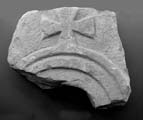
Object type: Architectural panel with opening
Measurements: H. 48 cm (18.9 in); W. 47 < 57 cm (18.5 < 22.4 in); D. 16 < 18.5 cm (6.3 < 7.3 in)
Stone type: Non-calcareous, greyish orange pink (5YR 7/2), clast-supported, quartz sandstone. The sub-rounded to sub-angular clasts range from 0.2 to 0.5 mm, but are mostly 0.3 to 0.4 mm across; they are mostly quartz, but there are a few white feldspar fragments. Although this piece is of similar grain size to Coventry (priory) 1 above, it differs by being non-calcareous and not such a deep red. It corresponds more with the Triassic Bromsgrove Sandstone Formation, Sherwood Sandstone Group, than the Carboniferous Corley [formerly Coventry] Sandstone.
Plate numbers in printed volume: Ills. 589-91; Fig. 20E
Corpus volume reference: Vol 10 p. 338
(There may be more views or larger images available for this item. Click on the thumbnail image to view.)
Found in 2001 during controlled excavations in the precinct of the medieval priory of St Mary; the discovery was made in an unstratified context in a service area close to the mill on the north side of the priory precinct (Rylatt and Mason 2003, 2–3, 53–4, 75–6, 136–7). Site code PP01. Type-stone number T878.
Panel with arched opening surmounted by a cross. This is probably a window head, but it is possible that it could instead have been part of a screen. The carving consists of an arch in relief above the semi-circular head of an opening that would have been about 30 cm (11.8 in) wide. The arch itself is split into three concentric bands by two broad, round-bottomed grooves. On top of the arch is an equal-arm cross 20 cm (7.9 in) high and 24 cm (9.4 in) wide which is carved in progressively higher relief as it rises (1 cm (0.4 in) at the point where it sits on the top of the arch and 2 cm (0.8 in) at the top of the upper arm). All four arms of the cross are wedge-shaped (type B6). The remains of a rebate cut in the lower right edge of the stone indicates later reuse, together with rough curved shaping of the back face of the stone in the same area.
Although the block on which this arch is carved is large, it is similar in size to the heads of several other Anglo-Saxon windows and openings, for example the belfry openings in the tower at Earl's Barton, Northamptonshire (c. 50 cm (19.7 in) in height and width). Indeed the heads above the double windows in the second stage of Earl's Barton tower, which carry similarly carved crosses in shallow relief, are in fact bigger — c. 60 cm (23.6 in) high and c. 115 cm (45.2 in) wide (Taylor and Taylor 1965, i, 222–6, figs. 100, 458; Taylor 1978, fig. 691). However, the progressive deepening of the Coventry carving means that the 'background' face of the stone slopes inwards from bottom to top, and, while visually this would have emphasised the cross, it is difficult to see how this would have worked in relation to a wall face unless there was a (now missing) frame around the edge of the stone, or the stone was set in a frame of strip-work pilasters. An alternative suggestion might be that the stone was part of a panelled screen, in which the 'thinning' of the panel was in part designed to reduce the weight in the upper part of the screen and therefore improve its structural stability. This fragment presumably also comes from one of the churches in the early minster complex (for which see no. 1 above); in this case the fragment may well come from the abbey founded by Leofric or from an earlier church on the site of St Mary's. A shallow-relief cross, similar in size and shape to the Coventry example, was noted at Limpley Stoke, Wiltshire on a reused slab that may originally have been a tenth- or eleventh-century lintel (Cramp 2006, 220–1, ill. 462).
