Select a site alphabetically from the choices shown in the box below. Alternatively, browse sculptural examples using the Forward/Back buttons.
Chapters for this volume, along with copies of original in-text images, are available here.


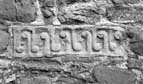
Object type: Architectural; string-course or frieze
Measurements: H. 19 cm (7.5 in); W. 71 cm (27.9 in); D. unknown
Stone type: Yellowish grey (5Y 7/2), weakly calcareous, poorly sorted, clast-supported, dominantly medium grained sandstone bedded. The sub-angular to sub-rounded quartz grains vary from 0.2 to 0.6 mm across, but are mostly in the range 0.3 to 0.4 mm. A few scattered pebbles up to 10 mm across; one mud clast 2.5 cm across. Downton Castle Sandstone Formation? (Lower Old Red Sandstone Group, Old Red Sandstone Super Group), Upper Silurian (Pridoli) age.
Plate numbers in printed volume: Ill. 507; Fig. 20J
Corpus volume reference: Vol 10 p. 286-7
(There may be more views or larger images available for this item. Click on the thumbnail image to view.)
Section of string-course or frieze. The stone is carved in low relief with pairs of curling-tipped, straight-sided stems which rise and fall alternately from the narrow borders along the top and bottom of the stone. The lower border only survives in part. There is a similar vertical border at the left end of the stone.
This is an unusual design which, at first glance, appears to be a simple repeating motif but gradually changes from one end of the stone to the other. At the east (left) end the plant stems are tall and slender, the curling tips are clearly defined and between the tips there is a small round pellet. Moving to the right the next three pairs alternate with thicker rising and thinner falling stems, while the last two pairs are both thick or both thin and the small pellet between the tips has disappeared.
The motifs are not unlike the extended plant tendrils in the upper right border of the Beatus page from the early eleventh-century Cambridge University Library, Psalter Ff. 1. 23 which is believed to be a product of Winchcombe Abbey, Gloucestershire (Temple 1976, 97–8, cat. 80, ill. 250). The motifs are also similar to the paired stems with tightly curling tips that are carved on the capitals of two belfry mid-wall shafts at Sompting, Sussex (Tweddle et al. 1995, 183–4, ills. 206–11). No exact parallel for this design has been found, but it carries echoes of some chains of interlace, for example the rather more rounded stopped-plait used on the narrow faces of two sections of the tenth-century Stanwick 1 cross in northern Yorkshire (Lang 2001, 201–2, ills. 753, 757).
