Select a site alphabetically from the choices shown in the box below. Alternatively, browse sculptural examples using the Forward/Back buttons.
Chapters for this volume, along with copies of original in-text images, are available here.


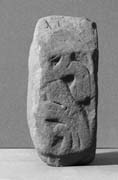
Object type: Part of carved jamb
Measurements: H. 23 cm (9 in); W. 16.5 cm (6.5 in); D. 10 cm (3.9 in)
Stone type: Pale red (5R 6/2), weakly calcareous, clast-supported, quartz sandstone. The sub-rounded to sub-angular clasts range from 0.2 to 0.5 mm, but are mostly 0.3 mm across; they are mainly quartz, but there are a few white feldspar fragments. Corley [formerly Coventry] Sandstone, Keresley Member, Salop Formation, Warwickshire Group, Carboniferous.
Plate numbers in printed volume: Ills. 585-8; Figs. 18c, 24m, 27o
Corpus volume reference: Vol 10 p. 336-8
(There may be more views or larger images available for this item. Click on the thumbnail image to view.)
Found c. 1932 in Palmer Lane 'laid edgewise forming part of the paving of a street some depth below the 'present ground level' (Chatwin 1934, 62; Rylatt and Mason 2003, 136). The site is close to the west front of the medieval priory of St Mary.
The stone is not part of a cross, as suggested by Chatwin 1934, but is part of the carved jamb for a doorway or opening. The full width of the stone survives. Faces A and D are carved in low relief, while face B is plain. The stone is split in half vertically, so that the jointing face (face C) that would have been set against the masonry of the jamb is now missing together with half of the carving on face D.
A (broad): Carved with a creature enmeshed in a plant-scroll, bounded by narrow vertical borders on both sides of the stone. The creature's neck and body are outlined, and the head is twisted backwards so that the body faces right and the head left. The head is quite large in relation to the body. What looks at first like part of a wing is the front leg with a spiral shoulder-joint more deeply outlined, presumably for emphasis. The tail curves up around the inner face of the creature's rear leg. The lower parts of both legs have been lost. The head is complete, with a long, pointed snout (sometimes described as a beak), a large, oval incised eye and a downward curving mouth with a curling lower lip. There is a crest on the back of the creature's head that breaks across one of the volutes of the plant-scroll. The plant-scroll itself is wide and outlined with incised lines. The stem splits just above the creature's head, one half twisting round to form the inhabited volute and the other half curving upwards to pierce, or pass over, the almost horizontal strands of what seems to be a second plant. One of these secondary strands forms a wide loop around the rising stem of the plant-scroll before part of it continues to the right as a broad stem over which lies a tightly curled, slightly oval leaf. The other strand seems to grow downwards and is very narrow. It passes under the rising stem of the inhabited plant-scroll and over the wide loop of the first horizontal strand, before terminating in a small, tight, round bud or leaf.
B (narrow): Plain
C (broad): Destroyed
D (narrow): This face, previously unpublished, carries a plant-scroll that is very similar to that carved on face A. A broad stem, outlined with incised lines, splits in two at a node which is enhanced with three short parallel grooves. One half of the stem twists to the left to form what is probably a volute, with a round-tipped leaf or tendril rising from a point below the surviving carved area, and curving around the inner edge of the main stem. The other half of the stem curves upwards to pass under a separate plant stem which end in a fleshy, club-tipped, downward pointing leaf and part of an upward curving tendril.
The fact that this piece is part of the carved jamb for a doorway or opening and that it was found near the west end of St Mary's Priory, suggests that it might be a surviving element of an earlier church on or near the site (see below). Some features of the carving have been linked to the Urnes style of the eleventh century (Graham-Campbell 1987, 150; Owen 2001, 219, pl. 11.9(b)). However the fleshy plant-scroll in which the creature stands is more like ninth-century work, as is the curling-tipped leaf or tendril tight against the inside of the volute on face D. The present author also believes that the stance of the creature on face A, with the body facing to the right and the head twisted backwards, is very similar to beasts on ninth-century cross-shafts, for example Gloucester St Oswald 3 (Ills. 279, 283) and Frome 1 from Somerset (Cramp 2006, 152, ill. 222), or a late eighth- to early ninth-century string-course or impost fragment from Rothwell in western Yorkshire (Coatsworth 2008, 242, ill. 682). The spiral shoulder joint on Coventry 1 is also found on Gloucester St Oswald 3, Wroxeter 1 (Ill. 562) and a panel from Colerne in Wiltshire (Cramp 2006, 211–12, ill. 434). Two of the parallels noted above (Gloucester St Oswald 3 and Wroxeter 1) are members of the ninth-century 'Cropthorne' group (see p. 73), and it is suggested that Coventry 1, although rather simpler in style, may have been inspired by the 'Cropthorne' carvings and be reasonably close in date.
St Mary's was established as an abbey of Benedictine monks by Earl Leofric of Mercia, who was subsequently buried there in 1057; Leofric's wife, Godgifu (better known as Godiva), seems to have been associated with him in the foundation, which is usually dated to 1043, though the date is not reliably attested. There are various traditions of late medieval and early modern date about an earlier nunnery on the site, possibly associated with St Osburg; no faith can be placed in the details of these traditions, but the cult of St Osburg may indeed be ancient (Hunt 1994; Foot 2000, ii, 71–2; Bassett 2001). Archaeological excavation in and around St Mary's has produced evidence for pre-Conquest burial and possibly for a stone structure of late Anglo-Saxon date (Rylatt and Mason 2003, 12–15, 136–7). By 1102 St Mary's had become a cathedral priory and was part of a major group of churches. Beside it, to the south, stood Holy Trinity and, a little further to the south-east, St Michael's, both churches of substantial dimensions in the later Middle Ages. There were also two further medieval chapels in the vicinity, so that in the twelfth century there were five churches in the same graveyard (Bassett 2001, 12–13, fig. 1). Steven Bassett (2001) has recently made a strong case that there was a minster of Middle Saxon date at Coventry; he argues that Holy Trinity is likely to have been the principal church of the early minster foundation, but there will doubtless also have been other churches in the early complex. It seems very likely that this architectural fragment comes from one of the churches of Middle Saxon date.
