Select a site alphabetically from the choices shown in the box below. Alternatively, browse sculptural examples using the Forward/Back buttons.
Chapters for this volume, along with copies of original in-text images, are available here.


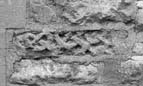
Object type: Fragment
Measurements: H. 10 cm (3.93 in); W. 43 cm (16.9 in); D. unknown
Stone type: Yellowish grey (5Y 7/2), matrix-supported, shelly oolite. Ooliths (forming some 60 to 70% of the stone) are medium-grained in the range 0.2 to 0.5 mm and set in a micritic matrix; most ooliths have fallen or weathered out to give an 'aero-chocolate' texture. Scattered platy shell fragments (forming some 5 to 10% of the stone) up to 1 cm long aligned horizontally. Farmington Freestone?, Taynton Limestone Formation, Great Oolite Group, Jurassic.
Plate numbers in printed volume: Ill. 99
Corpus volume reference: Vol 10 p. 154
(There may be more views or larger images available for this item. Click on the thumbnail image to view.)
None. Noticed by Michael Hare during a visit in May 1978 and mentioned by Verey and Brooks (1999, 298).
Fragment of interlace broken at a slightly oblique angle across the carved face; type uncertain. The design is terminated at the right end by a wide plain border, but extends beyond the stone in the other three directions.
The fact that the interlace on this small fragment extends beyond the surviving upper and lower edges of the stone suggests that the complete design would have been too wide for a string-course. It seems more likely that the stone is part of a gravestone or perhaps a cross-shaft. Another possibility is that the stone derives from a shrine. A list of saints' resting-places dating probably to c. 1180–1230 mentions Coln St Aldwyns as the resting-place of St Ælwinus (a name probably deriving from Old English Æthelwine) (Blair 2002a, 487; id. 2002b, 509).
The presence of a saint's cult suggests that Coln St Aldwyns was a minster church, and it has indeed been suggested on other grounds that Coln St Aldwyns may have been a minster church serving part or all of the territory of Brightwell's Barrow hundred (Slater 1976, 88).
