Select a site alphabetically from the choices shown in the box below. Alternatively, browse sculptural examples using the Forward/Back buttons.
Chapters for this volume, along with copies of original in-text images, are available here.


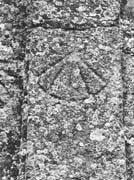
Object type: Sundial
Measurements: H. 15 cm (5.9 in); W. 20 cm (7.9 in); D. unknown
Stone type: Yellowish grey (5Y 7/2), matrix-supported, poorly sorted, micritic shelly oolite. Ooliths range from 0.2 to 0.6 mm, but most are in the range 0.3 to 0.5 mm. Most ooliths have fallen or weathered out to give an 'aero-chocolate' texture. The ooliths form about 65% of the stone. Scattered shell fragments are mostly less than 5 mm across, but a few bivalves are up to 2 cm across. The shell debris constitutes about 5% of the stone. Farmington Freestone?, Taynton Limestone Formation?, Great Oolite Group, Jurassic.
Plate numbers in printed volume: Ill. 490
Corpus volume reference: Vol 10 p. 273
(There may be more views or larger images available for this item. Click on the thumbnail image to view.)
Incised sundial with an unusual quadrant shape divided into four segments by five incised radii. The gnomon hole has been filled in.
Appendix D item (sundials presumed to be of pre-Conquest date).
The four segments of this sundial presumably equate to the 3-hour tides into which the Anglo-Saxons divided the day (Green 1928). The sundial is probably contemporary with the pilaster into which it is carved.
