Select a site alphabetically from the choices shown in the box below. Alternatively, browse sculptural examples using the Forward/Back buttons.
Chapters for this volume, along with copies of original in-text images, are available here.


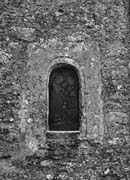
Object type: Window
Measurements:
Stone through which window is cut: H. 81 cm (31.8 in); W. 58.5 > 54 cm (23 > 21.2 in)
Window aperture: H. 49.5 cm (19.5 in); W. 24 cm (9.4 in)
Recessed surround (external): H. 62 cm (24.4 in); W. 30 cm (11.8 in); (internal) H. 63 cm (24.8 in); W. 31.5 cm (12.4 in); D. of recess: 0.5 > 0.8 cm (0.2 > 0.3 in)
Stone type: Yellowish grey (5Y 7/2), poorly sorted, clast-supported, micritic, shelly, oolite. Angular to sub-angular shell fragments (including echinoid spines and bryozoa) up to 5 mm across form about 65% of the stone. The ooliths, which form about 20% of the stone, range from 0.3 to 0.5 mm across. Ardley Member?, White Limestone Formation?, Great Oolite Group, Jurassic (same rock type as Coln Rogers 4).
Plate numbers in printed volume: Ills. 95-6
Corpus volume reference: Vol 10 p. 153-4
(There may be more views or larger images available for this item. Click on the thumbnail image to view.)
This small, round-headed window is surrounded by a shallow rebate on the external wall face and is deeply splayed internally. The window glass is set c. 1 cm in from the face of the rebate, giving the effect of a double-rebate.
Windows carved from single blocks of stone, as this one, are seen as a distinctive Anglo-Saxon feature (Taylor and Taylor 1965, i, 168), and other architectural elements of the church support this suggestion (see Coln Rogers 1–4).
