Select a site alphabetically from the choices shown in the box below. Alternatively, browse sculptural examples using the Forward/Back buttons.
Chapters for this volume, along with copies of original in-text images, are available here.


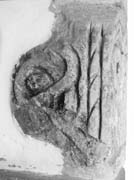
Object type: Cross-shaft fragment
Measurements: H. 38.5 cm (15.1 in); W. (face B) 25 > 24.5 cm (9.8 > 9.6 in); D. (face A) 22.5 cm (8.8 in)
Stone type: Very pale orange (10YR 8/2), matrix-supported, sparry, shelly oolite. The ooliths range from 0.3 to 0.6 mm, but are mostly between 0.4 and 0.5 mm, and set in a sparry calcite cement. Most ooliths have fallen or weathered out to give an 'aero-chocolate' texture — they form between 40 and 50% of the rock. Platy shell fragments up to 5 mm long pick out the vertical bedding. Shells form about 15 to 20% of the rock. Taynton stone?, Taynton Limestone Formation, Great Oolite Group, Jurassic.
Plate numbers in printed volume: Ills. 6-7; Fig. 29A
Corpus volume reference: Vol 10 p. 127
(There may be more views or larger images available for this item. Click on the thumbnail image to view.)
An account of the restoration completed in 1876 relates that there are remains in situ of the twelfth century and that 'some further fragments were discovered during restoration'. The shaft is with little doubt to be numbered among these fragments; the porch into which it was built was itself rebuilt during the restoration ((—) 1876).
Fragment of a cross-shaft
A: There is a double edge-moulding consisting of a square section moulding 2 cm (0.8 in) wide, inside which is a cable-moulding 3 cm (1.2 in) wide. The face is sharply carved (1 cm / 0.4 in deep) with a simple running scroll. The lower part of the face has been badly damaged, with a diagonal gouge cutting deeply through the carving.
B: Covered with a coarse, wide (3 cm / 1.2 in) tangle of interlace, two strands of which end in clawed 'feet'. At the bottom of the central loop of interlace there are what seem to be rudimentary clasped 'hands', while on the right side the broad single strand on interlace splits into two. About 4 cm (1.6 in) up from the bottom of the stone a round-bottomed groove has been cut across the face. This is a later feature. The main carving is up to 1 cm (0.4 in) deep. Some of the incised areas of the carving are filled with later mortar.
The interlace on face B is probably a ribbon-bodied creature, perhaps late tenth century in date. Ribbon-bodied creatures were a widespread motif in Anglo-Saxon carvings of this date. Examples have been found as far apart as Durham and Aycliffe (Co. Durham) (Cramp 1984, 41–3, 66–7, pls. 8, 37) and Bishop's Waltham (Hampshire) (Tweddle et al. 1995, 250, ill. 421).
