Select a site alphabetically from the choices shown in the box below. Alternatively, browse sculptural examples using the Forward/Back buttons.
Chapters for this volume, along with copies of original in-text images, are available here.


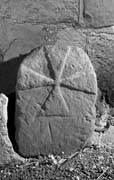
Object type: Grave-marker
Measurements: H. 46 cm (18 in); W. 33.5 cm (13.2 in); D. 13 cm (5.1 in)
Stone type: Greyish orange pink (10R 7/3), open textured, fairly well sorted, fine to medium-grained (0.2 to 0.3 mm but with some grains over 0.5 mm) sandstone. Grains mainly quartz, subangular but commonly very well rounded. Some mica and feldspar. Bedding parallel to face of headstone. Bridgnorth Sandstone Formation, early Permian.
Plate numbers in printed volume: Ills. 538-40
Corpus volume reference: Vol 10 p. 305
(There may be more views or larger images available for this item. Click on the thumbnail image to view.)
Round-topped headstone. In the upper part of the stone the background is cut back to leave a low relief, equal-armed cross with wedge-shaped arms (type B6). The other faces are plain.
Small grave-markers of this type can be late Anglo-Saxon in date, and an eleventh-century date is proposed above for the very similar stone from Brimpsfield, Gloucestershire (p. 150, Ills. 85–6). Another example can be found at Stedham in Sussex (Tweddle et al. 1995, 196, no. 7, ills. 243–4). However, as noted for Brimpsfield 1, both the form and decoration have a long life, and the date of this stone cannot be assigned with certainty.
The church of St Eata at Atcham has some renown as the site of the baptism of the chronicler, Orderic Vitalis, in 1075 (Chibnall 1969–80, iii, 6–8; vi, 552). The obscure dedication to St Eata (mentioned by Orderic), coupled with the reuse of Roman stonework from nearby Wroxeter, has led to suggestions that the church is of some antiquity; thus the Taylors considered the building as possibly belonging to their period A (before 800) (Taylor and Taylor 1965, i, 31–2). However, there is no real warrant for such an early date, and Steven Bassett's recent study of the development of ecclesiastical organisation in this area lends no support to the suggestion of a Middle Saxon origin for the church (Bassett 1992b, 5, 9–10). An origin in the tenth or eleventh centuries seems more likely.
