Select a site alphabetically from the choices shown in the box below. Alternatively, browse sculptural examples using the Forward/Back buttons.
Chapters for this volume, along with copies of original in-text images, are available here.


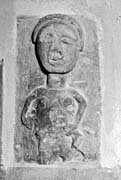
Object type: Small figure carving
Measurements: H. 31.5 cm (12.4 in); W. (max.) 18 cm (7.1 in); D. unknown; depth of carving 3 cm (1.2 in)
Stone type: Very pale orange (10YR 8/2) sparsely shelly, matrix-supported, oomicrite. Ooliths are in the range 0.3 to 0.5 mm and form some 70% of the rock; most ooliths have fallen or weathered out to give an 'aero-chocolate' texture. Shell fragments constitute less than 1% of the rock. Farmington Freestone?, Taynton Limestone Formation, Great Oolite Group, Middle Jurassic.
Plate numbers in printed volume: Ill. 449
Corpus volume reference: Vol 10 p. 254
(There may be more views or larger images available for this item. Click on the thumbnail image to view.)
According to Daubeny (1921, 137), this stone was discovered in the course of the major restoration of 1877–9. No detailed information seems to have survived as to the circumstances of discovery.
Carved fertility figure. The figure is female. She wears nothing but a floppy hat or head-dress and stands with her arms akimbo and hands on hips. The body is barrel-shaped, with pronounced nipples. The left leg is splayed outwards. The figure's vulva is graphically depicted and has been damaged at some time, possibly deliberately.
Appendix A item (stones dating from Saxo-Norman overlap period or of uncertain date)
This small crudely-carved fertility figure seems to have been reset in its present position, just west of the western arch in the north arcade. There is some evidence for Anglo-Saxon fabric in the building (Taylor and Taylor 1965, i, 27). The figure could, therefore, be Anglo-Saxon in date as suggested by Dobson (1933, 269–70, fig. 9; Rice 1952a, 144) but, as with most such figures, it is impossible to date closely.
