Select a site alphabetically from the choices shown in the box below. Alternatively, browse sculptural examples using the Forward/Back buttons.
Chapters for this volume, along with copies of original in-text images, are available here.


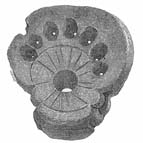
Object type: Portable sundial
Measurements:
(after Way 1868) Dial: L. 3.5 in (8.9 cm); W. c.3.2 in (c.8.2 cm); D. c.1.5 in (c.3.8 cm)
Disc(s): Diam. 1.5 in (3.8 cm)
Stone type: The dial was probably made from 'coarse sandstone' (Way 1868, 221; W[ilson] 1868, 447). One of the two accompanying discs was said to be sandstone and the other limestone (Haigh 1879, 201) who also, probably incorrectly, noted that the dial was 'shell limestone'.
Plate numbers in printed volume: Ills. 580-1
Corpus volume reference: Vol 10 p. 328-30
(There may be more views or larger images available for this item. Click on the thumbnail image to view.)
Wilson stated that this stone 'was found in 1816, in ploughing a small entrenchment, or what is termed by my informant "cooking encampment", upon Holly Waste or Holly Fast, near Girch' (W[ilson] 1868, 446–7); Wilson adds that the information as to the circumstances of discovery was 'derived from a short memorandum made at the time by the proprietor's father'. Hollywaste is at SO649756, about one mile west of Cleobury Mortimer. An attempt to locate the entrenchment in 1991 was unsuccessful: see the information from Shropshire Sites and Monuments Record, available online at http://www.discovershropshire.org.uk/html/search/verb/GetRecord/ CCS:MSA2291 (last accessed on 5 February 2009). The stone was last recorded in the possession of Dr E. Whitcombe towards the end of the nineteenth century (Page 1969, 37); Page identifies him as 'presumably the Edmund Bancks Whitcombe, native of Cleobury Mortimer, who died in Birmingham in 1911'.
So-called pocket sundial, described by Way as 'flat on one side and convex on the other ... It will be seen that it is perforated by a hole cut with considerable regularity, from which, on both sides, lines are drawn radiating towards the circumference. There are also seven perforations of smaller dimensions, apparently intended to be equidistant; and towards these some of the radiating lines appear to be drawn; an eighth possibly existed in a part of the stone that has broken off. There is, moreover, a perforation passing through the thickness of the stone transversely, possibly adapted for some purpose of suspension; of this hole, one termination only on the right hand edge of the stone is shown in the woodcut. Two rudely fashioned stone whorls, the "fairy mill-stones" or "pixy grind-stones" of some localities, possibly to be regarded as fastenings of dress rather than, as frequently supposed, the verticilla of the spindle used in spinning, were found at the same time in the encampment before noticed' (Way 1868, 221).
Inscription Way did not mention any lettering, but the three stones were examined ten years later by the Rev. D. H. Haigh, who published the following remarks.
'On one of the beads [or discs] is this inscription in runes, here written from left to right, but on the beads from right to left. 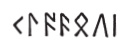
The lower part of the first rune is a little disfigured by the chipping away of the stone; the lower part of the fifth is defaced, but I restore it by aid of the other disk. As the first belongs not to the Anglian futhorc, but rather to the Gothic, I must read the whole according to the values I have assigned to them in my "Runic Monuments of Kent",
CLA1A3 OUI.
The first four surely convey the name of the original owner of the fortress of Cleobury; the meaning of the others is not so clear; but such an inscription as this is sufficient to refer the antiquity of these relics to the fifth or sixth century ... The other bead, being of softer stone, is more worn, and is broken; but I can faintly trace the fourth and fifth of the above runes upon it, probably the remains of the same inscription, but written in the opposite direction' (Haigh 1879, 201–3).
Appendix D item (sundials presumed to be of pre-Conquest date).
In 1969 R. I. Page commented: 'The Cleobury Mortimer "pocket sundial" and its two accompanying stone discs were found in 1816 but not published until 1868, when the "dial" was accurately described as an "uncertain stone implement". ... A drawing of one side of the "dial" accompanied the find-report, and [this drawing] was repeated in (?) 1869 when the well-known antiquary Albert Way first publicized du Noyer's identification of it as a sundial. In 1879 Haigh produced new drawings of both "dial" and discs, recording runes on the latter ... No other drawings of these characters are known, so that, until the "sundial" is rediscovered, Haigh remains our only authority for them ...' (Page 1969, 37; id. 1995, 167).
Way noted that prior to du Noyer's identification, 'it was conjectured that [the larger stone] might have been worn as an ornament of the neck suspended by a thong or cord that passed through the transverse aperture, and that such appendages as the smaller relics, resembling rudely fashioned beads, might be attached to the lesser perforations' (Way 1868, 221–2).
A tenth-century cast silver portable sundial with a gold cap and chain was found at Canterbury Cathedral during alterations in 1938. This dial is somewhat different not just in the materials from which it was made but also in design, with separate gnomon holes in the Canterbury dial corresponding with the months, 'grouped in pairs according to their distance either side of the summer solstice' (Backhouse et al. 1984, 94, cat. 77). This portable dial apparently 'measures time not by the sun's movement across the sky ..., but from its altitude, using as its reference the vertical derived from gravity by its own suspension from a chain' (ibid.). The catalogue entry includes an explanation by Ward of how such a dial worked (Ward 1966, 24). It is unclear whether the Cleobury Mortimer dial worked in a similar way, but the radial divisions are more like the divisions of a normal wall dial.
Inscription Haigh's drawings of the two smaller stone discs are the only record of the runes that survives (Haigh 1879, 201–3, figs. on 201, 202). Although Page concluded that the object may be genuinely runic, he observed that this reliance on Haigh's work alone was 'unfortunate in view of the speciousness of his other work in the field' (Page 1969, 37, 40). To the examples that he gave (e.g. 'it is clear that the Irton inscription was a figment of Haigh's fertile imagination' (Page 1969, 35)) can be added others (Parsons 1994). Part of the difficulty is that Haigh knew what Anglo-Saxon runes looked like, and so he cannot generally be found out by wholly implausible letter-forms. Nor is the problem that he invented inscriptions from scratch. Rather he tended to 'improve' scratches and incisions, sometimes genuinely runic and sometimes not, giving them a more securely runic appearance. It is thus very difficult to place much reliance on his unsupported testimony, though it can be equally difficult to determine how much is his invention.
In this case the runes depicted appear to be as follows. On one disc, running retrograde, i.e. right to left, are: 'c l a æ œ i w i'. (Haigh himself transliterated the final complex as 'u i' (1879, 201–2), though the 'w' is clear in the drawing, which is certainly one point in favour of the authenticity of the markings.) The characters are arranged roughly radially around the disc, somewhat uneven in size. The first is indistinct but more like an archaic angled form of 'c' than anything else, and this is how both Haigh and Stephens (1884a; 1884b) interpreted it. There is a fairly clear gap between 'œ' and the final three runes. On the second disc, Haigh could 'faintly trace' 'æ œ' with the arms of the former indicating in this case a conventional left to right direction.
No coherent interpretation arises from these sequences, and the runs of vowels 'a æ œ' and 'æ œ' are unlikely to have formed part of a straightforward text. Stephens's claæo iwi 'let-the-claw (pointer) eye (show you)!' is fanciful nonsense (though note that he correctly read 'i w i' rather than 'u i' at the end); Haigh's contention that the first four runes 'surely convey the name of the original owner of the fortress of Cleobury' is no better. Unintelligibility (to us) is not a simple criterion for judging a runic inscription's authenticity, though nor is it much of a point in its favour. Conversely, since Haigh's Old English was weak, then had he drawn a good intelligible text, however bungled his interpretation, it would have been a strong recommendation.
If the runes are genuine, then the form of 'a' is distinctive of the Anglo-Saxon, rather than Scandinavian, version of the script. Initial 'c', if correctly identified, is of a type suggestive of the earlier stratum of inscriptions, fifth to seventh centuries; its appearance in eighth- and ninth-century contexts is not impossible, but would be unique (Parsons 1999). The use of Anglo-Saxon runes much after the ninth century is rare.
On balance, there are a number of unsettling circumstances attaching to the inscriptions. The form of the 'c' rune is uncommon, and its suggestion of an early date is perhaps surprising in a possible sundial, and particularly so in a find from so far west in England. Runes of any date are hardly known from the western Midlands, though it is of course true that the object could have been brought from anywhere. Nonetheless, combined with Haigh's poor reputation, these concerns probably should lead us, at least, to suspend judgment on the authenticity of the runes unless and until the object reappears and can be subjected to modern examination.
The findspot lies some two miles to the west of Cleobury Mortimer village; Cleobury Mortimer has been suggested as a probable minster church (Croom 1988, 71–2, 74), and it may be in this context that an explanation for this piece should be sought.
